After approval by the National Committee and reporting to the Election Commission, it concludes
The distorted semi-proportional representation system that gave rise to 'member lending'
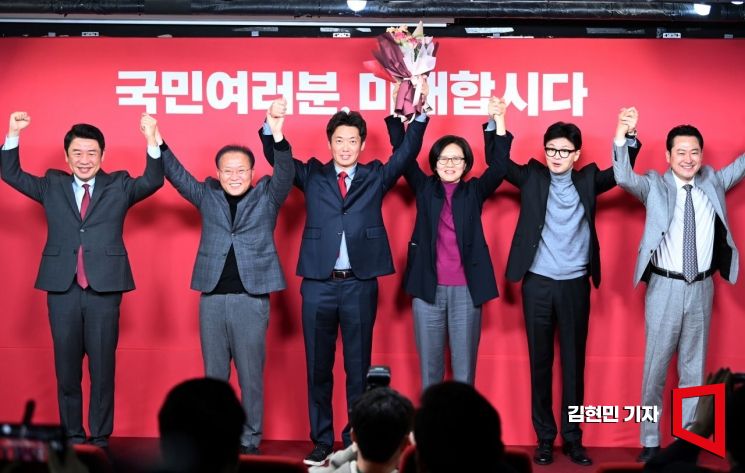 Handonghun, Emergency Response Committee Chairman of the People Power Party, and Jo Hyejeong, Party Leader of the People’s Future Party, along with other attendees, are taking a commemorative photo at the 'People’s Future Central Party Founding Convention' held on the 23rd at the People Power Party headquarters in Yeouido, Seoul. Photo by Kim Hyunmin kimhyun81@
The People Power Party and its proportional satellite party, Kukminui Mirae, will merge just two months after their founding.
On the morning of the 18th, the People Power Party held a Standing National Committee meeting and initiated the absorption merger process with Kukminui Mirae. Lee Heun-seung, chairman of the People Power Party's National Committee, issued a notice convening a National Committee meeting to resolve the absorption merger with Kukminui Mirae the day before. After the merger is approved by a vote at the National Committee, the two parties' entrusted organizations will hold a joint meeting and report to the National Election Commission, completing the merger procedure.
Kukminui Mirae is a proportional satellite party created as the ruling and opposition parties adopted the 'semi-linked proportional representation system' in both the 21st and 22nd National Assembly elections. The semi-linked proportional system was introduced ahead of the 21st general election with the intention of helping minor parties enter the legislature. However, the introduction's purpose was undermined when the two major parties, the United Future Party and the Democratic Party of Korea, created satellite parties to secure more seats.
In response, during the 21st National Assembly, discussions were held on abolishing the semi-linked proportional system and returning to the parallel system used until the 20th general election, as well as on introducing a regional proportional representation system, but no agreement was reached. The People Power Party criticized the complex formula of the semi-linked proportional system and advocated returning to the parallel proportional system. Failing to reach an agreement, they founded Kukminui Mirae. Kukminui Mirae set up an office at the People Power Party's central headquarters in Yeouido, Seoul, proving that although the names differ, the two parties are effectively one.
The semi-linked proportional system created phenomena such as 'borrowing lawmakers.' This is because the party symbols used in voting are determined by the number of incumbent lawmakers each party holds. Priority is given to parties that have at least five incumbent constituency lawmakers or that received at least 3% of the total valid votes nationwide in the previous presidential or proportional representation elections.
Initially, the People Power Party sent eight proportional representation lawmakers?Kim Geun-tae, Kim Ye-ji, Kim Eun-hee, Noh Yong-ho, Woo Shin-gu, Lee Jong-sung, Jung Kyung-hee, and Ji Seong-ho?to Kukminui Mirae but did not send any constituency lawmakers. The Democratic Party of Korea's satellite party, 'The Democratic Union,' which had more constituency lawmakers than Kukminui Mirae, was assigned party symbol number 3, 'Saeroun Mirae' received number 4, and the 'Green Justice Party,' which secured 3% of the vote in the last election, was assigned number 5, pushing Kukminui Mirae to number 6. In response, the People Power Party sent additional constituency lawmakers?Kim Byung-wook, Kim Young-sik, Kim Yong-pan, Kim Hee-gon, and Lee Joo-hwan?to Kukminui Mirae, securing party symbol number 4 for the election.
© The Asia Business Daily(www.asiae.co.kr). All rights reserved.
![Clutching a Stolen Dior Bag, Saying "I Hate Being Poor but Real"... The Grotesque Con of a "Human Knockoff" [Slate]](https://cwcontent.asiae.co.kr/asiaresize/183/2026021902243444107_1771435474.jpg)
















