Dobong-gu Expands Mobile Employee ID Usage for the First Time in Seoul
Usable for Building Access and Cafeteria Payments
Plans to Apply in Various Fields Reflecting Staff Feedback
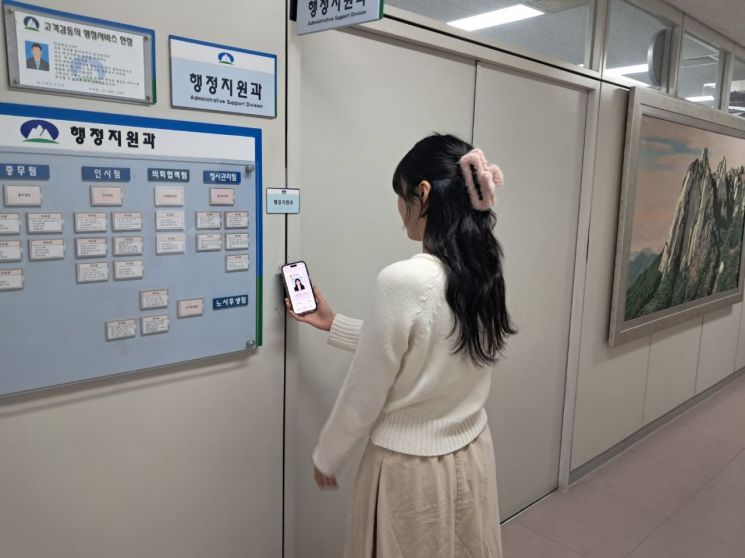
Dobong-gu (Mayor Oh Eon-seok) is drawing attention as it expands the usage of mobile government employee IDs this year, following its pioneering introduction last year.
The district announced that it is broadening the scope of mobile government employee ID usage to support a work environment that aligns with the digital convergence era.
First, the range of use within the district office building has been expanded. Not only can employees recharge funds at the district cafeteria, but they can now also pay for meals using the mobile ID.
Additionally, access to employee lounges and meeting rooms within the district office, which was previously restricted to plastic government employee IDs, is now also possible with the mobile government employee ID.
A district official stated, “The inconvenience of having to carry a plastic government employee ID within the district office has now been eliminated,” adding, “In the future, we plan to gather employee feedback to enable the mobile government employee ID to be used in various fields.”
Oh Eon-seok, Mayor of Dobong-gu, said, “We expect that expanding the usage of the mobile government employee ID will enhance employees’ work convenience,” and added, “The district will continue to innovatively improve the work environment to increase employee work efficiency and provide high-quality administrative services to residents.”
Meanwhile, the mobile government employee ID is a smartphone-based digital identification card that can be used both offline and online. It holds the same legal validity as the existing plastic government employee ID, allowing employees to prove their official status via smartphone during official duties.
Usage records of the government employee ID are stored only on the individual’s smartphone, accessible solely by the user, and are not saved on a central server. This allows the identity holder to manage their usage history, protecting them from personal information infringement. In particular, biometric authentication technologies such as fingerprint or facial recognition are applied, ensuring safety from risks of theft or misuse in case of loss.
© The Asia Business Daily(www.asiae.co.kr). All rights reserved.
![Clutching a Stolen Dior Bag, Saying "I Hate Being Poor but Real"... The Grotesque Con of a "Human Knockoff" [Slate]](https://cwcontent.asiae.co.kr/asiaresize/183/2026021902243444107_1771435474.jpg)











