Korea Institute of Machinery and Materials Develops Off-Road Environment Recognition Technology for the First Time in Korea
Related Technology to Be Transferred to Companies and Applied to Air Force Snow Removal Vehicles
Technology to recognize foreign substances such as dust, mud, snow, and rain necessary for off-road autonomous driving of industrial machinery and defense autonomous vehicles such as excavators, dump trucks, and reconnaissance vehicles has been developed by domestic researchers.
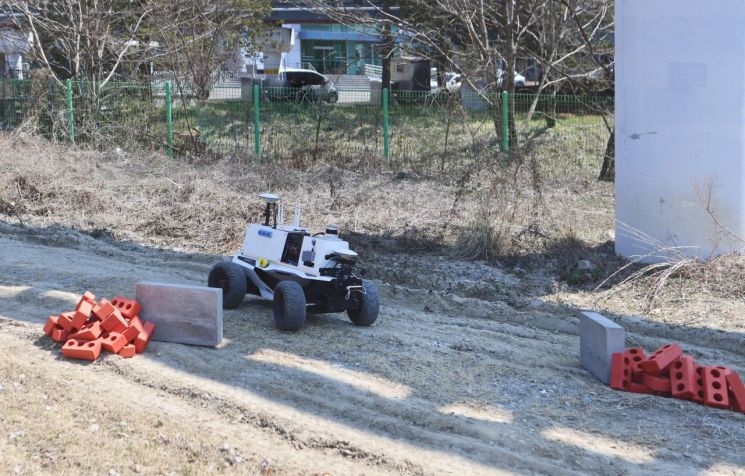 An autonomous vehicle equipped with environmental recognition technology developed by the Korea Institute of Machinery and Materials is driving while avoiding obstacles. Photo by Korea Institute of Machinery and Materials
The Korea Institute of Machinery and Materials (Director Ryu Seok-hyun) announced on the 17th that the research team led by Hanmin Lee, head of the Industrial Machinery DX Research Lab at the Virtual Engineering Platform Research Division, has developed off-road environment recognition technology applied to off-road unmanned vehicles in mountainous terrain, watersides, and snowy roads.
Among the off-road environment recognition technologies developed by KIMM, the 'sensor protection and cleaning module' technology sprays cleaning fluid on mud or muddy water that may splash onto the sensor surface during off-road autonomous driving and wipes it off in real time with a wiper.
The 'sensor signal correction' technology, which removes small particle signals such as dust, snow, and rain that are likely to occur during driving, enables more stable off-road autonomous driving even in adverse weather conditions.
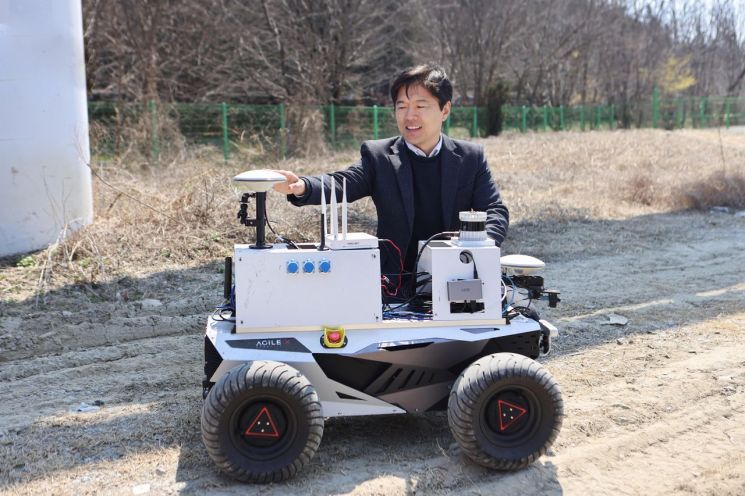 Lee Han-min, Head of the Mechanical Engineering Research Division, is explaining high-performance environmental recognition technology for off-road autonomous driving. Photo by Mechanical Engineering Research Division
The 'drivable area estimation technology' and 'driving control technology' find only the drivable areas on rough roads such as obstacles, steep slopes, and pits, automatically avoid obstacles, and control the vehicle's driving in real time, helping to prevent accidents caused by sudden collisions with people or animals during work.
Previously, there was no technology to protect sensors from foreign substances such as mud or muddy water in off-road environments. There were cases where accidents occurred because some obstacles were not detected due to misrecognition of dust, rain, snow, etc., and there was no technology to recognize in real time terrains with height differences such as cliffs and pits as well as protruding obstacles like trees or rocks, making it difficult to apply autonomous driving technology in off-road environments.
KIMM expects that this technology can fill gaps in similar research conducted in the defense sector by Hyundai Rotem and the Agency for Defense Development, such as slow recognition speed or insufficient response to vibration generation. KIMM also plans to use this technology to automate Air Force runway snow removal vehicles.
Hanmin Lee, head of the Industrial Machinery DX Research Lab, said, "The technology developed this time is a core technology that solves environmental recognition problems that frequently occur during off-road autonomous driving of unmanned vehicles," adding, "We will strive to apply it not only to industrial machinery such as excavators, dump trucks, and tractors where autonomous driving will be applied in the future, but also to defense unmanned vehicles such as tanks and reconnaissance vehicles."
© The Asia Business Daily(www.asiae.co.kr). All rights reserved.


















