Incheon City is accelerating the transition to hydrogen buses by starting the operation of the country's first liquefied hydrogen refueling station. On the 17th, the Ministry of Environment and Incheon City held a completion ceremony for the nation's first liquefied hydrogen refueling station at the bus garage in Gajwa-dong, Seo-gu, marking the beginning of the liquefied hydrogen refueling era.
A total of 7 billion KRW was invested in the construction of the Gajwa liquefied hydrogen refueling station. The project operators, Sewoon Industry and SK E&S, were selected in 2022 for the 'Private Capital Subsidy Project for Hydrogen Electric Vehicle Refueling Station Installation' and received 4.2 billion KRW in national funding, covering 60% of the total project cost. The facility can refuel 120 kg of hydrogen per hour, capable of refueling up to 120 hydrogen buses daily on average.
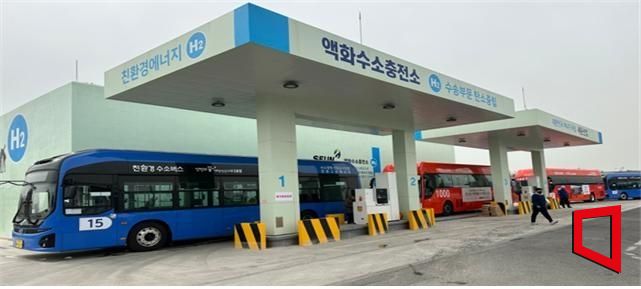 The Incheon Gajwa Liquefied Hydrogen Charging Station was completed on the 17th and began the country's first commercial operation.
 [Photo by Incheon City]
Hydrogen exists as a gas at room temperature, but when gaseous hydrogen is cooled to minus 235 degrees Celsius, it becomes liquid hydrogen. Liquefied hydrogen has a volume that is 1/800th that of gaseous hydrogen, allowing storage of over 800 times more hydrogen in the same space. The refueling speed is 2 kg per minute, which is faster and allows more hydrogen to be refueled compared to gaseous hydrogen stations that refuel 1 kg per minute.
Also, while gaseous hydrogen stations in the metropolitan area receive hydrogen produced in places like Seosan, Chungnam and Pyeongtaek, Gyeonggi, the liquefied hydrogen station can stably receive hydrogen produced at the liquefied hydrogen plant in Wonnam-dong, Seo-gu, Incheon, which is expected to ensure smooth hydrogen supply. The government plans to increase the number of liquefied hydrogen refueling stations to 40 next year and more than 280 by 2030.
Meanwhile, Incheon completed its first hydrogen refueling station for cargo trucks last year at the Natruck House Incheon branch located in Sinheung-dong 3-ga, Jung-gu. Following the opening of the Gajwa liquefied hydrogen refueling station, the Namdong Nonghyup hydrogen refueling station in Namdong-gu and the metropolitan landfill hydrogen refueling station in Seo-gu will open consecutively this month, bringing the total number of hydrogen refueling stations in operation to 12. Incheon City aims to increase this to 16 stations this year and operate 52 hydrogen refueling stations by 2030.
The expansion of hydrogen refueling stations is expected to further accelerate the transition to hydrogen buses in Incheon. Incheon City has been striving to establish a hydrogen public transportation system to lead the 'carbon-neutral future hydrogen city.' Starting with the introduction of seven hydrogen shuttle buses in 2020 and the distribution of eight hydrogen city buses in 2021, a total of 126 hydrogen buses have been deployed to date.
This year, the city secured 115.8 billion KRW in national funding, the largest amount nationwide, to supply 505 hydrogen buses, the highest volume in the country. Considering stable hydrogen supply, 252 buses will be supplied first in the first half of the year, with purchase subsidies of 300 million KRW for hydrogen low-floor buses and 350 million KRW for hydrogen high-floor buses.
An official from Incheon City stated, "By continuously expanding hydrogen refueling stations and increasing the supply of hydrogen vehicles, which are zero-emission eco-friendly vehicles, we will take the lead in responding to the climate crisis and lead domestic hydrogen public transportation."
© The Asia Business Daily(www.asiae.co.kr). All rights reserved.
![Clutching a Stolen Dior Bag, Saying "I Hate Being Poor but Real"... The Grotesque Con of a "Human Knockoff" [Slate]](https://cwcontent.asiae.co.kr/asiaresize/183/2026021902243444107_1771435474.jpg)
















