Second Preservation Treatment Work from the 18th
Estimated Cost Over 100 Million Won
The Cultural Heritage Administration will resume preservation treatment to restore the Gyeongbokgung Palace wall damaged by spray graffiti last December. Once the work is completed, they plan to calculate the costs incurred and claim damages from the vandals.
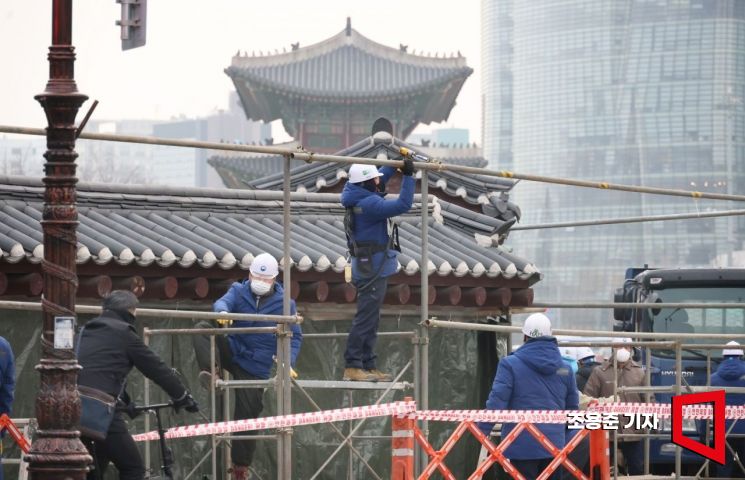 On the 4th, after the graffiti removal work on the Gyeongbokgung Palace wall was completed, officials from the Cultural Heritage Administration removed the covering from the wall at Gyeongbokgung Palace in Jongno-gu, Seoul. The wall, restored through cleaning and color matching, will be open to the public starting that day. Photo by Jo Yongjun jun21@
On the 17th, the Cultural Heritage Administration announced that from the 18th, a second preservation treatment will begin around Yeongchumun Gate of Gyeongbokgung Palace and the side gate area of the National Palace Museum, focusing on the palace walls. From the 18th to 19th, the treatment will be applied around Yeongchumun Gate, and from the 22nd to 24th, the same chemical method, which has undergone preliminary testing, will be applied around the museum’s side gate.
The work sections are each about 12 to 13 meters long, roughly one-third of the 36.2-meter damaged area. A Cultural Heritage Administration official explained, “Based on weekly surface condition checks of the palace walls conducted over three months since January, we have determined the scope and method for additional preservation treatment.”
Fourteen experts from the National Palace Museum’s Conservation Science Department will be involved in the work. Last year’s first treatment was more of an emergency preservation effort, focusing on removing contaminants to prevent spray paint from penetrating the stone. This time, the focus is on erasing the fine remaining traces. The official added, “Overall, the spray contaminants have been removed, but some traces are still visible to the naked eye in certain sections.”
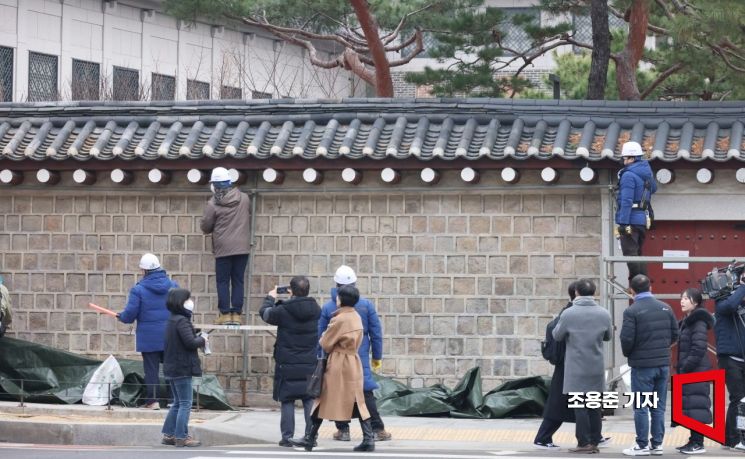 On the 4th, after the graffiti removal work on the walls of Gyeongbokgung Palace was completed, officials from the Cultural Heritage Administration removed the barriers covering the walls of Gyeongbokgung Palace in Jongno-gu, Seoul. The walls, restored through cleaning and color matching, were opened to the public from that day. Photo by Jo Yongjun jun21@
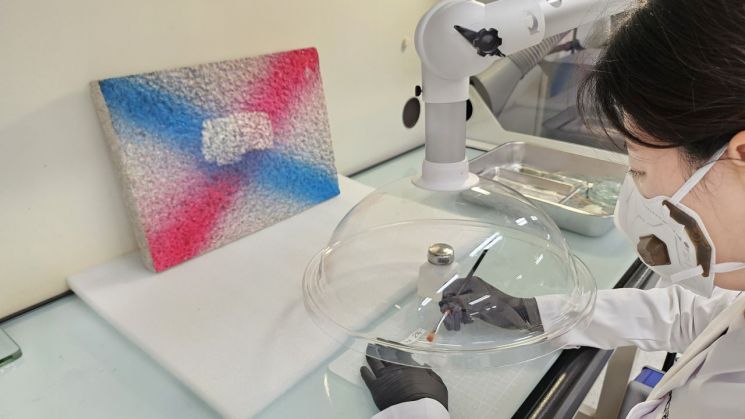
Gelangum and acetone will be used in the treatment. Gelangum is a polymer material containing natural ingredients. Due to its excellent adhesion and viscosity, it is used as a preservation agent for cultural heritage in countries such as France, Italy, and Canada. Acetone is commonly used in everyday life to remove paint. A Cultural Heritage Administration official stated, “We have pre-verified the preservation effect and set the appropriate concentration for on-site application.”
The cost of the work, including professional labor and materials, is estimated to exceed 100 million KRW. The Cultural Heritage Administration plans to obtain an accurate cost assessment through a professional appraisal agency and claim damages from the vandals. Since Gyeongbokgung Palace is the royal palace of the Joseon Dynasty and a representative cultural heritage of Korea, they intend to respond firmly to acts of vandalism.
An official stated, “We will establish a plan to prevent recurrence by installing additional closed-circuit television (CCTV) and informational banners, as well as strengthening related patrols, to ensure similar damage cases do not occur.”
© The Asia Business Daily(www.asiae.co.kr). All rights reserved.



















