No Sharp Additional Rise Expected Due to Foreign Exchange Authorities' Intervention
Possibility of Rebound if Middle East Crisis Escalates or US Raises Interest Rates
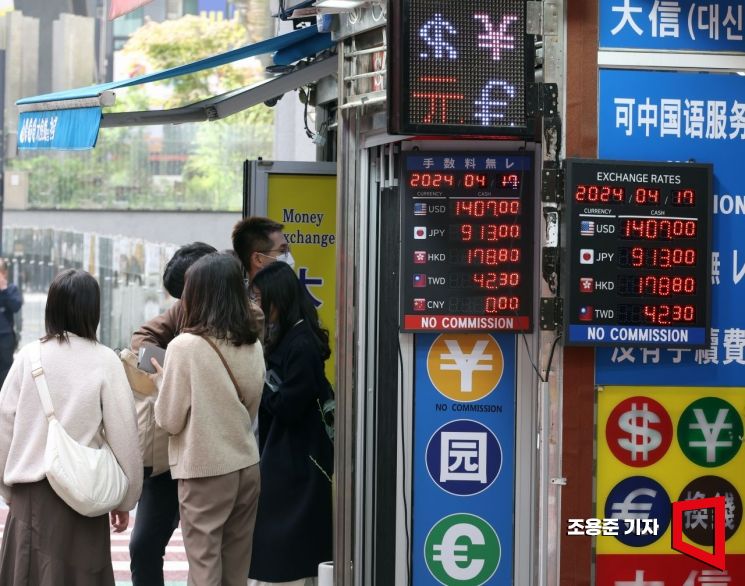 On the 17th, the won/dollar exchange rate was trading in the 1400 won range at a currency exchange office in Myeongdong, Jung-gu, Seoul. Photo by Jo Yongjun jun21@
The won-dollar exchange rate has reached 1,400 won for the first time since 2022, sparking increased interest in the possibility of further rises. Experts, while considering the potential for additional increases, predict that it will not climb to the mid-1,400 won range as seen during past economic crises.
On the 17th, in the Seoul foreign exchange market, the won-dollar exchange rate opened at 1,390.0 won, down 4.5 won from the previous trading day. It then declined further and as of 10:20 a.m., it was trading in the high 1,380 won range.
The won-dollar exchange rate had briefly hit 1,400 won the previous day. The last time the won-dollar exchange rate rose to 1,400 won during intraday trading was about 1 year and 5 months ago, on November 7, 2022 (1,413.50 won).
So far, the won-dollar exchange rate has exceeded 1,400 won in the Korean foreign exchange market only three times: during the 1997 foreign exchange crisis, the 2008 global financial crisis, and the 2022 U.S.-originated high interest rate shock.
Verbal Intervention by Foreign Exchange Authorities Amid Sharp Exchange Rate Surge
As the exchange rate surged sharply, foreign exchange authorities actively engaged in verbal intervention, which is interpreted as having contributed to the slight decline in the exchange rate on that day.
Choi Sang-mok, Deputy Prime Minister and Minister of Economy and Finance, met with Suzuki Shunichi, Japan’s Minister of Finance, on the 16th (local time) in Washington D.C., U.S., where they shared concerns about the depreciation of their respective currencies and stated that appropriate measures could be taken to respond to sudden volatility in the foreign exchange market.
Lee Chang-yong, Governor of the Bank of Korea, also said in an interview with U.S. CNBC on the same day, "Not only the strength of the U.S. dollar but also geopolitical tensions in the Middle East are affecting the exchange rate," adding, "If excessive exchange rate volatility continues, we will take measures to stabilize the market."
Market experts assessed that considering various external conditions, the exchange rate could rise further to some extent. Lee Jung-hoon, an economist at Eugene Investment & Securities, explained, "The won’s value plummeted due to weakened expectations for a U.S. interest rate cut and the emergence of Middle East issues. Given that these issues are still ongoing, it is difficult to rule out the possibility of the won-dollar exchange rate breaking through 1,400 won again."
Jeon Gyu-yeon, an economist at Hana Securities, also forecasted, "The expected timing of U.S. rate cuts has been pushed to the third quarter, and the number of rate cuts is limited to two, so the exchange rate is expected to show an upward trend until the end of the year."
Unlikely to Rise to Mid-1,400 Won Range
However, there were many negative opinions about whether it would break through the mid-1,400 won range as it did during the 2022 or earlier economic crises.
Park Sang-hyun, a research fellow at Hi Investment & Securities, said, "In the short term, the won-dollar exchange rate is likely to move in the low 1,400 won range for a while," but added, "Considering verbal intervention by foreign exchange authorities and the possibility of futures selling by pension funds, there is no room for further increases under the current circumstances." He further noted, "Unless there is a sudden change in the Middle East situation or a drastic move such as an unexpected U.S. interest rate hike, the possibility of a further sharp rise is low."
Economist Lee Jung-hoon also predicted, "Unless the war between Iran and Israel intensifies further, it will be difficult for the exchange rate to rise to the mid-1,400 won range."
Analyses also suggest that the possibility of additional won weakness due to foreign dividend outflows in April, which some have expressed concern about, is not significant. The Korea Center for International Finance recently assessed that Korea’s exports are recovering, centered on semiconductors, and the momentum for goods balance recovery could offset the adverse effects on foreign exchange supply and demand caused by dividend repatriation. The center emphasized that over the past decade, even when net foreign currency outflows occurred related to dividends, other current account factors offset these, resulting in no significant seasonality in the exchange rate.
© The Asia Business Daily(www.asiae.co.kr). All rights reserved.
![User Who Sold Erroneously Deposited Bitcoins to Repay Debt and Fund Entertainment... What Did the Supreme Court Decide in 2021? [Legal Issue Check]](https://cwcontent.asiae.co.kr/asiaresize/183/2026020910431234020_1770601391.png)















