UNIST and Catholic University Joint Research Team Reveals Role of DDX41 Protein in Blood Cancer
Potential for Leukemia Treatment and Onset Prediction... Published Online in Journal 'Leukemia'
The impact of protein mutations on the development of leukemia has been revealed.
A research team led by Professors Kim Hong-tae and Lee Ja-il from the Department of Life Sciences at UNIST (President Lee Yong-hoon), in collaboration with Professors Kim Yoo-jin and Kim Myung-shin from The Catholic University of Korea, elucidated the role of the mutated DDX41 protein in myelodysplastic syndrome (MDS), a type of blood cancer. Through this, they clarified the relationship between increased genomic instability?the total amount of genes?and the onset of leukemia.
 (Top row from left) Ye-jin Lee, Ju-min Kyung, Tae-hong Min, Joo-rak Lee researchers (Bottom row from left) First author Won-chan Hwang researcher, Hong-tae Kim professor, first author Ki-beom Park researcher.
Myelodysplastic syndrome is a disease in which the production of normal blood cells is suppressed in hematopoietic stem cells, leading to a decrease in the number of normal blood cells in peripheral blood. If it becomes chronic, it can progress to acute myeloid leukemia (AML).
The number of male patients with acute myeloid leukemia is 1.7 times higher than that of female patients, and the average age is over 65. However, even with the ongoing aging population, the exact cause of onset has not been clearly identified.
The research team analyzed mutations in the DDX41 genome from samples of 336 Korean patients with myelodysplastic syndrome. They confirmed that the DDX41 mutation Y259C is associated with poor prognosis in myelodysplastic syndrome.
In particular, they confirmed that Y259C is a congenital mutation and a specific variant occurring in East Asia, especially in Korea and Japan. Unlike the widely occurring acquired mutation R525H worldwide, the mechanism of action of Y259C was previously unknown.
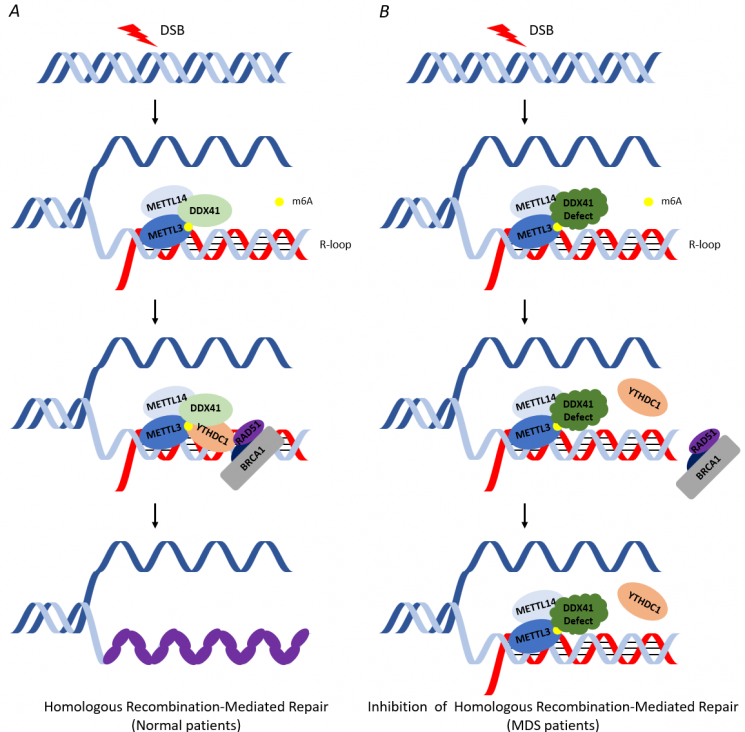
DDX41 normally interacts with proteins that repair damaged genes. When the DDX41 protein mutates, genomic instability increases due to the R-loop structure, a loop-shaped RNA attached to damaged DNA.
The RNA strand of the R-loop undergoes a modification called m6A (N6-methyladenosine). m6A increases the stability of the otherwise unstable R-loop and regulates genomic instability. When damaged DNA is repaired, the m6A-formed R-loop is dismantled and performs its normal function.
The research team investigated the occurrence of ‘m6A-formed R-loops’ in samples from patients with DDX41 mutations. Compared to the normal control group, the amount of m6A-formed R-loops was over 10,000 times higher. This indicates that damaged DNA was not properly repaired, leading to accumulated DNA damage.
Furthermore, the team examined how the DDX41 mutation affects the regulation of m6A-formed R-loops and how it induces leukemia.
R-loops form m6A through m6A complexes called ‘Methyl3’ and ‘Methyl14.’ The ‘YTHDC1’ protein recognizes the formed m6A and recruits DNA damage repair proteins. Normal DDX41 acts as a bridge connecting the m6A complexes Methyl3 or Methyl14 with the YTHDC1 protein.
However, the DDX41 mutation prevents it from performing this bridging role. As a result, the recruitment of proteins that repair DNA damage is inhibited, increasing genomic instability and potentially leading to leukemia.
Professor Kim Hong-tae of the Department of Life Sciences said, “Through this study, the molecular role of DDX41, a genetic mutation frequently found in blood cancer, has been precisely revealed,” adding, “It provides a foundation for leukemia control strategies.”
This research was supported by the Ministry of Science and ICT’s National Research Foundation of Korea and the Samsung Future Technology Development Fund. The research results were published online on March 21 in Leukemia, a world-renowned international academic journal.
© The Asia Business Daily(www.asiae.co.kr). All rights reserved.


















