2010 14.8% → 2023 33.6%
Positive Responses to Single Living and Cohabitation Also Increase
One in three people in our country was found to be living in a single-person household. It was also revealed that 'one-generation households,' where individuals do not live with their parents or children, including single-person households, have increased over the past three years.
On the 17th, the Ministry of Gender Equality and Family announced the results of the "2023 Family Status Survey," which included these findings. The Family Status Survey is a nationally approved statistic based on Article 20 of the Framework Act on Healthy Families. Last year, the survey cycle was shortened from five years to three years to reflect rapidly changing social environments. This survey targeted all household members aged 12 and older from 12,000 households nationwide, conducted from June 1 to July 31 of last year.
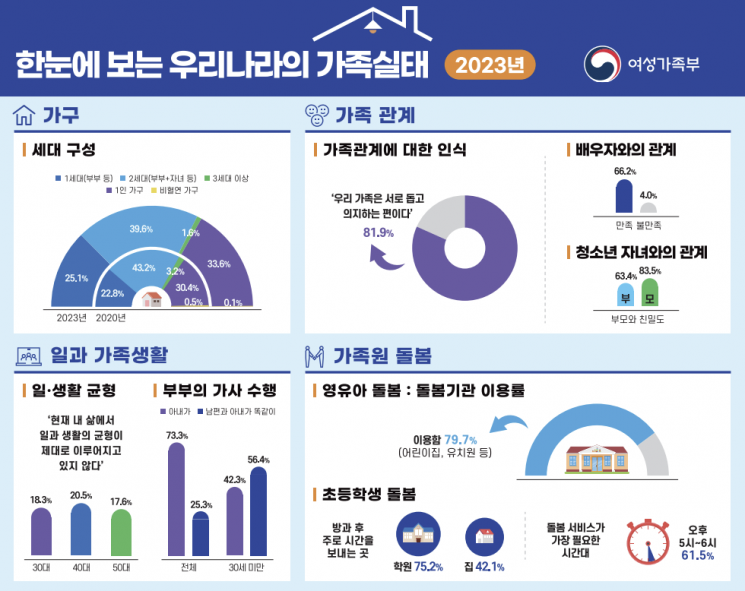
The survey results showed that single-person households increased from 30.4% in 2020, when the previous survey was conducted, to 33.6%. One-generation households, such as couples living without children or parents, also rose from 22.8% to 25.1% during the same period. The proportion of single-person households among all households has increased with each survey since 2010. It was 15.8% in 2010, 21.3% in 2015, exceeded 30% in 2020, and this year accounted for one-third of all households.
Recognition of diverse lifestyles also appears to have expanded. Positive responses toward living single or cohabiting increased compared to 2020. In this survey, the response agreeing with "living single without getting married" rose from 34.0% in the previous survey to 47.4%. The response agreeing with "cohabiting without marriage" also noticeably increased from 26.0% to 39.1%.
Within households, it was confirmed that wives primarily perform housework more than husbands. The highest response rate, 73.3%, indicated that wives handle housework such as grocery shopping, meal preparation, and cleaning. 25.3% answered that "husband and wife share equally," while only 1.4% said the husband mainly does housework. Regarding childcare, a high proportion also responded that wives generally share the responsibility. Especially for daily care tasks such as managing children's meals and bedtime, the rate of wives mainly performing these duties was high at 78.3%.
However, younger age groups reported more frequently that "husband and wife share housework equally." Among couples in their teens and twenties, 56.4% responded that husband and wife share housework equally, which was higher than the rate of "wife mainly does it." For couples in their thirties, 44.1% said that husband and wife share housework equally.
The family support services that citizens consider necessary vary distinctly by age group. People in their twenties prioritized education and counseling related to pregnancy, childbirth, and child-rearing (22.3%), those in their thirties chose childcare services (22.2%), people in their forties and fifties selected family relationship counseling (19.5% and 20.8%), and those in their sixties and seventies or older pointed to support for families caring for elderly parents (20.3% and 30.4%).
Based on this status survey, the Ministry of Gender Equality and Family announced plans to strengthen family services tailored to diverse needs. Shin Young-sook, Vice Minister of Gender Equality and Family, stated, "We will respond swiftly and flexibly to new service demands arising from changes in family structures such as low birth rates and aging, accelerating the implementation of the national agenda to realize 'families where no one is left behind and a society where everyone participates together.'"
© The Asia Business Daily(www.asiae.co.kr). All rights reserved.


















