Jerome Powell, Chairman of the U.S. Federal Reserve (Fed), made a hawkish statement (favoring monetary tightening) suggesting that the timing of interest rate cuts could be delayed, while the International Monetary Fund (IMF) also warned against "too early cuts" citing concerns over the so-called 'Last mile'?the final stretch before reaching the target.
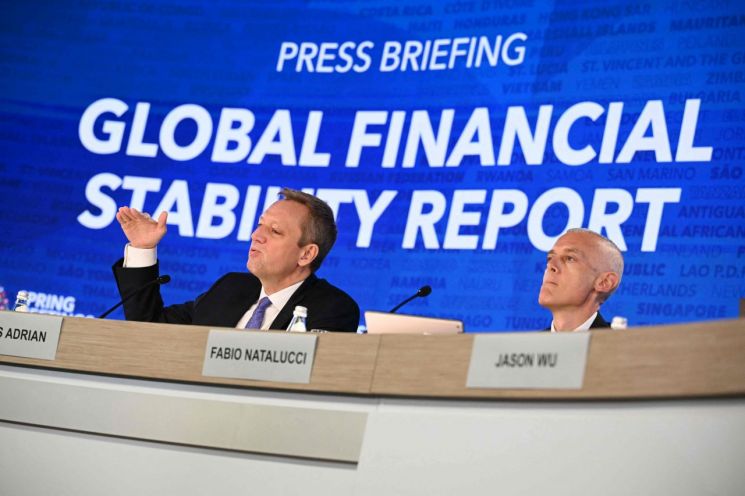
On the 16th (local time), the IMF released its "Global Financial Stability Report," stating, "Central banks should be cautious about the last mile of disinflation (easing of inflation)."
First, the IMF noted, "There may be difficulties in the last mile. Geopolitical tensions could pressure market sentiment," warning of the possibility of inflation rebounding. It also pointed out, "In some countries, disinflation may have stalled," and "there is evidence that underlying inflation may persist in certain sectors."
Recently, an increase in expected inflation rates has been observed in major countries. In particular, the IMF warned that if geopolitical risks escalate, they could directly impact transportation and energy production, potentially driving inflation up again.
The IMF expressed concern that "higher-than-expected inflation figures not only spread the last mile narrative but also affect investors' recent optimism," adding that this "could lead to financial market adjustments and high volatility."
Due to inflation that is stubbornly persistent, market expectations for interest rate cuts are collapsing, which could lead to sell-offs in bonds, stocks, and cryptocurrencies. The IMF also added that in this scenario, financial conditions would tighten overall, potentially causing losses especially among leveraged investors.
Accordingly, the IMF emphasized that central banks of each country should rely on data but carefully decide monetary policy tailored to their national circumstances.
The IMF stressed, "In economies (countries) experiencing inflation above the price stability target, central banks should not cut rates too hastily," and warned, "Investors' overly optimistic expectations for monetary easing could also cause overheating in financial markets." It further urged that only when inflation is judged to be continuously easing toward the price stability target should a gradual shift to a less restrictive monetary policy stance be made.
This aligns with Fed Chairman Powell’s remarks at a forum event, where he said, "Recent economic indicators have not given greater confidence that the price stability target is being achieved," and suggested that "it is appropriate to allow time for restrictive policies to take effect," implying that the timing of rate cuts could be delayed. Fed Vice Chairman Philip Jefferson also stated in a speech that "if indicators show inflation is more persistent than expected, it would be appropriate to maintain the current restrictive policy stance longer." On the other hand, Christine Lagarde, President of the European Central Bank (ECB), reaffirmed on CNBC that rate cuts could be possible soon if there are no major shocks.
The IMF recommended, "To maintain financial stability in the last mile phase, a multifaceted approach is necessary," suggesting the use of stress tests and other supervisory tools to ensure institutions can withstand default risks, and the completion of the phased implementation of Basel III.
On the same day, the IMF also released an update to its World Economic Outlook (WEO). The global economic growth rate for this year was revised upward by 0.1 percentage points to 3.2% compared to the January forecast. However, the IMF also pointed out significant downside risks, mentioning rising borrowing costs and geopolitical fragmentation risks such as the war in Ukraine. Pierre-Olivier Gourinchas, Chief Economist, expressed concern about the impact of Iran’s invasion of Israel, stating, "There is pressure on energy prices, which could affect inflation."
Meanwhile, according to data released on the same day by the Federal Reserve Bank of New York, which analyzed consumer expectations surveys over the past decade, the median expected inflation in the U.S. has returned to pre-pandemic levels, but uncertainty remains somewhat elevated. The New York Fed stated, "Consumers perceive both deflation and high inflation above 4% as more likely than usual."
© The Asia Business Daily(www.asiae.co.kr). All rights reserved.
!["The Woman Who Threw Herself into the Water Clutching a Stolen Dior Bag"...A Grotesque Success Story That Shakes the Korean Psyche [Slate]](https://cwcontent.asiae.co.kr/asiaresize/183/2026021902243444107_1771435474.jpg)
















