Oil Prices Exceed $90... Middle East Risk Highlighted
Strong Dollar Continues to Weaken Won
Public Utility and Food Price Increases Suppressed After General Election
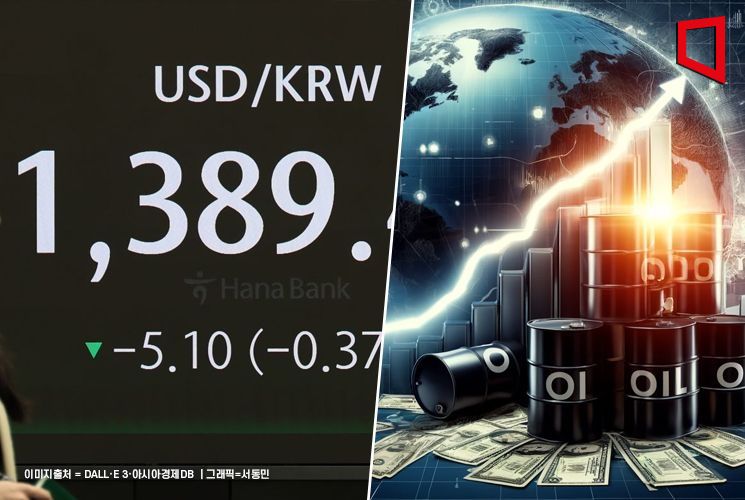
Amid growing concerns over rising oil prices due to instability in the Middle East and the added pressure of a high exchange rate, the government is facing an emergency in managing inflation. The rise in oil prices and exchange rates leads to increased production costs through higher prices for various raw materials and logistics expenses, acting as multiple adverse factors that further stimulate already uncontrollable inflation. Since these high oil and exchange rates are variables beyond the government's control, the early achievement of the government's '2% inflation target' has become uncertain.
Soaring Oil Prices Due to Middle East Crisis... Inflation Concerns Reignite
On the 16th (local time), June Brent crude traded on the London ICE exchange closed at $90.02 per barrel, down $0.08 (0.1%), remaining above $90. On the same day, May West Texas Intermediate (WTI) crude traded on the New York Mercantile Exchange closed at $85.36 per barrel, down $0.05 (0.06%) from the previous session. International oil prices paused their upward trend and showed slight adjustments as the market watched the developments in the Middle East.
International oil prices have been on an upward trend since the outbreak of the Middle East crisis last October, triggered by armed clashes between Israel and the Palestinian militant group Hamas. Recently, with the escalation of the threat of full-scale war between Iran and Israel, international oil prices are soaring again. If Iran uses oil supply as leverage and blocks the Strait of Hormuz, a major international oil shipping route, it could disrupt the supply of about 30% of the world's maritime oil trade. The Strait of Hormuz serves as an export route for Middle Eastern oil-producing countries such as Saudi Arabia, Kuwait, Iraq, Iran, and the United Arab Emirates (UAE), and Middle Eastern crude oil imported into Korea also passes through this strait.
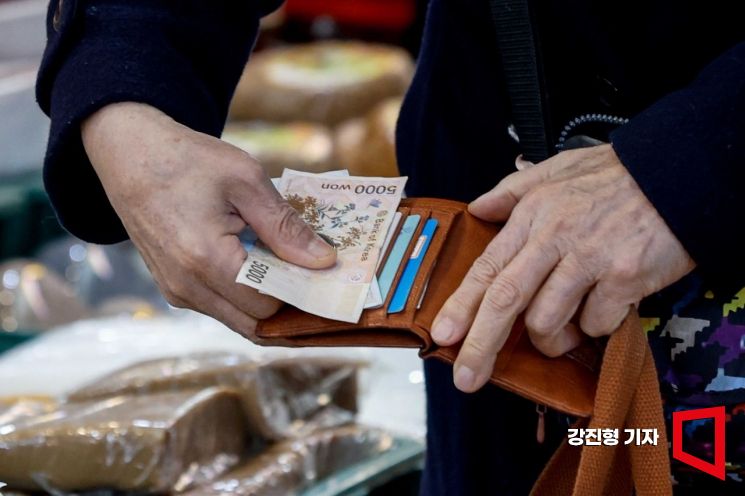 Despite the decline in international oil prices, import prices continued to rise for the fourth consecutive month due to the increase in exchange rates. The photo was taken on the 14th at Mangwon Market, Mapo-gu, Seoul. Photo by Jinhyung Kang aymsdream@
If international oil prices exceed $100, it could deal a fatal blow to the global economy, which has not yet fully recovered from the economic recession caused by the COVID-19 pandemic and the Russia-Ukraine war. The International Monetary Fund (IMF) warned last October, when the Middle East crisis erupted, that if international oil prices rise by 10%, global production would decrease by 0.15 percentage points, and inflation would increase by 0.4 percentage points. If the tension in the Middle East prolongs and the upward trend in international oil prices solidifies, stabilizing prices will become even more difficult.
Exchange Rate Breaks 1,400 Won... Fueling High Inflation
The rise in oil prices combined with a high exchange rate is further pushing up import prices. The won-dollar exchange rate briefly entered the 1,400 won range during trading the previous day, sounding an alarm for rising import prices. The exchange rate breaking 1,400 won has only occurred three times: during the 1997 Asian financial crisis, the 2008 global financial crisis, and the 2022 COVID-19 pandemic aftermath triggered by high U.S. interest rates.
Domestic import prices have been on the rise since January this year. According to the Bank of Korea, the provisional import price index last month was 137.85, up 0.4% from the previous month. This marks the third consecutive month of increase following January (2.5%) and February (1.2%). Rising import prices push up domestic consumer prices with a lag of 1 to 3 months. This is a double blow to private consumption, which is already in recession.
 Choi Sang-mok, Deputy Prime Minister for Economic Affairs and Minister of Economy and Finance, attends the Emergency Economic Ministers' Meeting held at the Government Seoul Office in Jongno-gu, Seoul on the 15th, touching his glasses. Photo by Jo Yong-jun jun21@
Public Utility and Manufactured Goods Prices Likely to Rise After General Election
Although the government expected prices to stabilize quickly in the second half of the year, achieving the targeted '2% inflation rate' seems difficult. The domestic consumer price inflation rate recorded 3% for two consecutive months in March (3.1%) and February (3.1%). It had fallen to the 2% range in January (2.8%) for the first time in six months but rebounded due to rising agricultural product prices. Furthermore, with the April 10 general election over, there is growing concern that public utility fees such as electricity and transportation fares, which the government had suppressed, will rise one after another, increasing inflationary pressure.
Food service and food companies, which had been cautious before the election, are now raising product prices one after another. Chicken franchise Goobne raised prices for nine chicken products by 1,900 won each on the 15th, and Popeyes increased prices for chicken and sandwiches by an average of 4%. E-commerce company Coupang decided on the 12th to raise its monthly subscription fee from 4,900 won to 7,890 won, a 58% increase. Food companies such as Lotte Wellfood and Dongwon F&B recently informed the Ministry of Agriculture, Food and Rural Affairs that they need to raise prices of products like seasoned seaweed and chocolate by up to 30% due to rising raw material costs.
© The Asia Business Daily(www.asiae.co.kr). All rights reserved.



















