Hi Investment & Securities analyzed on the 17th that the fear triggered by the domestic dollar-won exchange rate touching 1400 won is excessive and pointed out that the past and present situations are different. However, it added a caveat that credit risk amplification or additional crude oil price surges should be guarded against.
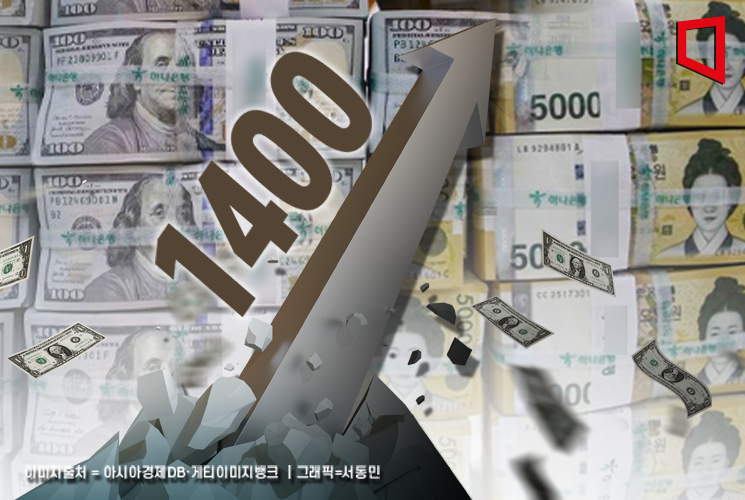
Park Sang-hyun, a researcher at Hi Investment & Securities, said, "Although the dollar-won exchange rate closed at 1394.5 won on the 16th due to the government's verbal intervention, it touched 1400 won intraday for the first time in 17 months," adding, "The dollar-won exchange rate has recorded 1400 won only four times, including during the International Monetary Fund (IMF) crisis, the global financial crisis, the 2022 US Federal Reserve rate hikes and the Gangwon Jungdo Development Corporation rehabilitation application incident, and this time."
He continued, "As seen in the previous three cases, these were either domestic credit crises or global crisis phases, so the fear associated with 1400 won is inevitably significant," and analyzed, "Domestically, there is a trauma of ‘IMF crisis = rapid exchange rate surge,’ so the financial market and government authorities tend to respond sensitively to exchange rate surges rather than stock price crashes."
However, he analyzed that there is a difference between the time when the 1400 won exchange rate was previously recorded and the present. The main reasons are △credit risk △economic cycle trends △not a won-only depreciation but a concurrent depreciation of non-dollar currencies.
Researcher Park said, "The biggest difference is the difference in credit risk or liquidity squeeze risk," explaining, "The previous 1400 won exchange rate surge was accompanied by credit crises during the IMF and global financial crises, and in 2022, credit risk materialized domestically due to the Gangwon Jungdo Development Corporation rehabilitation application along with the US Federal Reserve's aggressive rate hikes."
He noted, "Currently, although there are concerns, the atmosphere is not one where a credit crisis is significantly materializing," and explained, "For example, the US credit spread is on a downward stabilization trend. This is clearly different from the previous sharp rise in US credit spreads."
The second point is the economic cycle. Researcher Park said, "The US economy is showing a more robust trend than expected, and economies outside the US are also showing signs of emerging from the bottom," adding, "Domestically, although there are risks such as internal demand instability, the economy is entering a recovery phase, which places it in a different position in the economic cycle compared to when the 1400 won exchange rate was recorded."
Park Sang-hyun said, "The third point is that it is not just the won weakening alone; the dollar-yen exchange rate is also approaching the 155 yen level, and the dollar-yuan exchange rate is rising, meaning that non-dollar currencies are effectively depreciating together," and urged, "It is necessary to refrain from interpreting the recent rapid rise in the dollar-won exchange rate as an excessive risk."
He added, "Although foreigners have shown net selling in the stock market for several days, the phenomenon of foreigners ‘selling Korea’ has not appeared, which is because foreigners also recognize that the won’s weakness is not a unique phenomenon to Korea."
He further said, "Lastly, from a trend perspective, it is important to note that the dollar-won exchange rate level has risen since the COVID-19 pandemic compared to before the pandemic," analyzing, "As the US economy took global hegemony starting from the pandemic, the economy improved and the dollar’s value rose, which lowered the value levels of non-dollar currencies including the won."
However, he cautioned that credit risk amplification or additional crude oil price surges should be guarded against. He explained, "Due to the prolonged high interest rates by the US Federal Reserve (Fed), the possibility of an unexpected credit crisis cannot be excluded," adding, "Considering that credit-related risks such as unresolved domestic real estate risks are latent, whether the dollar-won exchange rate will rise further depends on credit risk."
He continued, "A variable that could stimulate short-term credit risk might be a crude oil price surge originating from the Middle East," and added, "The area where the won’s weakness should be guarded against is the domestic economy’s vulnerability. While the depreciation of the Japanese yen or Chinese yuan partly reflects artificial currency depreciation policies aimed at economic stimulus, the won differs in that it reflects structural risks domestically and is somewhat excluded from the global supply chain expansion."
© The Asia Business Daily(www.asiae.co.kr). All rights reserved.

















