Bloomberg Dollar Index Rises 2% in 5 Trading Days
Largest Increase Since February Last Year
Dollar Continues Solo Strength Amid ECB Rate Cuts
The 'no landing' scenario, where the U.S. economy continues to grow without a downturn, is gaining traction, leading to expectations that interest rate cuts may be delayed and accelerating the 'King Dollar' (strong dollar) phenomenon. With major central banks including those in Europe signaling potential rate cuts and increased demand for the dollar as a safe haven amid Middle East instability, forecasts for a sustained dollar rally are gaining momentum.
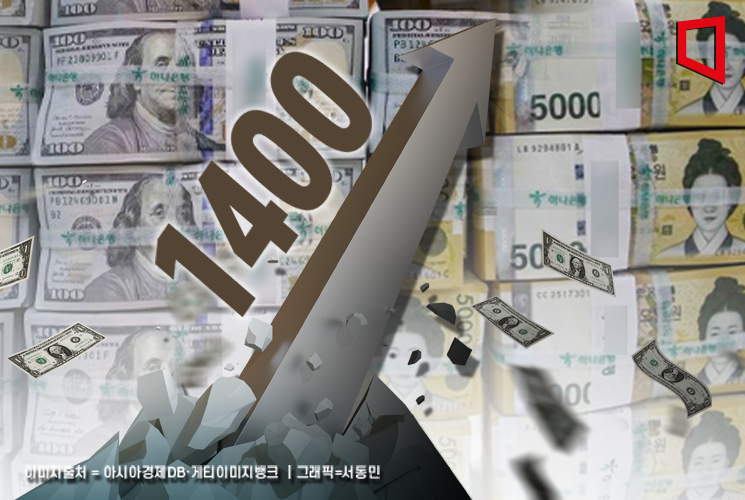 Due to the geopolitical tensions in the Middle East escalating following Iran's airstrike on Israel, the Korean won touched the 1,400 won per dollar mark on the 16th.
As of 1:27 PM local time on the 16th, the Bloomberg Dollar Spot Index stood at 1266.08, marking a 2% increase over five trading days since the 9th (1240.78). This is the largest gain in 14 months since February last year.
A robust U.S. labor market supporting consumption is fueling expectations that high inflation and high interest rates may persist longer, which in turn is strengthening the dollar. March U.S. retail sales, released the previous day, rose 0.7% month-over-month, significantly exceeding the forecast of 0.4%. Market sentiment increasingly anticipates that the Federal Reserve's (Fed) timing for rate cuts will be pushed further back.
Chris Turner, Head of Currency Strategy at ING Group NV, said, "It is very difficult to fight against the current dollar strength trend," and predicted, "The dollar index could break above the 1280 level, its highest since October last year."
The dollar's value has risen significantly against the Swedish krona and Australian dollar over the past five days. In Asia, the increase was particularly pronounced compared to the Korean won and Indonesian rupiah.
While the Fed's rate cut timing is expected to be delayed, major central banks such as the European Central Bank (ECB) and the Bank of England (BOE) are likely to begin cutting rates soon, which could prolong the dollar's strength. ECB President Christine Lagarde stated that "if we become more confident in the inflation slowdown, prices move as expected, and there are no major shocks, we will move toward a moment to ease restrictive monetary policy," suggesting that rate cuts may occur shortly.
Michael Metcalfe, Head of Macro Strategy at State Street Global Markets, said, "The surprise in the March U.S. retail sales data has solidified the view that interest rate directions will diverge," adding, "Rates will likely fall across Europe by summer, but probably not in the U.S."
Joe Little, Chief Global Strategist at HSBC Asset Management, analyzed, "If other central banks start cutting rates while the Fed maintains its current policy longer, the global rate-cutting cycle will become chaotic," meaning "currency volatility could increase further." He also predicted, "The euro, pound, and yen may experience the greatest volatility in the coming months."
Meanwhile, Mohamed El-Erian, Advisor to Allianz Group, mentioned the possibility of the Fed raising rates, which would further strengthen the dollar.
El-Erian said, "The risk of the Fed raising rates is low but not zero," adding, "If inflation worsens significantly, rate hikes could occur, which would cause all kinds of shocks to regional banks and markets."
Geopolitical instability in the Middle East is also driving increased demand for the dollar as a safe haven. Although the U.S. has repeatedly urged Israel to restrain from retaliating against Iran to prevent escalation, Israel's indication of retaliatory attacks has kept concerns about rising tensions in the Middle East alive.
© The Asia Business Daily(www.asiae.co.kr). All rights reserved.
![Clutching a Stolen Dior Bag, Saying "I Hate Being Poor but Real"... The Grotesque Con of a "Human Knockoff" [Slate]](https://cwcontent.asiae.co.kr/asiaresize/183/2026021902243444107_1771435474.jpg)
















