80% of S&P 500 Companies 'Beat Expectations'
Continued Rise in Treasury Yields
Focus on Fed Chair Powell's Remarks
The three major indices of the U.S. New York stock market showed mixed trends in the early trading session on the 16th (local time). Following a decline in the market due to a sharp rise in Treasury yields the previous day, investors are cautiously monitoring corporate earnings amid a watchful atmosphere.
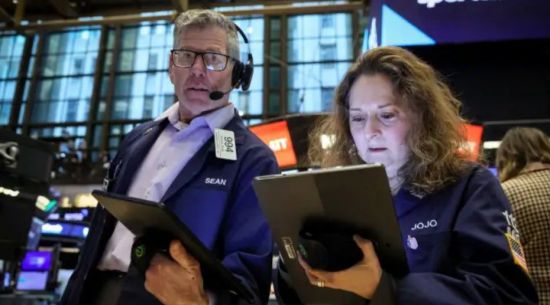
As of 9:47 a.m. at the New York Stock Exchange (NYSE) on the day, the Dow Jones Industrial Average was up 0.18% from the previous close, standing at 37,802.58. The S&P 500, which focuses on large-cap stocks, was down 0.29% at 5,046.89, and the tech-heavy Nasdaq index was trading 0.34% lower at 15,830.7.
By individual stocks, UnitedHealth rose 5.78% after reporting first-quarter sales that exceeded expectations. Morgan Stanley also gained 1.66% following earnings that beat forecasts. On the other hand, Tesla, which announced a plan to cut 10% of its global workforce due to weak electric vehicle sales, was down 3.93%.
According to market research firm FactSet, less than 10% of companies in the S&P 500 have reported earnings so far, and among them, four out of five companies have posted results exceeding market expectations.
Lauren Goodwin, senior market strategist at New York Life Investments, analyzed, "The U.S. stock market will not experience a sustained downturn until earnings problems and cracks in the labor market emerge," adding, "Our unease stems from high stock valuations and significant uncertainties."
The previous day, the New York stock market fell across the board as Treasury yields surged following a surprise increase in March retail sales. According to the U.S. Department of Commerce, retail sales rose 0.7% month-over-month last month, surpassing the market forecast of 0.4%. A robust labor market supporting consumption raised concerns about entrenched hot inflation, causing Treasury yields to spike. The 10-year U.S. Treasury yield, a global bond yield benchmark, surpassed the 4.6% level, marking the highest point in five months since mid-November last year. This reflects expectations that the Federal Reserve (Fed) will be more cautious about cutting interest rates.
As a result, the market is increasingly considering a 'no landing' scenario?where the U.S. economy continues to grow?rather than a 'soft landing' scenario.
UBS Group AG sees a higher probability of the Fed raising interest rates due to strong U.S. economic growth and persistent inflation. While the base scenario anticipates two rate cuts within the year, if inflation does not fall to the Fed's 2% target, the Fed may reverse course and raise rates, potentially triggering a sell-off in bonds and stocks.
Jonathan Pingle, UBS strategist, said, "If the economic expansion maintains resilience and inflation remains above 2.5%, there is a real risk that the Fed will resume rate hikes early next year," adding, "Rates could rise to 6.5% from the current 5.25?5.5% by mid-next year."
Meanwhile, Fed Vice Chair Philip Jefferson predicted that inflation will continue to decline. He stated, "My baseline outlook is that if policy rates remain at current levels, inflation will fall further," and added, "The labor market remains strong, and labor supply-demand balance will continue to adjust." However, he noted that if inflation remains higher than expected, it would be appropriate to maintain a restrictive policy stance for a longer period.
Additionally, instability in the Middle East is heightening market caution. While the U.S. has repeatedly urged Israel to exercise restraint to prevent escalation, and Iran has indicated it will not launch further attacks unless Israel retaliates, concerns about a 'fifth Middle East war' have somewhat eased but have not completely disappeared. Reports emerged the previous day that Israel is focusing on painful retaliation while avoiding full-scale war.
Fed Chair Jerome Powell is scheduled to speak in the afternoon. Amid growing uncertainty about the timing of U.S. rate cuts, the market is expected to seek hints about future monetary policy direction from Powell's remarks.
U.S. Treasury yields are rising. The 10-year U.S. Treasury yield, a global bond yield benchmark, is trading at 4.69%, up 6 basis points (1bp = 0.01 percentage points) from the previous session, while the 2-year Treasury yield, sensitive to monetary policy, is at 4.97%, up 3 basis points from the previous day.
International oil prices are slightly down. West Texas Intermediate (WTI) crude oil is trading at $85.36 per barrel, down $0.05 (0.06%) from the previous session, and Brent crude, the global oil price benchmark, is down $0.23 (0.26%) at $89.87 per barrel.
© The Asia Business Daily(www.asiae.co.kr). All rights reserved.












