Cabbage Head 4,267 Won... 26.4% Increase Compared to Previous Month
Frequent Rain Causes Poor Growth of Spring Cabbage
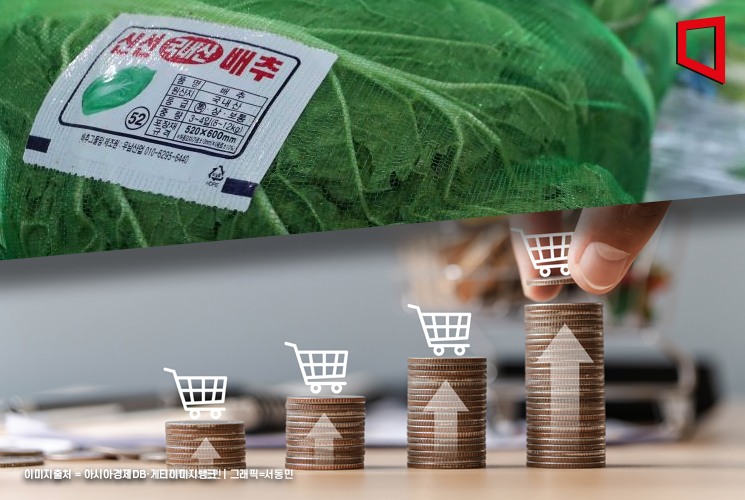
The price of napa cabbage has risen by nearly 30% in a month. This is due to frequent rains before this spring, which adversely affected the growth of spring napa cabbage. Following last year's poor harvest that caused a sharp increase in apple and pear prices, the prices of napa cabbage and radish, key ingredients on Korean tables, are also on the rise, increasing the burden of food prices.
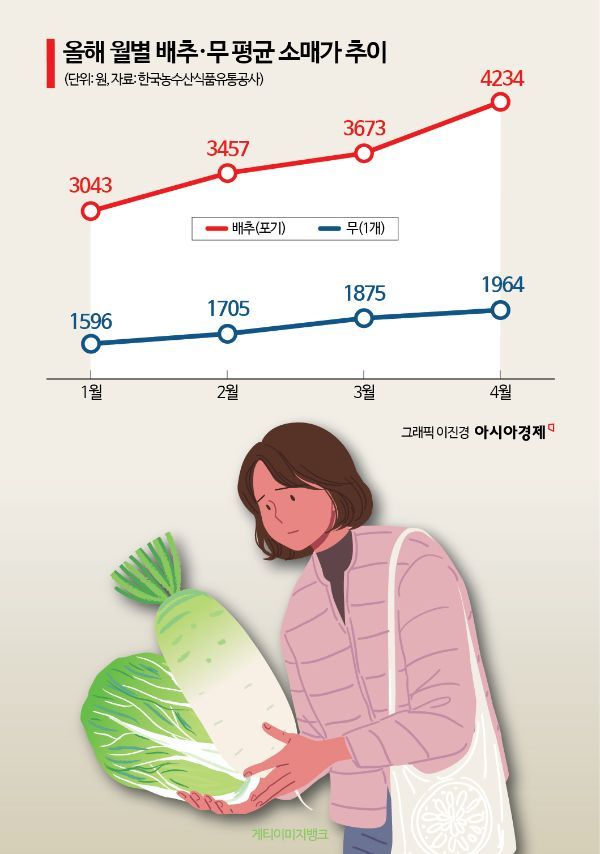
According to the Agricultural Products Distribution Information from the Korea Agro-Fisheries & Food Trade Corporation (aT) on the 17th, the retail price of one head of napa cabbage as of the 15th was 4,267 won, a 26.4% increase from one month ago (3,375 won). This price is 7.7% higher than the average (3,961 won) and 6.4% higher compared to one year ago (4,011 won). The price of napa cabbage has been steadily rising this year. The average price per head was 3,043 won in January, 3,457 won in February, 3,673 won in March, and rose to 4,234 won this month.
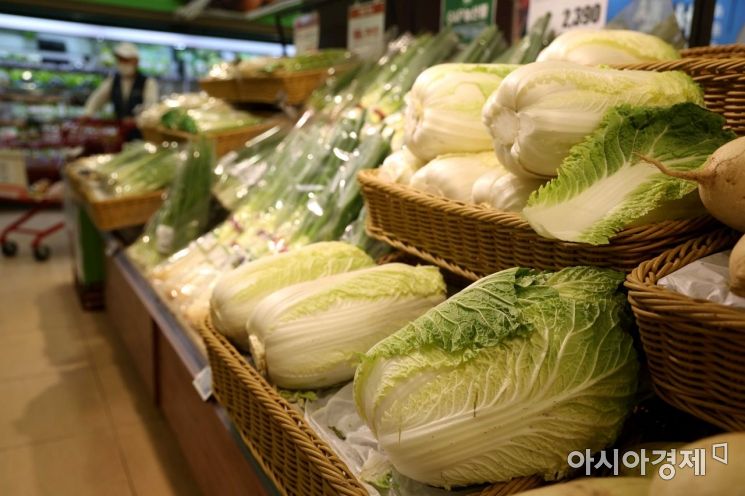
Along with napa cabbage, the price of radish, another major ingredient for kimchi, is also continuing to rise. As of the 15th, the price of one radish was 2,022 won, up 9.1% from one month ago (1,854 won). This is a 27.7% increase compared to the average price (1,583 won). The monthly average retail price of radish was 1,596 won in January, rising to 1,705 won in February, 1,875 won in March, and 1,964 won in April.
Compared to last year, when the harvest was very good, the reduced production volume is driving up the recent napa cabbage prices. According to the Agricultural Outlook Center, frequent rains in late February reduced sunlight, causing poor growth of winter-season facility-grown spring napa cabbage, leading to decreased production. The total sunlight hours in the main production areas of facility-grown spring napa cabbage during February and March were 303 hours, less than last year (423 hours) and the average year (384 hours). As a result, this year's production of facility-grown spring napa cabbage is expected to decrease by 10.0% to 29,955 tons from last year's 33,299 tons.
Additionally, the reduced storage volume of winter napa cabbage is also affecting prices. This winter's storage volume was 79,000 tons, which is 6.8% and 7.1% lower than the previous year and the average year, respectively. Continuous rainfall until the end of February caused unstocked volumes, and the napa cabbage that was stocked was stored under humid conditions, reducing storability and increasing shrinkage rates. Furthermore, early shipment of already stored volumes also contributed to the decrease in storage volume.
As napa cabbage prices continue to rise, the government has started to take action to expand supply. At the emergency economic vice-ministerial meeting combined with the price-related vice-ministerial meeting held on the 12th, the government announced that it will release about 170 tons of napa cabbage daily this month, which is more than half of the average daily total inflow (314 tons) at Garak Market. In addition to napa cabbage, 5,000 tons of onions under low tariff import quotas and 3,000 tons of green onions under tariff quotas will also be supplied.
However, the upward trend in napa cabbage prices is expected to continue for the time being. According to the Agricultural Outlook Center, this month, the storage shipment volume has decreased by 6.3% compared to the previous year due to reduced winter napa cabbage storage, and the shipment area of facility-grown spring napa cabbage has also decreased by 6.9%, so the price increase due to supply reduction is expected to continue. Next month, although the cultivation area of open-field spring napa cabbage will increase, the transplanting of seedlings grown in greenhouses to the fields will be delayed, leading to a decrease in shipment volume.
© The Asia Business Daily(www.asiae.co.kr). All rights reserved.
![Clutching a Stolen Dior Bag, Saying "I Hate Being Poor but Real"... The Grotesque Con of a "Human Knockoff" [Slate]](https://cwcontent.asiae.co.kr/asiaresize/183/2026021902243444107_1771435474.jpg)


















