One Month Left Until May 29, End of 21st Term
Political Reform and Pension Reform Initiatives Underway
Post-Election Aftermath, Political Issues, and Leadership Changes as Variables
The term of the 21st National Assembly ends on May 29. Just over a month remains. Can the 21st National Assembly, which earned the stigma of being the worst in history, finish on a high note?
On the 16th, a Democratic Party of Korea official said, "When the 22nd National Assembly begins negotiations for the organization of the National Assembly starting in June, an agreement can be reached around mid-July. Once the new National Assembly opens, bill reviews and other processes will restart, so bills may only be processed by the end of the year. Efforts are required to wrap up important legislation for now."
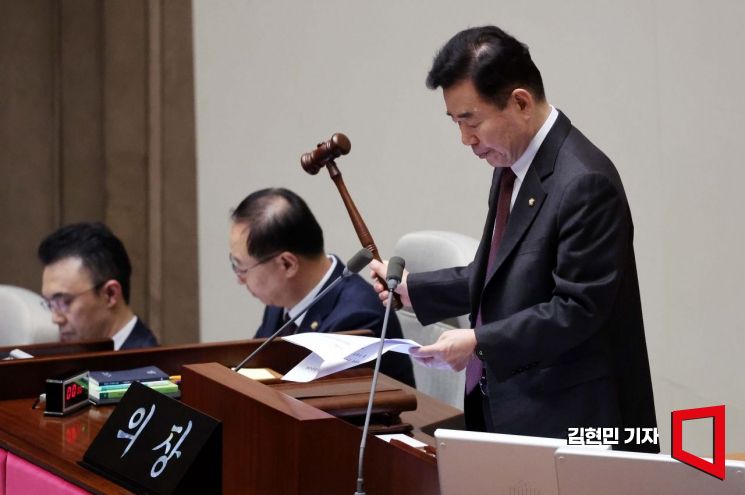 Speaker Jinpyo Kim is striking the gavel at the plenary session held at the National Assembly on the 29th. Photo by Hyunmin Kim kimhyun81@
In political circles, there are calls to finalize the major frameworks of political reform and pension reform.
The political reform agenda is being actively pursued by Speaker Kim Jin-pyo. On this day, Speaker Kim introduced a series of bills related to the three major political reform legislative tasks to conclude the 21st National Assembly. First, regarding the revision of the election system, if an external institution proposes an election system one year before the general election, the National Assembly must finalize the system nine months prior and delineate electoral districts six months prior. Additionally, as preparation for constitutional amendment, the Constitutional Amendment Procedure Act was passed, and a permanent special committee called the 'Constitutional Special Committee' was established in the National Assembly. Furthermore, a proposal was made to separate the systematic and textual review authority from the Legislation and Judiciary Committee, formerly known as the Upper House, and establish a concurrent standing committee called the Legislation Committee. A senior National Assembly official said, "As the term nears its end, the Speaker and the floor leaders of both parties will sift through bills without partisan disputes," adding, "In this process, Speaker Kim plans to attempt political reform."
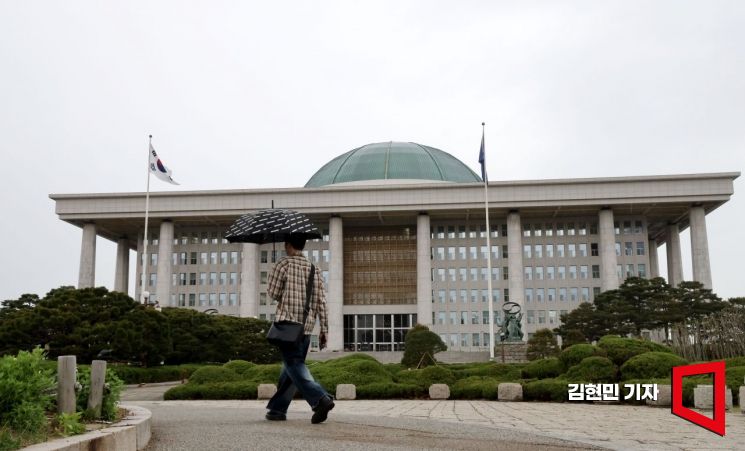 On the 15th, dark clouds heavily covered the National Assembly building. With the 22nd general election concluded on the 10th, attention is focused on how the 21st National Assembly, with just over a month left in its term, will resolve pressing issues such as pension reform and the abolition of the financial investment tax. Photo by Hyunmin Kim kimhyun81@
The goal is also to reach an agreement on pension reform, which is being discussed through the Pension Reform Public Deliberation Committee, before the end of the 21st National Assembly. The Public Deliberation Committee will hold two discussion sessions on the 20th and 21st to discuss reform plans. The committee is debating two proposals: one to raise the national pension contribution rate from the current 9% to 13% and increase the income replacement rate from 40% to 50% (income guarantee), and another to raise the contribution rate to 12% while maintaining the income replacement rate at 40% (financial stability). If the Public Deliberation Committee reaches a conclusion this month, the matter will be passed on to the National Assembly. Kim Sung-joo, the Democratic Party's secretary of the Pension Reform Special Committee, said, "Pension reform has been discussed repeatedly in the 19th, 20th, and 21st National Assemblies but has yielded no results. We cannot pass this on to the next National Assembly again."
In addition, the Democratic Party has expressed its intention to pass the special investigation law on allegations of investigation interference in the death case of Corporal Chae at the plenary session on June 2. Other goals include passing the Itaewon Disaster Special Act and the Jeonse Fraud Prevention Act, which includes the 'Preemptive Candidate Award.' The opposition party's solo-passed laws, such as the Democratic Merit Recognition Act, the Fair Franchise Transactions Act, and the Grain Management Act, are also awaiting processing one after another.
Although the remaining month must yield as much legislative achievement as possible, the situation is not optimistic. Above all, the aftermath of the election is problematic. For example, in the Pension Reform Special Committee, seven of the 13 members lost in this general election, either by defeat or primary elimination. If contentious issues such as the special investigation law for Corporal Chae or the Itaewon Disaster Special Act come to the forefront, conflicts between the ruling and opposition parties may intensify, causing setbacks even in the processing of non-contentious bills. The replacement of the floor leadership is also a variable.
© The Asia Business Daily(www.asiae.co.kr). All rights reserved.
![Clutching a Stolen Dior Bag, Saying "I Hate Being Poor but Real"... The Grotesque Con of a "Human Knockoff" [Slate]](https://cwcontent.asiae.co.kr/asiaresize/183/2026021902243444107_1771435474.jpg)











