Even During Housing Price Adjustment, Gangnam 3 Districts Recover Prices Quickly
Two Apartments in Other Areas Can Be Purchased for the Price of One in Gangnam 3 Districts
Price Difference Between Seoul and Gyeonggi·Incheon Is 22.61 Million KRW per 3.3㎡
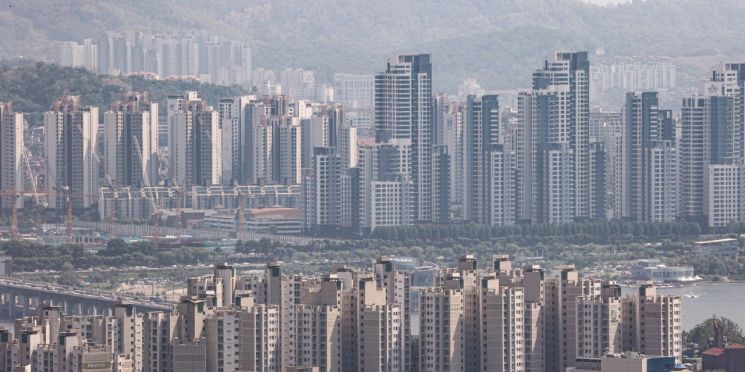
The price gap between apartments in Gangnam, Seoul, and other areas has widened. Since last year, when housing prices were adjusted downward, only the prices in the three Gangnam districts have risen, leading to a growing price difference compared to other regions.
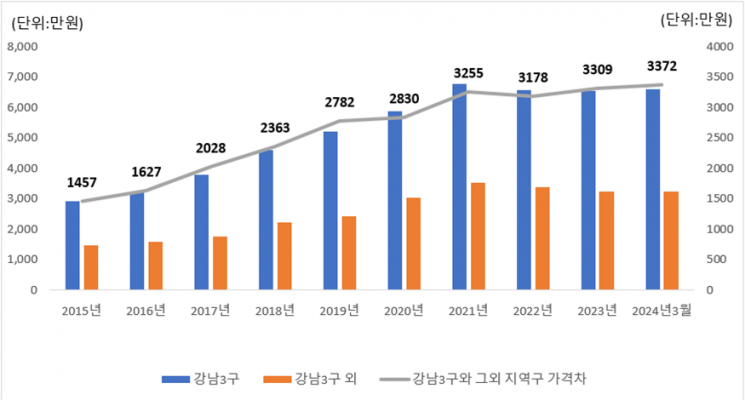 Price Difference Trend per Pyeong between Gangnam 3 Districts and Other Areas (Source=Real Estate R114 REPS DB, Data Provided by Woori Bank Asset Management Consulting Center)
According to Woori Bank Real Estate Research Lab on the 16th, the price difference per 3.3㎡ between apartments in the three Gangnam districts and other Seoul areas expanded from 33.09 million KRW last year to 33.72 million KRW as of March this year. This is an increase of 1.94 million KRW compared to 31.78 million KRW in 2022.
Apartment prices in the three Gangnam districts fell starting in 2022 but rebounded this year. The average sale price per pyeong in the Gangnam 3 districts was 66.7 million KRW in 2021, 65.61 million KRW in 2022, and 65.51 million KRW last year. In March this year, it recorded 66.09 million KRW.
In contrast, other areas continued to decline. Outside the Gangnam 3 districts, prices were 35.15 million KRW in 2021, 33.83 million KRW in 2022, 32.42 million KRW last year, and 32.37 million KRW as of March this year.
The Gangnam 3 districts are designated as regulated areas, including adjustment target zones, and there are restrictions on using the Newborn Special Home Loan for apartments priced under 900 million KRW. Nevertheless, demand for quick-sale properties during the price adjustment period flowed in, and expectations for asset value increases during the market recovery phase were reflected, leading to a relatively rapid price recovery. The 1·10 measures focusing on easing safety inspection regulations, amendments to the reconstruction excess profit recovery, and the recent strong subscription enthusiasm in the new sale market seem to have increased preference for purchases in the Gangnam area.
One apartment in the Gangnam 3 districts can buy two apartments in other Seoul areas. Looking at the ratio of apartment prices per 3.3㎡ in Gangnam 3 districts to other areas, it doubled since last year. During the real estate boom from 2020 to 2022, the ratio decreased to 1.9 but increased to 2.0 last year and this year amid the downward adjustment trend.
Ham Young-jin, head of Woori Bank Real Estate Research Lab, analyzed, "During the housing price rise, most areas in Gangnam and Gangbuk rose together, but in the market downturn, when buyers' asset choices are limited, differentiation increased toward areas with high waiting demand."
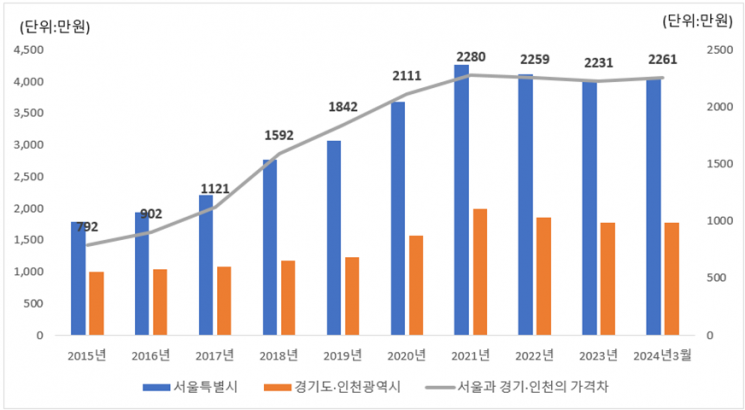
The price gap between Seoul and Gyeonggi/Incheon in the metropolitan area also widened. The price difference per 3.3㎡ increased from 7.92 million KRW in 2015 to 11.21 million KRW in 2017 and 22.8 million KRW in 2021. The gap, which had been widening for eight years since 2013, stopped after the base rate hike in the second half of 2022. As housing purchase demand shrank, it decreased to 22.59 million KRW in 2022 and 22.31 million KRW last year. Positive factors such as the opening of GTX and redevelopment projects in aging planned cities influenced this. In the first quarter of this year, the price gap widened again to 22.61 million KRW. The rise in Seoul’s jeonse prices and demand for quick-sale purchases in Gangnam and Han River areas significantly contributed to the increase in Seoul apartment prices.
The ratio of apartment sale prices per 3.3㎡ between Seoul and Gyeonggi/Incheon was 1.8 times in 2015, 2 times in 2017, and peaked at 2.5 times in 2019. As of last year and March this year, it remains at 2.3 times. Compared to Gyeonggi/Incheon, Seoul apartment prices have risen rapidly, preventing the ratio gap from narrowing. As of March this year, the sale price per 3.3㎡ in Seoul is 40.4 million KRW, while in Gyeonggi/Incheon it is 17.79 million KRW, showing a price difference of 22.61 million KRW.
Lab head Ham Young-jin explained, "The metropolitan housing market continuously varies in price differences depending on local real estate conditions, individual positive factors, and supply-demand. For the time being, polarization and demand concentration centered on Seoul are expected to continue somewhat longer, supported by land shortage and preference for new construction sales."
© The Asia Business Daily(www.asiae.co.kr). All rights reserved.
![Clutching a Stolen Dior Bag, Saying "I Hate Being Poor but Real"... The Grotesque Con of a "Human Knockoff" [Slate]](https://cwcontent.asiae.co.kr/asiaresize/183/2026021902243444107_1771435474.jpg)


















