Enforcement of the Urban Convergence Special Zone Act on the 25th... Leading Projects to Begin in Earnest
It is expected that the urban convergence special zone project, which concentrates workplace, residence, and entertainment?referred to as 'Jikju-rak'?in the downtown areas of regional metropolitan cities to create a 'regional version of Pangyo Techno Valley,' will gain momentum. The government anticipates that the basic plan approval for the pilot project sites (including special zone designation) will be possible within this year.
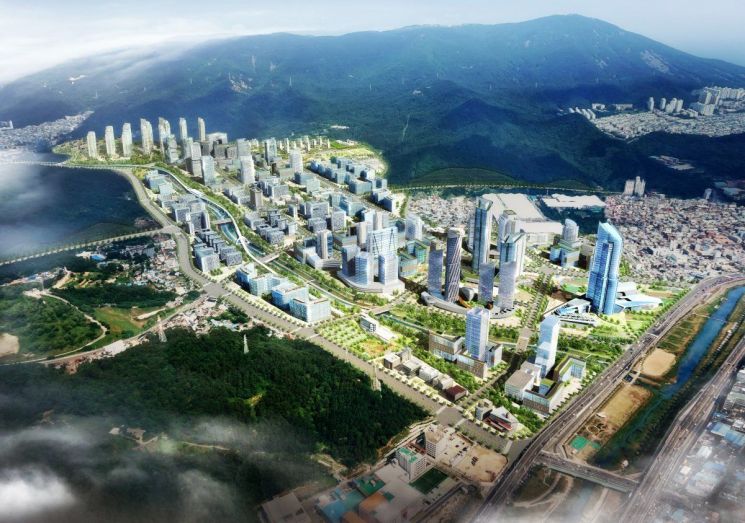 Aerial view of Centum 2 District Urban High-tech Industrial Complex. / Photo by Busan Urban Corporation
On the morning of the 16th, the government approved the enforcement decree of the "Special Act on the Creation and Promotion of Urban Convergence Special Zones" at the Cabinet meeting. This came about six months after the enactment of the special act in October last year. The enforcement will begin on the 25th of this month.
The enforcement decree includes detailed and support provisions regarding the establishment of comprehensive development plans for urban convergence special zones, designation and cancellation, and implementation of development projects. Specifically, project implementers are defined as 10 public institutions including the Korea Land and Housing Corporation (LH) and local public corporations designated by city and provincial ordinances. It also includes detailed procedures such as the contents and minor changes of the urban convergence special zone development project implementation plan, methods and procedures for supplying developed land, documents related to completion approval, and public announcements. From the project support perspective, local governments are allowed to apply special regulatory provisions under laws such as the Drone Act and Mobility Innovation Act when conducting various demonstration projects within the urban convergence special zones. Additionally, the operation of the Regulatory Sandbox Support Center and the Enterprise Comprehensive Support Center is planned to accelerate project progress.
The urban convergence special zone is a national agenda and one of the four major special zones in the era of regional development. It is a project to foster growth hubs where jobs (industry), life (residence), and leisure (commerce and culture) are concentrated in the downtown areas of regional metropolitan cities. Unlike development on the outskirts, it significantly relaxes urban and architectural regulations to enable high-density mixed-use development in downtown areas and designates regulatory free zones to provide benefits specific to each special zone. Since September 2020, this project has been promoted in five metropolitan cities?Busan, Ulsan, Daegu, Gwangju, and Daejeon?as pilot project sites.
In Busan, the Centum 2 District urban high-tech industrial complex area in Haeundae-gu was designated as an urban convergence special zone in November 2021. The total area is 1.91 million square meters, with more than 2 trillion won invested. The project period extends until 2030. President Yoon Suk-yeol revealed plans to seek regional balanced development and revitalization measures at a public discussion held in Busan in February, including the promotion of urban convergence special zones. The core is to move away from manufacturing-centered industrial complex development and establish a hub for advanced industries such as future mobility, robotics, and artificial intelligence (AI). To this end, benefits such as tax reductions, financial support, support for startup companies and talent development, temporary permits, and demonstration exceptions are provided.
In Ulsan, urban convergence special zone-related projects are underway in the KTX station area of Ulju-gun (1.62 million square meters) and the Innovation District in Jung-gu (310,000 square meters). The goal is to create a future mobility industry infrastructure and an eco-friendly energy industry ecosystem such as hydrogen, establishing a convergence cluster and advanced industrial belt. The total project cost is 52.8 billion won.
The five metropolitan cities are currently drafting the basic plans. It is expected that they will request approval of the basic plans from the Ministry of Land, Infrastructure and Transport (MOLIT) within this year at the earliest. Upon receiving the approval request, MOLIT will finalize the basic plans after consultations with related agencies and review by the Urban Development Committee. Next, the project implementer will establish the implementation plan, and once approved by the Minister of MOLIT, the project implementer will begin actual development.
Following the enactment of the enforcement decree, the government will also hold meetings with the five metropolitan cities, LH, and Busan Urban Corporation. These meetings will review the progress and plans for establishing basic plans for each pilot project. Additionally, continuous monitoring will be conducted to ensure speedy project implementation. Lee Sang-joo, Director of the Land and Urban Office at MOLIT, stated, "With the institutional foundation for the urban convergence special zone project now complete, we will accelerate the promotion of pilot projects," adding, "We will continue to do our best to attract companies and create quality jobs in regional downtown areas for balanced regional development."
© The Asia Business Daily(www.asiae.co.kr). All rights reserved.

















