Agricultural Product Price Surge, South Korea's Inflation Rate Higher Than Advanced Countries
High Price Uncertainty Makes It Difficult to Predict Base Rate Cuts
Recently, South Korea's Consumer Price Index (CPI) has risen more than those of major countries. This is due to the sharp increase in prices of agricultural products such as apples and pears. Since the beginning of this year, external uncertainties such as geopolitical crises and rising international oil prices have also increased, raising concerns about the uncertainty of price stability.
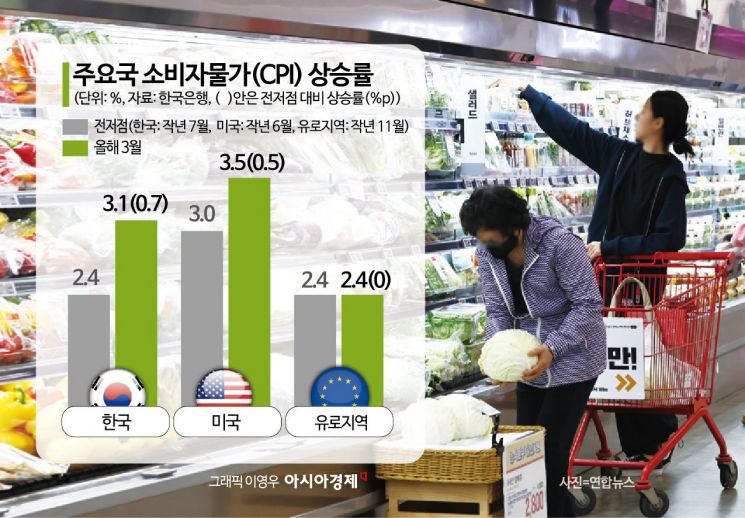
According to the Bank of Korea on the 16th, South Korea's consumer price inflation rate last month was 3.1%, up 0.7 percentage points from the previous low of 2.4% in July last year.
Meanwhile, the U.S. consumer price inflation rate rose 0.5 percentage points from 3.0% in June last year, its annual low, to 3.5% last month. The Euro area inflation rate fell to 2.4% in November last year and remained at 2.4% last month, maintaining a low level.
Price Increase Larger Compared to Other Countries Due to Sharp Rise in Agricultural Product Prices
The Bank of Korea cited the sharp rise in agricultural product prices as the main reason why South Korea's inflation rate is higher than that of other countries. Last month, agricultural product prices surged 20.5% compared to the same month last year, driving up overall prices.
In particular, fruit prices rose significantly. Last month, apple prices increased by 88.2%, marking the largest rise since statistics began in January 1980. Pear prices also rose 87.8%, the highest since the survey started in January 1975. Fruit prices have continued to rise due to poor harvests and the base effect from last year.
Park Chang-hyun, head of the price trend team at the Bank of Korea's Research Department, explained, "The rebound in prices in South Korea is larger than in the U.S. or the Euro area. This is because, unlike the U.S. or Euro area, agricultural product prices in South Korea have continued to rise sharply since the second half of last year."
Rising international oil prices were also cited as a cause of inflation. International oil prices have risen more than 20% this year alone due to geopolitical concerns. South Korea is more affected by oil price increases than the U.S. or Euro area because oil has a higher weight in the consumer price index.
Unlike oil prices, the downward pressure on prices from the recent decline in natural gas prices is relatively small in South Korea. The Bank of Korea explained that this is because South Korea's natural gas input ratio is lower than that of other countries and the decline in import prices has been relatively small.
Core Inflation Excluding Food and Energy Remains Relatively Stable
As food and energy have a large impact on inflation, core inflation excluding these items was relatively stable in South Korea compared to other countries. Last month, South Korea's core inflation rate was 2.4%, lower than the U.S. at 3.8% and the Euro area at 2.9%.
In the U.S. and Euro area, core inflation was high due to a robust economic situation, slow rent deceleration, and continued high wage pressures. In contrast, the Bank of Korea pointed out that South Korea's core inflation rate was lower than that of the U.S. or Europe due to weak consumption and employment issues.
The Bank of Korea assessed that the rise in food and energy prices has increased uncertainty in inflation forecasts. Bank of Korea Governor Lee Chang-yong also said at a press conference on the 12th, "Currently, core inflation is slowing as predicted, but headline inflation (CPI) is moving in the opposite direction due to rising agricultural product prices and oil prices, creating significant uncertainty in inflation forecasts." He also noted that if inflation does not stabilize, it would be difficult to anticipate a rate cut in the second half of the year.
Park said, "As the recent slowdown in consumer prices has stalled and geopolitical risks have increased, uncertainty over oil prices has intensified. It is important to check various indicators to determine whether inflation will trend toward the target level."
He added, "In addition to headline and core inflation, it is necessary to comprehensively examine whether underlying inflation is steadily slowing, whether the spread of price increases across items is narrowing, and whether inflation expectations remain stable to assess the inflation situation."
© The Asia Business Daily(www.asiae.co.kr). All rights reserved.


















