US and China Distributing Subsidies
EU Accelerates Support Fund Preparation
Top 3 Economies All Provide Subsidies
If Realized, Export-Oriented
Economic Structure Will Impact Korean Firms
Korea Needs Corresponding Countermeasures
The European Union (EU) is expected to enter the 'subsidy war' to foster advanced industries in competition with the United States, China, and others. As the global trade environment becomes increasingly challenging due to geopolitical risks, protectionism, and expanded environmental regulations, an alert has been raised for export-oriented South Korea.
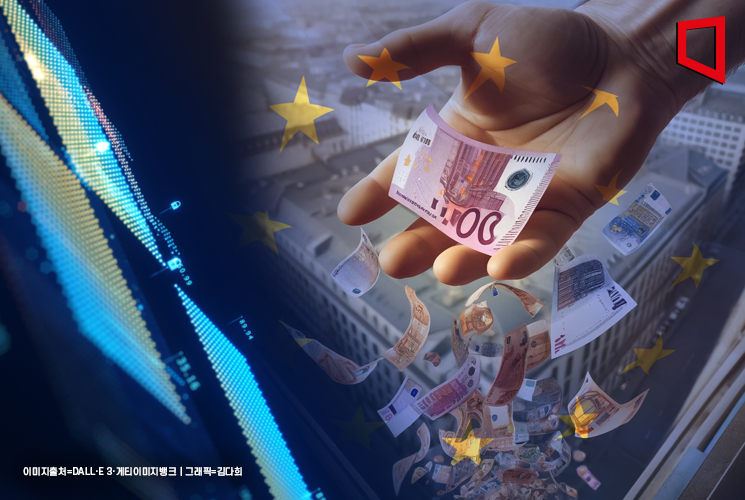
Bloomberg reported on the 15th (local time) that a report calling for EU-level subsidy support to respond to the active subsidy policies of trading partners will be announced at the special summit of the 27 EU countries scheduled for the 17th-18th. Through this, the EU aims to discuss specific methodologies for subsidy support.
The EU has so far shown a passive stance on subsidies due to concerns about independent growth by large member states such as Germany and France. However, dissatisfaction has grown recently as European companies' competitiveness falls behind due to the aggressive subsidy policies of the United States and China, prompting belated consideration of countermeasures. The European Trade Union Confederation (ETUC), representing 45 million workers in Europe, also released a study last month showing that about one million manufacturing jobs have disappeared over the past four years.
The report to be presented by former Italian Prime Minister Enrico Letta at this meeting is known to include the need for member states to develop bold and innovative solutions to better compete with the United States and China. A major solution proposed is to support the industry by injecting EU funds. Since this report was prepared at the official request of Belgium, the EU's chair country for the first half of the year, related discussions are expected to intensify thereafter.
European media Euractiv predicted, "If the report's measures are implemented, it could offset the negative impact within Europe caused by the implementation of the U.S. Inflation Reduction Act (IRA)."
There is an analysis that the competition for dominance in advanced technology, which had centered on the U.S. and China, is likely to spread to the EU. Given that the EU's economic scale ranks third in the world after the U.S. and China, the impact on the global industry would be significant. At the same time, calls have been made for South Korea to prepare correspondingly in line with the protectionist trends of major countries.
Professor Lee Cheol-in of Seoul National University's Department of Economics stated, "Currently, free trade centered on the World Trade Organization (WTO) is being shaken, and we are transitioning to a country-centered system to foster and protect advanced industries such as semiconductors. If this trend spreads, South Korea, with its export-oriented economic structure, risks losing competitiveness in the mid to long term."
Professor Lee advised, "It is important for the Korean government to provide subsidies at least for certain new technologies designated as future growth engines to support our companies so they do not fall behind in global competitiveness."
© The Asia Business Daily(www.asiae.co.kr). All rights reserved.
![Clutching a Stolen Dior Bag, Saying "I Hate Being Poor but Real"... The Grotesque Con of a "Human Knockoff" [Slate]](https://cwcontent.asiae.co.kr/asiaresize/183/2026021902243444107_1771435474.jpg)
















