As unexpectedly high inflation continues, the timing of the U.S. Federal Reserve's (Fed) interest rate cuts is gradually moving further away. To make matters worse, the escalation of war tensions between Iran and Israel has caused U.S. Treasury yields to spike, causing domestic bank loan interest rates to fluctuate as well.
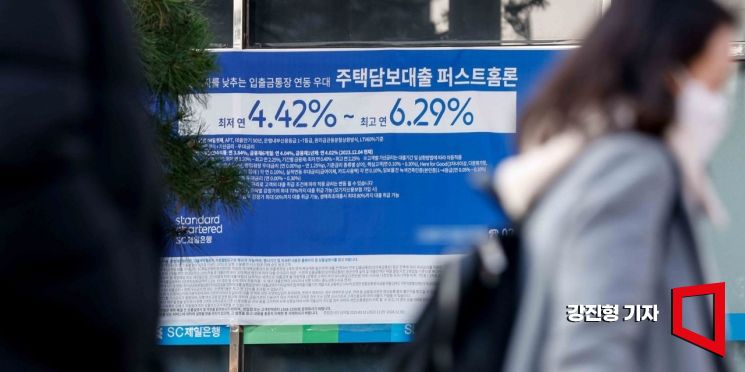 On the 26th, when the 'Stress DSR,' which precisely reflects future interest rate fluctuation risks in the Debt Service Ratio (DSR), was implemented, a real estate mortgage loan interest rate table was posted on the exterior wall of a branch of a commercial bank in Seoul. The Stress DSR system is a measure that applies an additional interest rate (stress interest rate) when calculating the DSR, considering the possibility that borrowers using variable interest rate loans may face increased principal and interest repayment burdens due to rising interest rates during the loan period. The stress interest rate applied until the first half of this year is 0.38%. Photo by Kang Jin-hyung aymsdream@
According to the financial sector on the 16th, as of that day, the fixed (hybrid) mortgage loan interest rates at the five major commercial banks (KB Kookmin, Shinhan, Hana, Woori, NH Nonghyup) were between 3.14% and 5.77%, while variable mortgage loan rates ranged from 3.90% to 6.80%. Considering that at the beginning of this month, fixed rates were 3.05% to 5.73% and variable rates were 4.01% to 6.84%, the rates have remained relatively stable.
The reason fixed mortgage loan rates, which once touched the low 3% range, are now stable is primarily due to banks adjusting rates to manage household loans. For example, Shinhan Bank raised mortgage loan rates by 0.10 to 0.30 percentage points starting from the 1st of this month to control household lending.
However, the main cause is also interpreted as the Fed's interest rate cut timing being gradually postponed. The U.S. Consumer Price Index (CPI) inflation rate in March was 3.5%, the highest since September last year (3.7%). As a result, the expected timing for rate cuts, initially anticipated around June to July, has been delayed until around November. Domestic bond yields have followed a similar trend. The 5-year financial bond yield, a benchmark for fixed mortgage loan rates, rose to 3.882% on the 11th. Since the beginning of this year, the 5-year financial bond yield has hovered around 3.7% to 3.8%.
The COFIX rate, which serves as the reference rate for variable mortgage loans, has also been declining for four consecutive months, but the decrease is limited. According to the Bankers Association, the COFIX based on new transactions in March was 3.59%, down only 0.03 percentage points from the previous month (3.62%).
To make matters worse, geopolitical risks are fueling this trend. On the 13th, Iran carried out retaliatory airstrikes against Israel. Although there are no signs yet of a full-scale military conflict between Iran and Israel, the market is reacting sensitively. The combination of prolonged high interest rates and geopolitical instability caused the U.S. 10-year Treasury yield to rise to 4.55% as of the previous afternoon.
Wall Street also anticipates further increases in bond yields. According to major foreign media, Thierry Wiseman, a global currency and interest rate strategist at Macquarie Group, stated, "With U.S. inflation exceeding the Fed's 2% target for three consecutive months, the market perceives that achieving the inflation target will be difficult," adding, "It seems reasonable for the U.S. 10-year Treasury yield to rise to 4.75% under the current circumstances."
The financial sector advises that, given the likelihood of a prolonged high interest rate environment beyond expectations, a cautious lending strategy is necessary. A representative from a commercial bank said, "At the beginning of the year, there were many predictions of two to three rate cuts within the year, but as the U.S. CPI continues to exceed expectations and inflation indicators do not improve, the timing of cuts is being pushed back," adding, "Since rates are stable, new borrowers might consider initially taking out fixed-rate loans and then refinancing into variable-rate products later if rates decrease."
© The Asia Business Daily(www.asiae.co.kr). All rights reserved.

















