Possibility of Israeli Retaliation to Iranian Attacks
Escalation in the Middle East Expected to Solidify New Cold War Structure
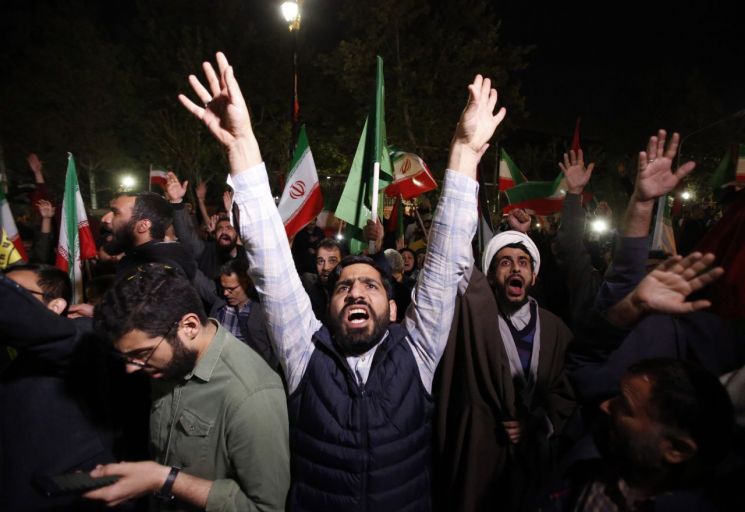 On the 14th (local time), Iranians gathered in front of the British Embassy in Tehran, Iran, cheering news of missile and drone attacks by the Iranian Revolutionary Guard targeting Israel. On this day, tensions in the Middle East escalated due to Iran's retaliatory attacks aimed at mainland Israel. [Image source=Yonhap News]
As tensions escalate in the Middle East due to the clash between Iran and Israel, there is an analysis that this could negatively impact security on the Korean Peninsula. Experts predict that North Korea will refine its military strategy on the peninsula while observing the responses of the United States and Israel, and will also show movements to strengthen the new Cold War structure between the West, including the U.S., and opposing forces.
According to major foreign media such as the U.S. Wall Street Journal (WSJ) on the 15th, Israel, which suffered large-scale airstrikes on the 13th and 14th, is expected to retaliate against Iran as early as today. Although the timing and method of the response have not yet been decided, key ministers including Israeli Prime Minister Benjamin Netanyahu reportedly discussed Iran’s bombing response plan for several hours.
If the conflict between Iran and Israel intensifies, the confrontation between the U.S. and opposing forces centered in the Middle East is expected to worsen. The Group of Seven (G7), including the U.S., has already expressed full solidarity and support for Israel. Analysts suggest that if Israel launches another counterattack, the conflict could escalate into a war involving the U.S. and Iran.
This could send a negative signal to North Korea, which confronts the U.S. on the Korean Peninsula using nuclear weapons and missiles. On the same day, the North Korean Workers’ Party organ newspaper Rodong Sinmun reported on Iran’s attack on Israel, stating, "International public opinion is concerned that Israel, which has lost reason and is madly enforcing a war policy, along with the U.S. and the West actively defending and condoning it, is pushing the entire Middle East into a sea of fire."
The confrontation within the United Nations Security Council (UNSC) is also intensifying. At an emergency UNSC meeting convened at the UN headquarters in New York immediately after Iran’s attack, the U.S. pressured, saying, "Iran and its proxy forces will be held accountable if they take further actions," but Russia countered, blaming the U.S. and the West for remaining silent about Israel’s attack on Iran.
This incident is explained as potentially solidifying the new Cold War structure between the West, including the U.S., and opposing forces such as Russia, China, North Korea, and Iran. Kim Yong-hyun, a professor in the Department of North Korean Studies at Dongguk University, predicted, "Since North Korea is creating a trend to strengthen solidarity with Russia, China, and Iran, if the war clouds spread in the Middle East, tensions and conflicts on the Korean Peninsula could also intensify."
Since the U.S. is involved not only in the Russia-Ukraine war but also in the war between Israel and Hamas, the escalation in the Middle East could lead to a decrease in focus on North Korea and Korean Peninsula issues. On the other hand, it is anticipated that North Korea will refine its military strategy technically by comparing Israel’s interception of about 300 drones and missiles with South Korea’s defense system.
Even if the Middle East war does not escalate further, the current clash between Iran and Israel is expected to influence North Korea’s strategy. Park Won-gon, a professor in the Department of North Korean Studies at Ewha Womans University, explained, "Israel, the U.S.’s greatest ally, was attacked, and how much the U.S. cooperates in this situation could have implications for the defense commitments the U.S. provides to South Korea within the ROK-U.S. alliance," adding, "North Korea will closely observe such aspects."
© The Asia Business Daily(www.asiae.co.kr). All rights reserved.

















