Won-Dollar Exchange Rate Approaches 1400 Won
Gold Price Surpasses $2400 per Ounce Intraday for the First Time
Increased Financial Market Volatility... Government Conducts Emergency Review
As Iran launched retaliatory attacks against Israel on the 13th (local time), concerns about rising international oil prices have emerged. If this war escalates and leads to the blockade of the Strait of Hormuz, a major international oil transportation route, international oil prices could soar to as high as $130 per barrel, experts say.
The Middle East crisis triggered by the Palestinian armed faction Hamas's invasion is raising fears of expanding into a large-scale war involving multiple countries including the United States due to Iran's participation, which could increase volatility in the domestic stock and financial markets.
Predicted Iranian Retaliatory Airstrikes... Asset Prices Including International Oil Prices Surge
With Iran already warning of retaliatory airstrikes against Israel, the price of gold, a representative safe-haven asset, surpassed $2,400 per ounce for the first time during trading. Additionally, international oil prices and the won-dollar exchange rate also surged.
According to the financial investment industry on the 14th, on the 12th (local time) at the New York Mercantile Exchange, June delivery gold futures closed at $2,374.10 per ounce, up 1.40% from the previous day. Gold prices reached an all-time high of $2,448.8 per ounce during the day, breaking the record set just one day earlier.
Gold prices had previously surpassed the $2,100 mark for the first time on the 4th of last month and rose above the $2,300 level on the 3rd of this month, just one month later.
On the same day, the May West Texas Intermediate (WTI) crude oil price rose to as high as $87.67 per barrel during trading. WTI closed at $85.66 per barrel, up $0.64 (0.75%) from the previous session. Brent crude oil prices reached $92.18 per barrel intraday and closed at $90.45 per barrel, up $0.71 (0.8%). Brent crude futures exceeding $92 per barrel is the first time in over five months since late October last year.
The won-dollar exchange rate has already approached 1,400 won. On the 12th, the Korean won exchange rate in the Seoul foreign exchange market closed at 1,375.4 won, up 22.6 won from the previous week. This is the highest closing level in 17 months since November 10, 2022 (1,377.5 won). The weekly increase was the largest since January 19 (25.5 won).
The sharp rise in the exchange rate, gold prices, and international oil prices is due to expectations that Iran's retaliatory airstrikes against Israel are imminent. As a result, there are predictions that these asset values will rise further if Iran carries out actual retaliatory airstrikes.
Iran Launches Large-Scale Retaliatory Airstrikes... Israel Successfully Defends with US and UK Support
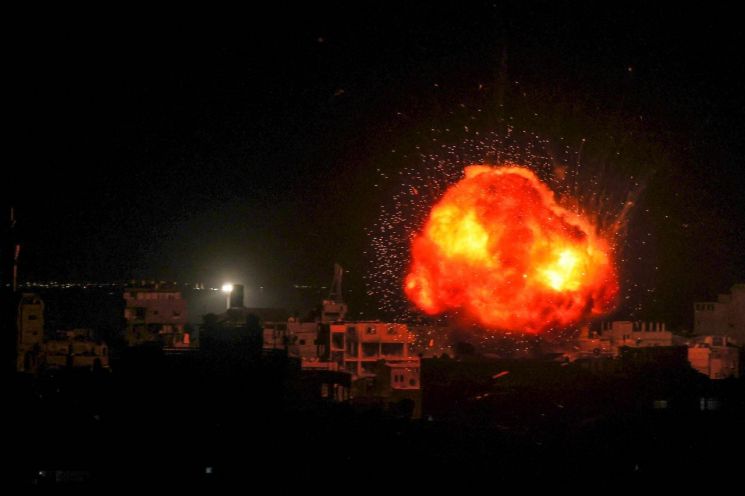
Earlier, in the early hours of the 14th Korean time, Iran launched direct attacks on Israeli territory using drones and cruise missiles. Iran had previously warned of retaliation, accusing Israel of being behind the bombing of its consulate in Syria on the 1st.
The Israeli military stated in a press release that it intercepted the majority of dozens of ballistic missiles launched by Iran toward Israel. The missiles were shot down by the Arrow missile defense system before entering Israeli airspace, the military explained. The United States and the United Kingdom provided defensive support to Israel on the same day.
US President Joe Biden abruptly returned from his Delaware residence to the White House and convened a National Security Council meeting to discuss response measures shortly after it was revealed that Iran had seized a container cargo ship related to Israel in the Strait of Hormuz.
Israel has announced that it will respond once the defense against Iran's airstrikes is completed. Israeli Prime Minister Benjamin Netanyahu stated early in the Iranian airstrikes, "We have established clear principles," adding, "We will harm anyone who harms us," signaling a policy of retaliation.
Middle East Produces Over 30% of Global Oil... Oil Prices Could Surge if Strait of Hormuz is Blocked
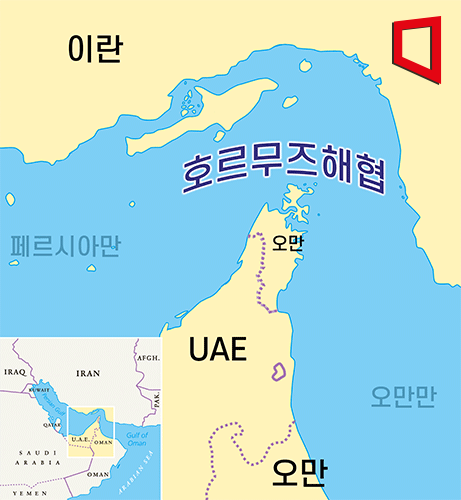
The Middle East accounts for one-third of global oil production, and Iran is the third-largest oil producer in the Organization of the Petroleum Exporting Countries (OPEC). Therefore, depending on how the conflict unfolds, international oil prices are likely to fluctuate. Furthermore, if the Strait of Hormuz is blocked, oil prices could surge sharply.
The Strait of Hormuz serves as an export route for Middle Eastern oil-producing countries such as Saudi Arabia, Kuwait, Iraq, Iran, and the United Arab Emirates (UAE). One-third of the world's liquefied natural gas (LNG) and one-sixth of the world's oil pass through this strait. Middle Eastern crude oil imported into Korea also passes through this strait.
Before the recent attacks, Bob McNally, CEO of energy consulting firm Rapidan Group, expressed concerns in an interview with CNBC, stating, "If the armed conflict leads to the blockade of the Strait of Hormuz, a major international oil transportation route, oil prices could soar to $120?130 per barrel."
Rebecca Babin of CIBC Private Wealth said, "If Iran directly intervenes in the conflict, the possibility of supply disruptions in the Middle East region increases," adding that call option purchases betting on rising oil prices are continuing.
Rising Oil Prices Increase Burden on South Korean Economy... Government Conducts Emergency Review

Rising international oil prices, as a factor of inflation (price increases), could add to the burden on the South Korean economy, which is already experiencing high inflation. In particular, sustained oil price increases could delay the timing of the US Federal Reserve's interest rate cuts, potentially affecting interest rate reductions in other countries as well.
Therefore, the government convened an emergency meeting on the day to discuss response measures. Deputy Prime Minister and Minister of Economy and Finance Choi Sang-mok chaired the 'External Economic Review Meeting' at the Government Seoul Office, attended by key officials from the Ministry of Economy and Finance. At the meeting, Deputy Prime Minister Choi reported on the results of the 'Joint Situation Review Meeting of Related Agencies' held earlier that morning, stating, "Depending on how the situation develops, the impact on our economy could increase," and added, "We will operate a joint emergency response team of related agencies daily to closely monitor domestic and international financial market conditions 24 hours a day."
The International Monetary Fund (IMF) expressed concerns about the impact of the expanded conflict during the early stages of the war between Israel and Hamas (Palestinian armed faction) in October last year, predicting that a 10% rise in oil prices would reduce global production by 0.15 percentage points and increase inflation by 0.4 percentage points.
Some voices even warn of the worst-case scenario resembling the 1973 'Oil Shock.' At that time, Arab oil-producing countries weaponized oil during the Middle East war, causing international oil prices to surge. South Korea, which enjoyed high growth rates of around 10% in the 1970s, recorded negative growth in 1980 due to the impact of the second oil shock.
© The Asia Business Daily(www.asiae.co.kr). All rights reserved.

![Clutching a Stolen Dior Bag, Saying "I Hate Being Poor but Real"... The Grotesque Con of a "Human Knockoff" [Slate]](https://cwcontent.asiae.co.kr/asiaresize/183/2026021902243444107_1771435474.jpg)

















