The Chinese government strongly protested as the United States, Japan, and the Philippines raised issues regarding the Senkaku Islands and the South China Sea during bilateral and trilateral summits, aiming to check China.
According to the Chinese Ministry of Foreign Affairs on the 12th, Liu Jinsong, Director-General of the Asian Affairs Department, summoned Akira Yokochi, the Charg? d'Affaires of the Japanese Embassy in China.
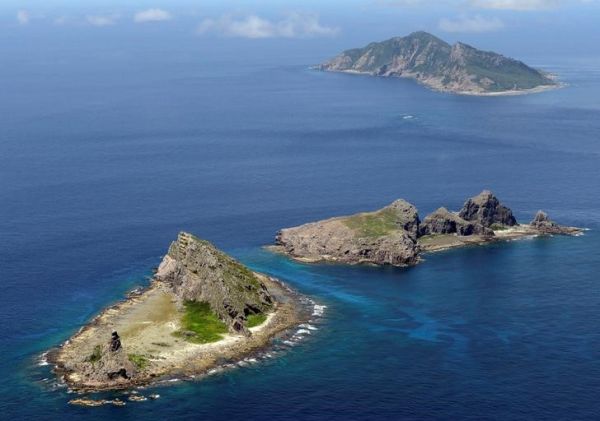 The Senkaku Islands (Chinese name Diaoyu Islands), over which Japan and China are engaged in a territorial dispute, currently under Japan's effective control
[Image source=Yonhap News]
At the meeting, Director-General Liu stated that "Japan showed negative movements toward China through the US-Japan summit and the US-Japan-Philippines summit held in Washington, and we lodged a stern representation (meaning a protest through diplomatic channels)," expressing serious concerns along with strong dissatisfaction.
Additionally, China deployed maritime police vessels to patrol the waters near the Senkaku Islands. The Chinese maritime police announced through their official WeChat account (China’s version of KakaoTalk) that "today, the maritime police vessel fleet 2502 patrolled within our Diaoyu Islands territorial waters."
The Senkaku Islands, effectively controlled by Japan, are a site of territorial dispute between China and Japan. The Chinese maritime police have frequently publicized their patrols around the Senkaku Islands to build justification supporting their territorial claims.
Mao Ning, spokesperson for the Chinese Ministry of Foreign Affairs, asserted at the daily briefing that China holds sovereignty over Taiwan, the South China Sea, and the Diaoyu Islands, strongly criticizing the United States, Japan, and the Philippines in a stern tone.
He questioned, "If the joint statement by the three countries is not slandering and attacking China, then what is it?" and raised the level of criticism with expressions such as "No interference is allowed in the Taiwan issue (Bu Rong Zhi Hui, 不容置喙)" and "extraterritorial countries are fanning the flames and inciting conflict."
Regarding Japanese Prime Minister Fumio Kishida’s expression of concern over China’s military actions during his speech to the US Congress the previous day, spokesperson Mao expressed "strong dissatisfaction and resolute opposition," urging Japan, which once followed the path of militarism, to reflect on its history of aggression and to cease security threats against neighboring countries.
He also strongly protested President Joe Biden’s statement after the trilateral summit that "the United States will respond to any Chinese attack on the Philippines," calling it a "malicious attack and criticism targeting China."
© The Asia Business Daily(www.asiae.co.kr). All rights reserved.
!["The Woman Who Threw Herself into the Water Clutching a Stolen Dior Bag"...A Grotesque Success Story That Shakes the Korean Psyche [Slate]](https://cwcontent.asiae.co.kr/asiaresize/183/2026021902243444107_1771435474.jpg)
















