The Bank of Korea Maintains Core Inflation Forecast at 2%
External Factors Like Timing of US Rate Cuts More Crucial
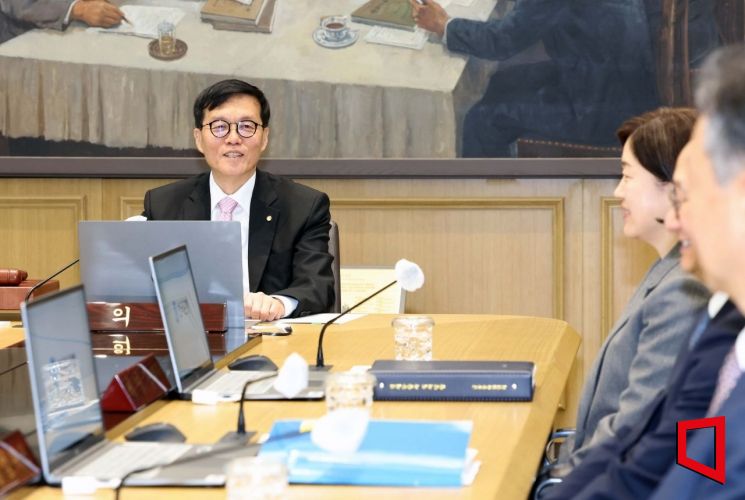 Lee Chang-yong, Governor of the Bank of Korea, is presiding over the Monetary Policy Committee meeting held on the 12th at the Bank of Korea in Jung-gu, Seoul. Photo by Joint Press Corps
The Monetary Policy Committee (MPC) of the Bank of Korea has kept the base interest rate unchanged for 10 consecutive months, leading securities firms to postpone the expected timing of rate cuts within the year. This is due to increased uncertainty in monetary policy and the judgment that it is difficult to cut rates before the United States does.
On the 12th, Kyobo Securities announced, "We revise the forecast for the Bank of Korea's first base rate cut from the second quarter to the third quarter of this year." Kiwoom Securities also changed the expected timing of the first rate cut from July to August.
Baek Yoon-min, a researcher at Kyobo Securities, explained, "For the Bank of Korea to actually implement a rate cut, external conditions (such as the Federal Reserve's monetary policy path) need to become clearer," adding, "The retreat in expectations for a Fed rate cut due to strong U.S. economic indicators poses a significant immediate burden on the Bank of Korea's monetary policy shift."
On this day, the MPC decided at its regular meeting to keep the base rate at 3.50%. This marks the 10th consecutive freeze since February last year. Domestic inflation and the U.S. Fed's monetary policy influenced this decision.
In March, the consumer price inflation rate was recorded at 3.1%, marking two consecutive months above 3% following February. Since this exceeds the Bank of Korea's inflation target (2%), the prevailing analysis is that the MPC will find it difficult to adopt an accommodative monetary policy.
However, the Bank of Korea projected in its monetary policy statement that the consumer price inflation rate will fall to around 2% by the end of this year. This is because the core inflation rate aligns with the forecast path from February and shows a slowing trend. Variables include movements in international oil prices and agricultural product prices.
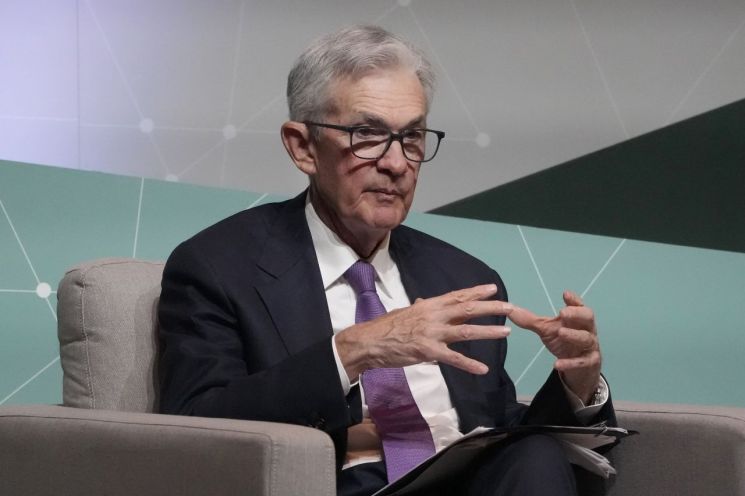
Externally, the timing of the U.S. rate cut is also considered an important factor. The U.S. Consumer Price Index (CPI) has surged, reducing the likelihood of a rate cut in June. Given that the U.S. is postponing its rate cut, it is assessed that Korea will find it difficult to preemptively lower rates. Currently, the interest rate gap between Korea and the U.S. stands at 2 percentage points, and widening this gap further could lead to foreign investor capital outflows.
An Ye-ha, a researcher at Kiwoom Securities, said, "Despite domestic consumption slowing, headline inflation needs to be confirmed as slowing," and added, "Considering external monetary policy uncertainties, the Bank of Korea is expected to implement rate cuts after the U.S. lowers its rates."
NH Investment & Securities analyzed that external variables are more important factors influencing the MPC's decision on rate cuts. The Bank of Korea's assessment of the domestic economy has not changed since the February economic outlook. Although the monetary policy statement mentioned the possibility of this year's growth rate exceeding the February forecast, the core inflation forecast, which reflects demand, remains at 2%.
Kang Seung-won, a researcher at NH Investment & Securities, explained, "This means that while export forecasts have been revised upward, the outlook for the domestic economy remains unchanged," adding, "In other words, domestic economic and inflation factors still support the possibility of a rate cut."
Researcher Kang also paid attention to remarks by Governor Lee Chang-yong of the Bank of Korea. Governor Lee said he would confirm the revised economic outlook in May and the European Central Bank's (ECB) policy decision in June regarding the timing of rate cuts. Kang interpreted this as, "Since the Federal Open Market Committee (FOMC) is also scheduled in June, it means that the Bank of Korea plans to respond to policy after confirming the monetary policy plans of major countries in the second half of the year."
He continued, "With the domestic economic outlook unlikely to change, if the ECB actually cuts rates in June and the U.S. maintains signals for cuts in the second half, the Bank of Korea could begin rate cuts starting in July."
© The Asia Business Daily(www.asiae.co.kr). All rights reserved.
![Clutching a Stolen Dior Bag, Saying "I Hate Being Poor but Real"... The Grotesque Con of a "Human Knockoff" [Slate]](https://cwcontent.asiae.co.kr/asiaresize/183/2026021902243444107_1771435474.jpg)

















