The structural reforms that will determine the future of the Republic of Korea are at a crossroads. In a National Assembly where no law can pass without the opposition's consent, President Yoon Seok-yeol must either change the direction of structural reforms or somehow persuade the opposing forces. If he fails to do so, there are concerns that his administration will fall into a 'puppet government' that only calls for reform but fails to implement it.
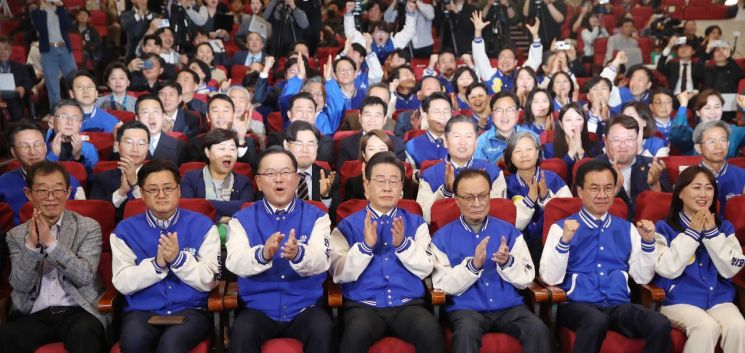 Democratic Party leader Lee Jae-myung, along with permanent co-election campaign committee chairs Lee Hae-chan and Kim Boo-kyum, and other party leaders, cheered while watching the broadcast exit poll results at the Democratic Party's vote counting situation room for the 22nd National Assembly election (general election) held on the afternoon of the 10th at the National Assembly Members' Office Building in Yeouido, Seoul.
According to the vote count results on the 11th, the opposition holds around 190 seats in the 22nd National Assembly. When combining the seats of the Democratic Party and the Party for Justice and Innovation, they can not only pass bills unilaterally but also designate bills as fast-track legislation. They have also secured the authority to forcibly end the minority ruling party's weapon of unlimited debate (filibuster). This means that no matter how much the ruling party opposes, the opposition can pass any law if they wish.
As a result, the leadership of structural reforms, such as labor and pension reforms advocated by the Yoon Seok-yeol administration, is expected to be seized by the opposition. Most of the key issues in structural reform require legislative approval from the National Assembly. In a parliamentary landscape where the opposition holds about 190 seats, a significant portion of the opposition's voice must be reflected to pass bills. Especially since the opposition has expressed opposition to many of the government's three major reforms, the passage of existing bills has become uncertain.
The most representative policy is the 'flexibilization of working hours.' The Ministry of Employment and Labor is promoting a policy that allows flexibilization in certain industries and occupations while maintaining the '52-hour workweek' framework. Amending the Labor Standards Act is necessary, but the Democratic Party strongly opposes it. Lee Jae-myung, leader of the Democratic Party, also criticized on the 13th of last month during the election campaign, saying, "They are trying to roll back the barely established 52-hour workweek and regress to a 69-hour system."
The possibility of reintroducing the Yellow Envelope Act has also increased. The Yellow Envelope Act strengthens the responsibility of the primary contractor for subcontracted workers (Article 2 of the Labor Union Act) and limits the scope of corporate claims for damages against striking workers (Article 3 of the Labor Union Act). Although the bill passed in the 21st National Assembly last year, it was nullified when President Yoon exercised his veto power. Among opposition politicians who entered the 22nd National Assembly, there are calls to 're-push the Yellow Envelope Act.'
If the Opposition's Consent Is Not Obtained, a 'Puppet Government' Is Inevitable
Pension reform is also expected to gain strength from the opposition. The reform plan is being discussed by the Public Deliberation Committee within the National Assembly's Special Committee on Pensions. Although the special committee and the public deliberation committee have equal participation from both ruling and opposition parties, the opposition's voice in the National Assembly inevitably grows stronger. While the government has emphasized the 'soundness' of pensions so far, it will have to listen to the opposition's voice that prioritizes 'security' going forward.
Cabinet reshuffles are expected to act as another variable. If President Yoon undertakes a cabinet reshuffle to reflect the general election results and renew the government, the speed of policy formulation in the affected ministries will slow down. In particular, the Ministry of Employment and Labor, which is in charge of labor reform, was excluded from the reshuffle before last year's general election, so it may be considered for a future reshuffle.
However, the opposition has failed to secure 200 seats that would nullify the president's right to request reconsideration, so unconditional passage of bills cannot be guaranteed. If the government rejects bills proposed by the opposition, a strong confrontation between the government and the National Assembly could continue throughout the term. There is also a possibility that scenes similar to the 21st National Assembly will repeat, where the opposition-led National Assembly proposes and approves bills, and the president exercises veto power. In this case, various reform legislations are likely to be stalled one after another, making it difficult to avoid criticism of being a 'puppet government.'
Government officials are extremely tight-lipped about the general election results but appear to be concerned about the more difficult parliamentary landscape. A senior government official said, "Since most reform policies are legislative tasks, civil servants are putting much more effort into persuading the National Assembly."
© The Asia Business Daily(www.asiae.co.kr). All rights reserved.

















