Democratic Party Secures 161 Constituency Seats, 14 Proportional Representation Seats
People Power Party Secures 90 Constituency Seats, 19 Proportional Representation Seats
Reform Party Secures 12 Proportional Representation Seats Only
The Democratic Party of Korea is expected to secure 175 seats, far surpassing the majority in the 22nd general election. It is interpreted that the public has sided with the judgment against the Yoon Seok-yeol administration amid the debate between 'regime judgment theory' and 'opposition party judgment theory.'
The People Power Party has suffered a 'three consecutive general election defeats' in the 20th (2016), 21st (2020), and now the 22nd general elections. Although it seems likely to maintain the 'constitutional amendment blocking line' with a late surge, it will inevitably be dragged by the large opposition party in this National Assembly as well.
As of 7 a.m. on the 11th, with a vote count rate of 99.8%, the Democratic Party leads in 161 constituencies, while the People Power Party leads in 90 constituencies.
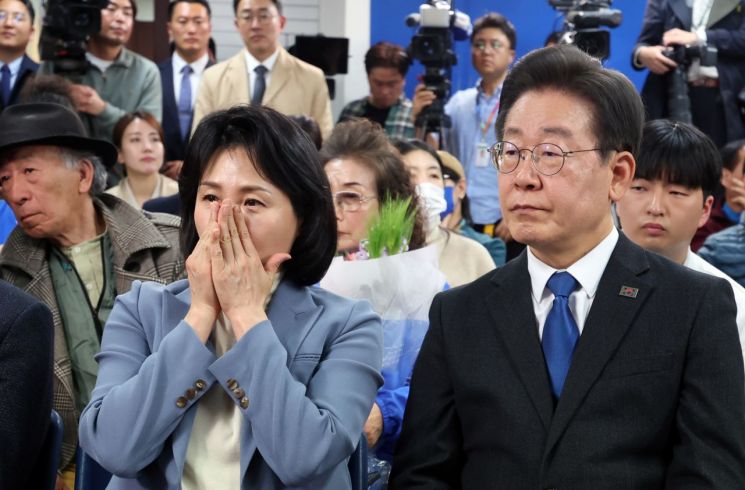 The leader of the Democratic Party of Korea, Lee Jae-myung, who ran for the 22nd National Assembly election in Gyeyang-gu B, Incheon, and his wife Kim Hye-kyung are watching the vote counting broadcast at his campaign office set up in Gyeyang-gu, Incheon on the 11th.
 [Image source=Yonhap News]
The Democratic Party achieved a large number of victories in the metropolitan area, a barometer of public sentiment. They won not only in traditional strongholds such as Gangbuk, Seongbuk, Dongdaemun, and Jungnang but also in the so-called 'Hangang Belt,' considered the biggest battleground. Democratic Party candidates were elected in notable districts such as Yeongdeungpo-gap (Chae Hyun-il), Mapo-eul (Jung Cheong-rae), and Jung-Seongdong-gap (Jeon Hyun-hee).
In the party vote for proportional representation, with a 97.1% vote count rate, the People Power Party's satellite party, Future of the People, received the highest share with 36.84%. The opposition proportional party led by the Democratic Party, the Democratic United Party, recorded 26.64%, the Homeland Innovation Party 25.13%, and the Reform New Party 3.59%. Only parties that receive more than 3% of the party vote can gain seats in proportional representation. Accordingly, the Green Justice Party (2.14%) and the Free Unification Party (2.29%) will not receive seats. Therefore, the 46 proportional representation seats are likely divided as 14 seats for the Democratic United Party, 19 seats for Future of the People, 12 seats for the Homeland Innovation Party, and 1 seat for the Reform New Party.
Combining constituency and proportional representation seats, the broad opposition bloc (Democratic Party 161 seats, Democratic United Party 14 seats, Homeland Innovation Party 12 seats, Saeroun Mirae 1 seat) is expected to hold around 188 seats, becoming a 'giant opposition' surpassing the previous general election. Following the 21st general election in 2020, they have secured another landslide victory, maintaining a minority government with a majority opposition.
Although the People Power Party lost, contrary to exit poll results, they prevented the broad opposition bloc from securing 200 seats, which would have enabled constitutional amendments. The People Power Party won in many competitive areas in the Busan and Gyeongnam regions, known as the Nakdong River Belt, and candidates Kwon Young-se and Na Kyung-won won in major metropolitan battlegrounds Yongsan and Dongjak in Seoul, respectively. In Seoul Dobong-gap, People Power Party candidate Kim Jae-seop defeated Democratic Party candidate Ahn Gwi-ryeong and was elected.
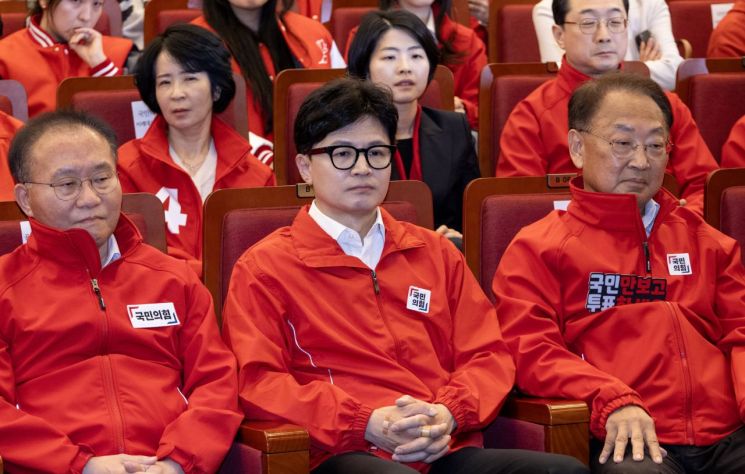 People including Han Dong-hoon, the General Election Committee Chairman of the People Power Party, are watching the exit poll results on the 10th at the 22nd National Assembly election counting situation room set up at the National Assembly Library in Yeouido, Seoul. [Image source=Yonhap News]
The ruling party's complete defeat in this general election is analyzed as a result of the judgment against the Yoon Seok-yeol government.
With the broad opposition bloc securing more than 180 seats, surpassing the limitations of the National Assembly's advanced legislative procedure law, they can effectively process all bills unilaterally using the fast-track system. For the government and ruling party, aside from the president's veto power, there is little they can do, increasing the burden of state administration. Especially, the Homeland Innovation Party, which caused a surge in this election, may attempt to form an additional parliamentary negotiation group, making it certain that the National Assembly will be led by the opposition.
Han Dong-hoon, the emergency committee chairman of the People Power Party, is scheduled to announce his position on the general election defeat on the morning of the same day. Lee Man-hee, the People Power Party situation room chief, said at the People Power Party vote counting situation room located in the basement of the National Assembly Library in Yeouido, Seoul, "We will organize the statements and separately announce the time and place in the morning."
© The Asia Business Daily(www.asiae.co.kr). All rights reserved.
![User Who Sold Erroneously Deposited Bitcoins to Repay Debt and Fund Entertainment... What Did the Supreme Court Decide in 2021? [Legal Issue Check]](https://cwcontent.asiae.co.kr/asiaresize/183/2026020910431234020_1770601391.png)

















