Except for the 6th to 8th general elections with party recommendation system, the first time
The two major parties each raise judgment arguments while personal issues disappear
In the 22nd National Assembly general election (April 10 general election), no independent candidates were elected. This is the first time since the 6th to 8th general elections, which were held during the military dictatorship era and adopted a party nomination system. It is interpreted that the intense partisan confrontation between the two major parties, the Democratic Party of Korea and the People Power Party, each promoting theories of regime judgment and Lee Jo judgment, respectively, prevented individual candidates from having a significant impact.
According to the counting results as of 5 a.m. on the 11th, none of the 58 candidates registered as independents in this general election made it into the winning ranks.
Choi Kyung-hwan, an independent candidate from Gyeongsangbuk-do Gyeongsan, increased his chances of winning by recording double-digit support rates in various opinion polls during the election campaign period but ultimately lost a fierce battle to Jo Ji-yeon, a candidate from the People Power Party. Candidates Jang Ye-chan (Busan Suyeong) and Do Tae-woo (Daegu Jung-Nam District), who left the People Power Party and ran as independents after their nominations were canceled due to past controversial remarks, also lost by a large margin.
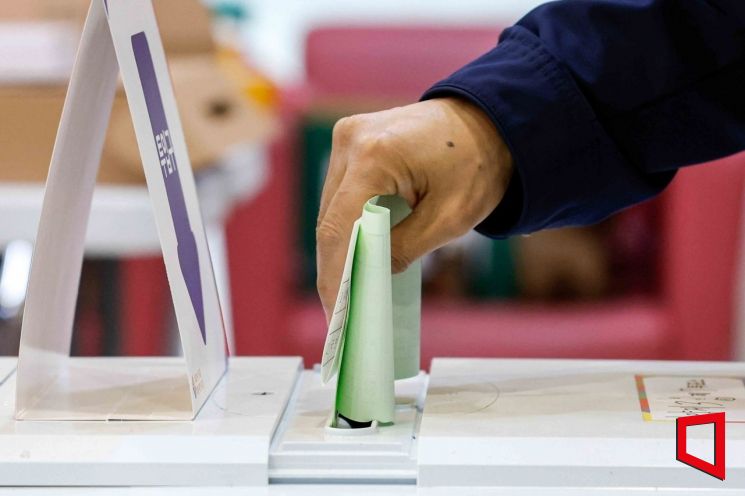 On the 10th, the 22nd National Assembly election day, voters visited the 7th polling station in Jayang 3-dong, Gwangjin-gu, Seoul, to cast their votes. Photo by Jinhyung Kang aymsdream@
Excluding the 6th to 8th general elections, this is expected to be the first case where no independent candidates were elected. Among the 21 National Assembly elections held so far, the highest number of independents elected was in the 2nd general election, where independents won 124 out of 204 seats, a majority. In the 1st general election held in 1948 to form the Constituent Assembly, 85 out of 200 inaugural members were independents. In the 3rd general election, which elected 202 members, no party other than the Liberal Party, which held 110 seats, surpassed the number of independents (70).
Since then, the number of independents elected has decreased, with 5 in the 16th general election and 2 in the 17th general election in the 2000s. However, in the 18th general election, due to internal conflicts over nominations in the then-Hannara Party, many pro-Park faction members left the party and ran as independents, resulting in 25 independents being elected.
The number dropped again to 3 in the 19th general election, but in the 20th general election, as the two-party structure fractured, 11 independents were elected. In the 21st general election, candidates Hong Jun-pyo, Kwon Seong-dong, Yoon Sang-hyun, and Kim Tae-ho were elected by emphasizing individual merit after protesting their nomination cutoffs. Lee Yong-ho, who was elected as a candidate of the People's Party in Jeonbuk Namwon-Imsil-Sunchang in the 20th general election, also ran as an independent and was elected in the 21st general election.
© The Asia Business Daily(www.asiae.co.kr). All rights reserved.

















