The World Trade Organization (WTO) forecasted that the global merchandise trade growth rate this year will be 2.6%, which is 0.7 percentage points lower than the estimate made in October last year. It also pointed out that geopolitical risks and uncertain economic outlooks are causing significant downside risks.
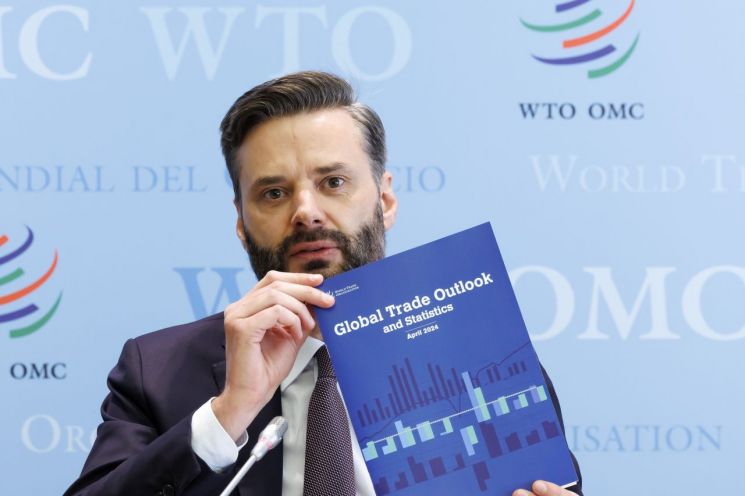
On the 10th (local time), the WTO, through its annual report "World Trade Outlook and Statistics," predicted that after a 1.2% decline in merchandise trade last year, growth rates of 2.6% this year and 3.3% next year are expected. The WTO explained, "Inflationary pressures are easing this year, leading to a rise in real incomes, especially in advanced economies, which will stimulate consumption of manufactured goods."
The decline in merchandise trade last year was primarily attributed to high inflationary pressures and high interest rates. Ralph Ossa, WTO Chief Economist, appeared on CNBC and noted, "The normalization of monetary policy to reduce inflation disrupted merchandise trade last year," highlighting that Europe experienced weakness regionally. However, the WTO's assessment is that as inflationary pressures ease, signals of export recovery continue, such as the rise in new export orders this year.
Regionally, Africa is expected to show the most notable export growth this year, with a 5.3% increase compared to the previous year. The Commonwealth of Independent States (CIS), a group of former Soviet Union countries, is also projected to grow by 5.3%, although the deterioration of its base following the Ukraine war must be considered. North America (3.6%), the Middle East (3.5%), and Asia (3.4%) are all expected to experience moderate export growth. Europe is estimated to have relatively weaker growth at 1.7% compared to other regions.
Despite the global trade rebound this year, the WTO also pointed out ongoing downside risks such as geopolitical risks and economic outlook uncertainties. The 2.6% trade growth rate presented this time is 0.7 percentage points lower than the estimate given in October last year.
The WTO stated, "Geopolitical tensions and policy uncertainties may limit the scope of the trade rebound," adding, "Although the economic impact of conflicts originating in the Middle East has so far been relatively limited, some sectors such as automotive products, fertilizers, and retail have already been affected by transportation delays and increased costs."
In particular, the WTO warned that if the war between Israel and the Palestinian armed group Hamas severely impacts the energy market, it could cause serious trade disruptions. Additionally, the WTO noted signs of trade fragmentation along geopolitical lines worldwide. Bilateral trade between the United States and China, which reached a record high in 2022, sharply froze last year. Moreover, this year, several elections that could affect global trade policies, including the upcoming U.S. presidential election in November, will be held consecutively.
WTO Director-General Ngozi Okonjo-Iweala stated in a press release, "We are making progress toward the recovery of global trade," but also emphasized, "Mitigating risks such as geopolitical conflicts and trade fragmentation is essential to maintaining economic growth and stability."
© The Asia Business Daily(www.asiae.co.kr). All rights reserved.

















