2014 Mummy Discovered and Analyzed in Cheongdo, Gyeongbuk
National Daegu Museum Publishes Report Containing Related Details
"Will Greatly Help Understand the Environment at That Time"
The owner of the mummy discovered in 2014 was identified as a man who died 382 years ago. Additionally, several clues that allow estimation of his life, such as the food he ate, were confirmed, drawing attention.
This information was published in the research report titled “Costumes Excavated from the Tomb of Lee Jing of the Goseong Yi Clan in Cheongdo-gun, Gyeongsangbuk-do,” released by the National Daegu Museum on the 10th.
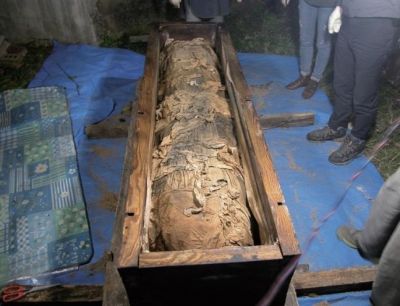 Mummy discovered in 2014 in Cheongdo-gun, Gyeongsangbuk-do [Image source=Provided by National Daegu Museum]
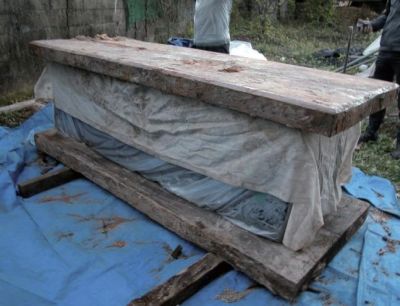
The tomb is a hoegwakmyo (灰槨墓), a lime-lined coffin tomb created to protect the coffin, and was discovered in October 2014 during the relocation of a tomb belonging to the Goseong Yi clan in Cheongdo-gun, Gyeongsangbuk-do. The tomb’s owner was identified as Lee Jing (1580?1642), a descendant of Dosagong of the Goseong Yi clan.
Inside the coffin was a body tightly wrapped in various fabrics, dressed in a quilted jeogori, dopo, jeoksam, hansam, and beoseon. The remains were immediately sealed and transported to Seoul National University College of Medicine, where they underwent computed tomography (CT) scans, deoxyribonucleic acid (DNA) analysis, and stable isotope analysis.
During the process of recovering the clothing worn by the deceased, a manuscript measuring 43 cm wide and 36 cm long with writing arranged in four rows was found. Curator Daeyoung Jeong preserved and analyzed it, interpreting the text as stating that “Lee Jing, born in the year of Gyeongjin (1580), residing in Suya-ri north of Cheongdo-gun, Gyeongsang Left Province of Joseon, died on the 6th day of the 11th lunar month in the year of Imo (1642) on the day of Imshin.”
The height of Lee Jing was confirmed to be 165.1 cm in the mummified state. This exceeds the average height of Joseon-era men from the 15th to 19th centuries, which was 161.1 ± 5.6 cm. Professor Jongha Hong of Kyung Hee University’s Institute of Korean Ancient History and Archaeology explained in the report that “when a living body becomes a mummy, the skin and muscles contract, causing the height to decrease,” adding, “the height during life was likely taller, and his nutritional status was probably good.”
It was also found that he was infected with a total of four types of parasites, including soil-transmitted parasites that infected more than half of Joseon people, as well as lung flukes and liver flukes. CT scans revealed a mass measuring 22.75 mm by 23.06 mm in an area presumed to be the liver, which is believed to have developed due to lung flukes invading the liver, leading researchers to conclude that the deceased suffered from Paragonimiasis. Professor Hong added, “This indicates that the deceased consumed freshwater fish and freshwater crustaceans such as crayfish raw, in addition to agricultural products.”
Meanwhile, the report also includes the results of preservation and analysis of 117 artifacts excavated from the tomb. These include the burial clothes worn by the deceased at the time of death, such as supui (襲衣), somnyeomui (小殮衣), daenyeomui (大殮衣), and bogongui (補空衣), which fills the inside of the coffin to prevent movement of the deceased.
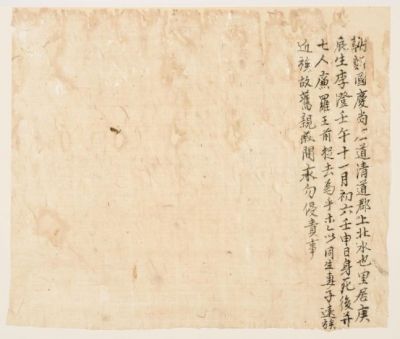 Information about the deceased written on a wooden tablet
 Photo courtesy of the National Daegu Museum
The report also contains explanations about the types of clothing and the order of dressing used in the mortuary rituals, as well as funeral items, including a bundle of papers repeatedly inscribed with the Chinese character ‘su’ (水, water), three pairs of beoseon found overlapping in different directions, and pouches containing the deceased’s fingernails, toenails, and teeth.
The museum evaluated that “this will be a great help not only in securing materials for the study of male clothing from the late 16th to early 17th century Joseon period but also in understanding the sociocultural environment of the time.” The report is available on the museum’s website.
© The Asia Business Daily(www.asiae.co.kr). All rights reserved.



















