'Semiconductor Issue Review Meeting' Hosted
"The Future of the Semiconductor Industry Depends on AI"
1.4 Trillion KRW Fund Established for AI Semiconductor Companies
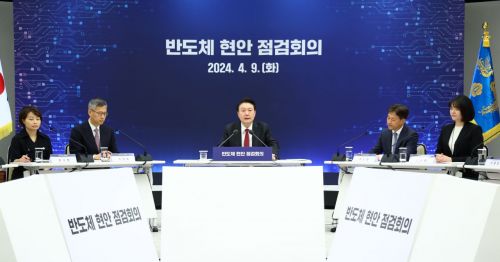 President Yoon Suk-yeol is speaking at the semiconductor issue review meeting held on the 9th at the Yongsan Presidential Office building in Seoul. [Image source=Yonhap News]
President Yoon Suk-yeol announced on the 9th that "9.4 trillion won will be invested in the fields of artificial intelligence (AI) and AI semiconductors by 2027, and a fund worth 1.4 trillion won will be established to support the growth of innovative AI semiconductor companies." He also stated, "Semiconductor competition is an 'industrial war' and a 'total national effort,'" adding, "To establish a total response system equivalent to wartime conditions, the government will conduct a comprehensive review of investment incentives for attracting the semiconductor industry."
Amid large-scale support from the United States and Japan to Taiwan's TSMC, the world's largest foundry (semiconductor contract manufacturing) company, South Korea intends to implement bold support measures for domestic companies to compete globally. In particular, the government plans to establish a 'National AI Committee' directly under the president and accelerate the creation of the world's largest semiconductor mega cluster worth 622 trillion won, aiming to increase the global system semiconductor market share to over 10% by 2030.
On the morning of the same day, President Yoon presided over a 'Semiconductor Issue Review Meeting' at the Yongsan Presidential Office, stating, "Just as we dominated the world with memory semiconductors over the past 30 years, we will write a new semiconductor legend with AI semiconductors for the next 30 years," and "We will leap to become one of the G3 (the three major countries) in AI technology." He emphasized, "We will comprehensively compare and analyze the investment environments and support systems of major countries and prepare bold support measures tailored to South Korea's circumstances."
Yoon: "Prepare Bold Support Measures Tailored to Korea's Circumstances"
The meeting was convened to review recent global semiconductor supply chain trends following partial shutdowns at TSMC and to discuss the progress of the semiconductor mega cluster initiative and AI semiconductor initiatives announced at the 3rd Public Livelihood Forum in January.
In his opening remarks, President Yoon evaluated, "The semiconductor market, which accounts for 19% of our exports, is now recovering, revitalizing the entire industry including industrial production and facility investment." He noted that although the impact of the partial shutdown of TSMC's semiconductor lines due to the Taiwan earthquake has not been significant yet, the future situation is unpredictable, so thorough preparation without any gaps is necessary.
President Yoon said, "The Office for Economic Policy Coordination and the Office for Economic Security, together with the National Intelligence Service, are closely monitoring the situation in Taiwan," and urged, "If government action is required, please respond immediately without delay to ensure no inconvenience to companies."
US, Japan, and Europe Building Their Own Semiconductor Supply Chains... "Falling Behind Will Be Difficult"
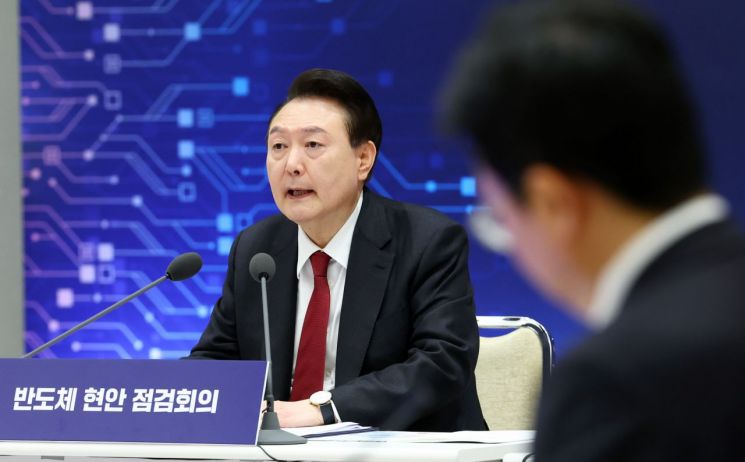 President Yoon Suk-yeol is speaking at the semiconductor issue review meeting held on the 9th at the Yongsan Presidential Office building in Seoul. [Image source=Yonhap News]
President Yoon pointed out, "Especially due to the recent Taiwan earthquake, the US, Japan, and Europe will accelerate the establishment of their own semiconductor supply chains," adding, "If South Korea falls behind this trend, not only the semiconductor industry but the entire economy will face great difficulties in advancing."
He then reviewed the infrastructure construction status for the world's largest semiconductor mega cluster worth 622 trillion won announced at the 3rd Public Livelihood Forum, including power, water supply, housing, and transportation, and urged relevant ministries to ensure smooth follow-up measures.
President Yoon promised that the government would take responsibility for supplying essential electricity and industrial water for the semiconductor mega cluster, starting with the groundbreaking of the Yongin National Industrial Complex by 2026. He also stated plans to accelerate procedures such as environmental impact assessments and land compensation, which usually take a long time, by more than twice the speed to complete them more than halfway ahead of schedule. He said, "We finalized the power supply plan in December last year to meet the power demand of over 10GW (gigawatts)," and added, "To build power infrastructure without disruption according to companies' investment schedules, legal support is also necessary. We will strive for the prompt passage of the 'Special Act on Expansion of National Power Grid,' which is currently pending in the National Assembly."
He further announced, "The pipeline stretching 48 km from Paldang Dam to Yongin will begin installation soon, as it was exempted from the preliminary feasibility study in February." Regarding living infrastructure, he explained that the semiconductor highway will complete the private investment eligibility review by this year, and the recently opened GTX-A (Great Train Express) line will open an additional Guseong Station in June.
Moreover, President Yoon evaluated, "The semiconductor market has recently shifted its focus rapidly to 'AI semiconductors,'" and said, "AI is a foundational technology that changes not only industry but society, and it can be called a tremendously powerful game changer." He mentioned that it is no exaggeration to say that the future of the semiconductor industry depends on AI and emphasized, "We must meticulously review strategies to secure early leadership for South Korea in the future semiconductor market landscape."
President Yoon stated, "Few countries possess both hardware manufacturing and software development and utilization capabilities," and declared, "We will promote the AI semiconductor initiative to leap to the G3 in AI technology and dominate the future AI semiconductor market beyond memory semiconductors." He explained, "First, we will boldly expand R&D investment in next-generation high-bandwidth memory (P-HBM) that adds processing functions to high-bandwidth memory (HBM), neural processing units (NPU), and Korean-style AI semiconductors based on neuromorphic technology," adding, "By applying Korean-style low-power, high-performance AI semiconductors, we will evolve the supercomputing data center K-Cloud and lead the global market with stand-alone smart devices that can be used without PC or smartphone connections by applying on-device AI."
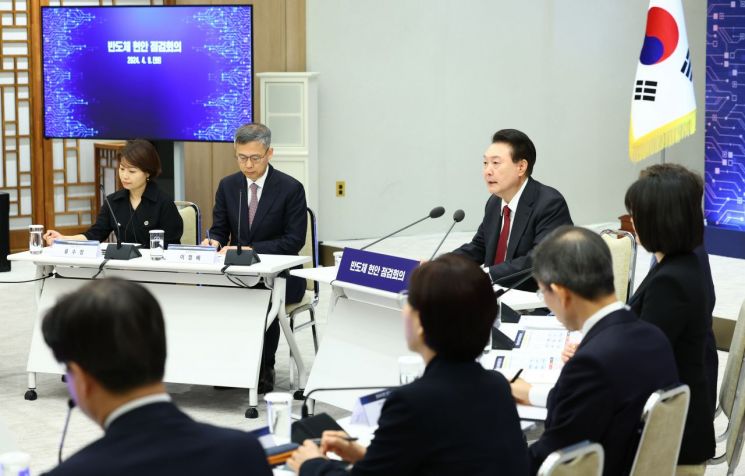 President Yoon Suk-yeol is speaking at the semiconductor issue review meeting held on the 9th at the Yongsan Presidential Office building in Seoul. April 9, 2024. Photo by the Presidential Office Press Photographers Group. [Image source=Yonhap News]
Establishment of 'National AI Committee'... "Will Personally Oversee"
President Yoon emphasized, "We will lead the development of AI technology responsibly and explainably through the development of next-generation general-purpose AI core technologies that overcome the limitations of existing generative AI and AI safety technologies." He added that public-private cooperation is important and announced the future establishment of the 'National AI Committee.' He said, "The AI Strategy High-Level Council was launched on the 4th, and this council will be elevated to the National AI Committee, which I will personally oversee."
President Yoon also pledged to continue securing global leadership in AI ethics standards. Through the successful hosting of the 'AI Seoul Summit' in May this year, which will discuss AI safety, innovation, and inclusion, South Korea plans to solidify its global leadership in AI ethical standards.
He urged, "I ask everyone to keep running without pause until the day South Korea writes the second act of the K-semiconductor legend with AI semiconductors and becomes an AI G3 based on this," adding, "I will run alongside you and support you with all my strength."
During the subsequent discussion, major companies in the semiconductor sector and ministers from related ministries engaged in in-depth discussions on topics such as the global semiconductor supply chain, semiconductor clusters, and AI semiconductors.
Lee Jung-bae, President of Samsung Electronics' DS Division, proposed, "It is urgent to introduce active support policies such as investment incentives so that semiconductors, the backbone of our economy, can secure cost competitiveness and South Korea can become a semiconductor hub nation." Kwak No-jung, CEO of SK Hynix, emphasized, "To preoccupy the global AI-semiconductor market, the government needs to implement active subsidy policies to encourage more investment not only from Korean companies but also from foreign companies investing domestically."
Regarding the groundbreaking of the Yongin National Industrial Complex, Park Sang-woo, Minister of Land, Infrastructure and Transport, said, "Typically, it takes about seven years from site selection to groundbreaking for industrial complexes, but we plan to reduce this to half, 3.5 years, and start site groundbreaking construction by 2026." Han Hwa-jin, Minister of Environment, explained about environmental impact assessments, "Environmental impact assessments for large-scale national industrial complexes usually take more than a year, but we will complete the Yongin National Industrial Complex within six months promptly."
Choi Sang-mok, Deputy Prime Minister and Minister of Economy and Finance, stated, "We will extend the tax credit for national strategic technology investments, which was set to expire this year, to continue tax support," and regarding supply chain risks including semiconductors, he said, "We will establish a fund worth 5 trillion won to ensure a stable and competitive supply chain."
Choi Soo-yeon, CEO of NAVER, requested, "Please help our companies secure core source technologies such as next-generation and challenge-type AI R&D so they can compete with global big tech companies." Ryu Soo-jung, CEO of Sapeon Korea, evaluated, "If we leverage our excellent memory semiconductor competitiveness well, we can also lead the low-power AI semiconductor market."
Yoon: "Applying Old Regulations Is Like Running with Lead Attached"
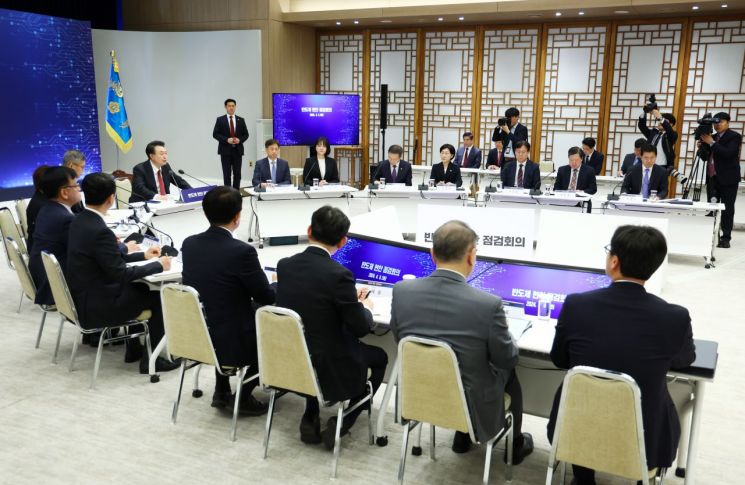 President Yoon Suk-yeol is speaking at the semiconductor issue review meeting held on the 9th at the Yongsan Presidential Office building in Seoul. [Image source=Yonhap News]
After the discussion, President Yoon, in his closing remarks regarding supply chain concerns caused by the Taiwan earthquake, ordered, "The Ministry of Trade, Industry and Energy should take the lead in thoroughly analyzing the market and supply chain impacts and share the results with our semiconductor companies." Regarding the semiconductor mega cluster creation, he said, "Speed is the most important. When carrying out national core strategic projects, regulations must be applied flexibly. We must not be bound by dogma," and criticized, "Applying regulations made long ago that do not fit the current industry and economic situation is like running with lead attached."
He continued, "While foundries are important for AI semiconductors, nurturing fabless companies is also crucial," emphasizing, "Just as universities build libraries for shared use, establishing shared system infrastructure to help small and medium fabless companies grow is as important as investing in R&D in individual fields."
President Yoon assessed, "AI is a core technology related to security, and international cooperation is not easily achieved in this field," and mentioned, "To lead international cooperation in this area, the government and the president must take direct action." He also expressed his willingness to personally engage in diplomatic activities if informed of what is needed to strengthen global cooperation.
He ordered relevant ministries, "Through the newly established National AI Committee directly under the president, set priorities for national financial support and identify obstacles such as regulations," and urged, "Let's organize the committee and hold a meeting as soon as possible."
Attendees at the meeting included Lee Jung-bae, President of Samsung Electronics; Kwak No-jung, CEO of SK Hynix; Choi Soo-yeon, CEO of NAVER; Ryu Soo-jung, CEO of Sapeon Korea from the private sector; and from the government, Deputy Prime Minister and Minister of Economy and Finance Choi Sang-mok; Minister of Trade, Industry and Energy Ahn Deok-geun; Minister of Science and ICT Lee Jong-ho; Minister of Environment Han Hwa-jin; Minister of Land, Infrastructure and Transport Park Sang-woo. From the Presidential Office, Chief of Staff Lee Kwan-seop, Policy Chief Sung Tae-yoon, Senior Secretary for Economic Affairs Park Chun-seop, and Senior Secretary for Science and Technology Park Sang-wook also participated.
© The Asia Business Daily(www.asiae.co.kr). All rights reserved.



















