State Council Explains Consumer Rights Protection Law Ordinance
Granting Consumers the Right to Terminate Contracts
The Chinese government has taken decisive action to prevent so-called 'meoktwi' damage, where businesses induce prepaid payments and then close down. In response to the frequent silent closures and disappearances of various commercial facilities such as academies, gyms, and beauty salons following the post-Zero COVID recession, relevant countermeasures have been established. This issue, which has long been recognized as needing regulation in China where a prepaid culture is active?paying in advance to receive various benefits and deducting usage accordingly?has now been addressed.
On the 9th, the State Council of China announced at a regular policy briefing the "Regulations on the Implementation of the Consumer Rights Protection Law of the People's Republic of China," which will take effect on July 1. The related provisions consist of 7 chapters and 53 articles, covering supervision of new types of businesses such as live commerce, big data processing, and strengthening protection of prepaid consumption.
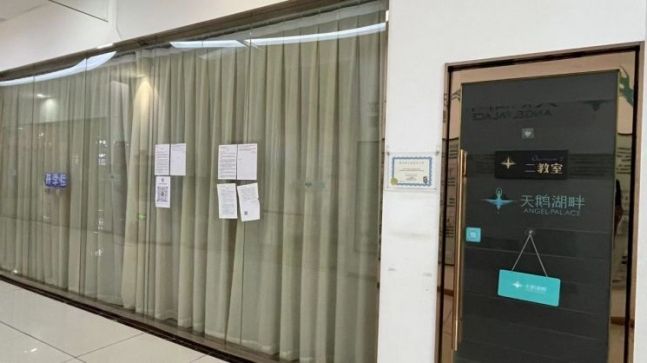 On the third floor of a large shopping mall located in Wangjing, Chaoyang District, Beijing, a closure notice, an apology letter from the business owner, and a notice of class resumption at some branches are posted side by side on the door of a closed ballet academy. This academy suddenly shut down at the end of last year and became the subject of disputes for not refunding prepaid fees. (Photo by Kim Hyunjung)
At the briefing, Kuangxu, Director of the Law Enforcement Inspection Bureau of the State Administration for Market Regulation, emphasized, "Prepaid consumption is a business model related to all industries, and the relevant administrative governments must strengthen supervision in their respective fields, investigate and punish illegal acts, and handle consumer complaints."
Although the related content was already disclosed last month, this briefing provided more detailed information regarding prepaid meoktwi. China’s Yicai Global assessed that the new regulations further strengthen operators' obligations in three aspects.
First is the obligation of a 'written contract.' Businesses must specify the detailed content and price of goods and services, fees, methods of refunding prepaid amounts, responsibilities in case of contract breach, and other matters, and conclude a written contract with consumers. The purpose is to reduce difficulties in proving consumer rights protection.
The second is the strengthened obligation of 'fulfillment of promises.' Businesses must provide goods and services as contracted and must not arbitrarily lower service quality or raise prices later. If services and goods are not provided as agreed, businesses must refund the prepaid amount upon consumer request. They may also have to return penalties for contract breaches in addition to the remaining prepaid balance. This regulation grants consumers the right to terminate contracts for the first time.
Lastly, there is the obligation of 'business notification.' Business owners must stop collecting prepaid funds if there is a significant business risk, and if they decide to close or relocate their business, they must notify consumers in advance and either continue fulfilling obligations or refund the remaining prepaid balance. Even if the business owner is not subjectively at fault, consumers are granted the right to terminate the contract.
© The Asia Business Daily(www.asiae.co.kr). All rights reserved.
![Clutching a Stolen Dior Bag, Saying "I Hate Being Poor but Real"... The Grotesque Con of a "Human Knockoff" [Slate]](https://cwcontent.asiae.co.kr/asiaresize/183/2026021902243444107_1771435474.jpg)
















