Declaration Announcing Recognition of Whale Legal Personhood
"Rights Such as Movement and Individual Restoration Must Be Legally Protected"
Indigenous leaders from the Pacific Island region have granted whales human-like rights to protect them. The British daily The Times reported on the 8th (local time) that 15 indigenous leaders from the Maori king of New Zealand in the South Pacific, as well as from Tahiti, the Cook Islands, and other Eastern Polynesian islands in the Pacific, signed a declaration last week recognizing the legal personhood of whales (the qualification to be a subject of rights and duties).
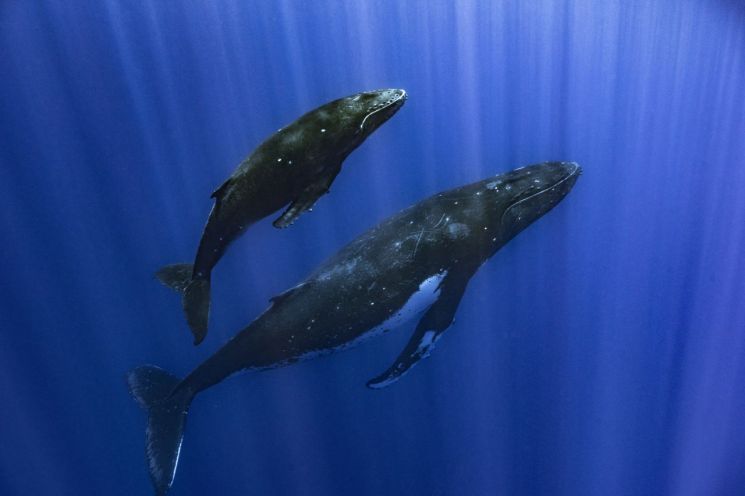 The British daily The Times reported on the 8th (local time) that 15 indigenous leaders, including the Maori king of New Zealand in the South Pacific and leaders from the eastern Polynesian islands such as Tahiti and the Cook Islands, signed a declaration last week recognizing the legal personhood of whales (Legal personhood: the qualification to be a subject of rights and duties).
 [Photo by AP·Yonhap News]
Through the declaration, they stated their intention to legally protect the rights of whales, including "freedom of movement, cultural expression including language, a healthy environment, healthy seas, and the restoration of whale populations." For this declaration to be effective, government-level support is necessary. Environmentalists believe that indigenous peoples will use this declaration to lobby governments of relevant countries such as New Zealand to strengthen whale protection measures.
Relalei Relaulu, chairperson of the Earth Council Alliance (ECA), a non-governmental organization (NGO), evaluated in an interview with New Zealand Radio that this declaration is very important for global whale conservation. He said, "I think it will accelerate actions in other parts of the world," adding, "The Eastern Polynesians of the Pacific were guided by whales to their current home islands. There is a very strong spiritual and metaphysical bond with whales."
Earlier, around November last year, Jeju Island also promoted the institutionalization of an 'Ecological Corporation' granting legal personhood to the endangered and internationally protected species, the Indo-Pacific humpback dolphin. An ecological corporation is a system that grants legal personhood to entities other than humans that have significant ecological value. Although unfamiliar domestically, there are already several cases overseas recognizing the legal rights of nature.
In 2008, Ecuador became the first in the world to codify 'rights of nature' in its constitution, and in 2011, Bolivia enacted the 'Mother Earth Law' recognizing the legal rights of nature. In 2014, an Argentine court recognized an orangutan named 'Sandra' held in a zoo as a 'non-human person.' In 2016, Colombia's Constitutional Court recognized the legal rights of the Atrato River, and in 2018, the Supreme Court recognized the legal rights of the Amazon region within Colombia. In 2017, New Zealand granted legal personhood to the Whanganui River. The Maori people of New Zealand fought for 160 years to grant legal personhood to the Whanganui River.
© The Asia Business Daily(www.asiae.co.kr). All rights reserved.

















