<여대야소 vs 여소야대 따라 달라지는 국회
When the Ruling Party is the Majority, Yoon Administration Secures Governance Momentum
When the Opposition Holds Majority, Reform Legislative Agenda Advances Reflecting Public Will
D-1 before the April 10 general election. As razor-thin electoral districts continue to emerge mainly in the metropolitan area, neither the ruling nor opposition parties can guarantee the election results. It is expected that the 22nd National Assembly will also be reshaped depending on the election outcomes of both parties.
On the 9th, the ruling party appealed to maintain the constitutional amendment blockade line, and in political circles, there is a strong possibility that opposition parties such as the Democratic Party of Korea will secure a majority of seats. Some speculate that if the opposition, led by the ‘regime judgment theory,’ wins overwhelmingly and the combined seats of opposition parties including the Joguk Innovation Party exceed 180, they could secure more than 180 seats. However, since many electoral districts remain extremely competitive and negative factors involving Democratic Party candidates Yang Moon-seok and Kim Jun-hyuk have emerged consecutively near the end of the election, there is still a prospect that the ruling party could overturn public expectations and become the largest party in the National Assembly. Significant changes in legislation and other areas are anticipated depending on the election results of both parties.
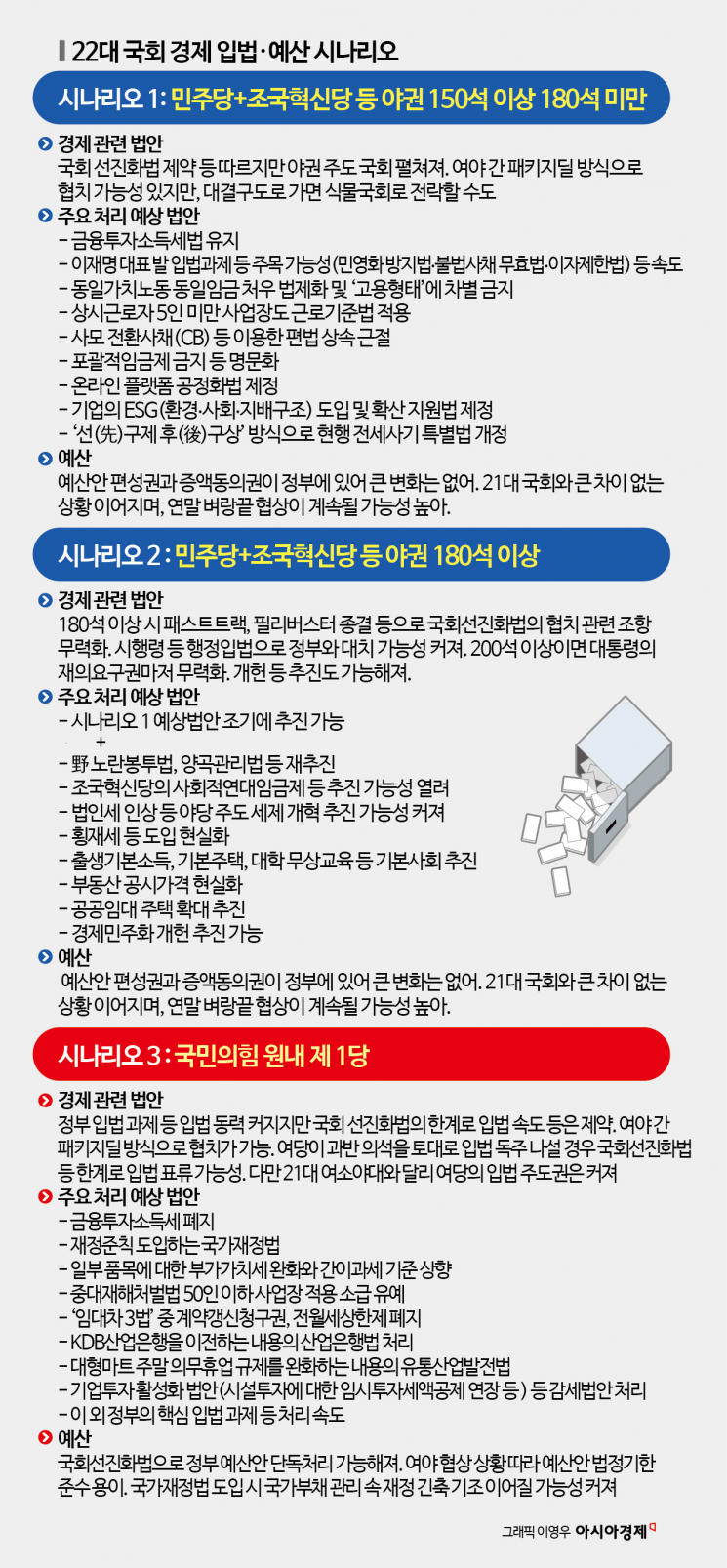
If the opposition wins a majority
If the opposition officially secures more seats than their election target, they are likely to launch a legislative offensive against the government, leveraging public opinion. However, the opposition’s seats are still constrained by the president’s veto power, unlimited debate (filibuster), and the agenda adjustment committee under the National Assembly Advancement Act, making opposition-led legislation likely to be stalled for a long time. Conflicts are expected to arise from the outset over which side will control key committees such as the Legislation and Judiciary Committee during the formation of the National Assembly. If relations between the ruling and opposition parties escalate into confrontation, making cooperation difficult, the government is likely to seek to manage state affairs through administrative legislation such as presidential decrees.
Legislation that the opposition is expected to prioritize includes laws that have been delayed despite being major legislative tasks in regular sessions, such as the public enterprise privatization prevention law, the illegal private loan nullification law, and the interest rate restriction law, all led by Democratic Party leader Lee Jae-myung. Although these laws were officially Democratic Party policies, there have been internal disagreements. However, as Lee’s leadership has solidified through nomination controversies, legislative momentum is expected to be stronger than ever. Additionally, the opposition is likely to push for the enactment of the online platform fairness law and amendments to the special law on jeonse fraud, which have been long-standing Democratic Party goals.
Moreover, the opposition may pursue other election pledges and issues related to public welfare raised during the 21st National Assembly. The Democratic Party has promised to enact the online platform fairness law and laws supporting the introduction and expansion of corporate ESG (environmental, social, and governance) practices. Who will become the Speaker of the National Assembly is also a matter of interest. Traditionally, the largest party has held the Speaker position, which is politically neutral to the extent that the Speaker is required to be nonpartisan. However, if a pro-opposition Speaker emerges regardless of party affiliation, the political situation could become turbulent.
If the opposition secures more than 180 seats
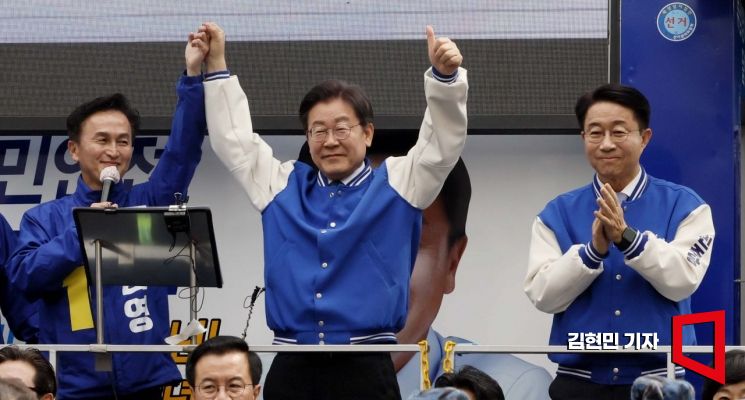 Lee Jae-myung, leader of the Democratic Party of Korea, is campaigning in support of candidate Ryu Sam-young at the entrance of Namseong Sagye Market in Dongjak-gu, Seoul on the 8th. Photo by Hyunmin Kim kimhyun81@
If the opposition secures more than 180 seats, the constraints of the opposition’s National Assembly Advancement Act will be lifted, making it possible for the opposition to dominate legislation. If the opposition seats do not exceed 200, the government and ruling party are expected to respond with maximum delay tactics and the president’s veto power.
In response, the opposition is expected to launch legislative offensives by reintroducing bills previously blocked by vetoes, such as the partial amendment to the Labor Union and Labor Relations Adjustment Act (Yellow Envelope Act) and the Grain Management Act. Especially as the political situation intensifies due to leader Lee’s judicial risks, the opposition is likely to engage in confrontations based on legislative power. Other possible legislative initiatives include the introduction of windfall taxes and basic income related bills. Economic legislation is expected to be a major point of contention, with the government advocating fiscal soundness and the opposition emphasizing the need for expansionary fiscal policy. Accordingly, there is a possibility of the opposition pushing for tax reforms such as corporate tax increases. The opposition is also expected to be more aggressive in motions for dismissal and impeachment petitions. During the election campaign, calls for "removal" or "impeachment" were not uncommon.
Particularly noteworthy is the possibility that the Joguk Innovation Party and others could become a negotiating group. The Joguk Innovation Party is expected to secure around 10 seats in this election but has a path to become a negotiating group. The Democratic Party has opened the possibility of easing the requirements for forming negotiating groups. Currently, the threshold is 20 seats, but the law may be amended to allow multiple negotiating groups to emerge. Typically, the emergence of a third negotiating group leads to a negotiation phase in the National Assembly, but if the Joguk Innovation Party becomes a negotiating group, the ruling party’s negotiating power will be significantly weakened.
Joguk Innovation Party leader Jo Guk also stated, "We can maintain order among minority parties and form a joint negotiating group." If the criteria for negotiating groups are lowered or a coalition negotiating group among minority parties is formed, a new National Assembly situation could arise with a negotiating group more progressive than the Democratic Party.
If the People Power Party becomes the largest party
If the People Power Party secures a majority of seats in the National Assembly or at least becomes the largest party without a majority, the government and ruling party will gain the power to push forward reform agendas.
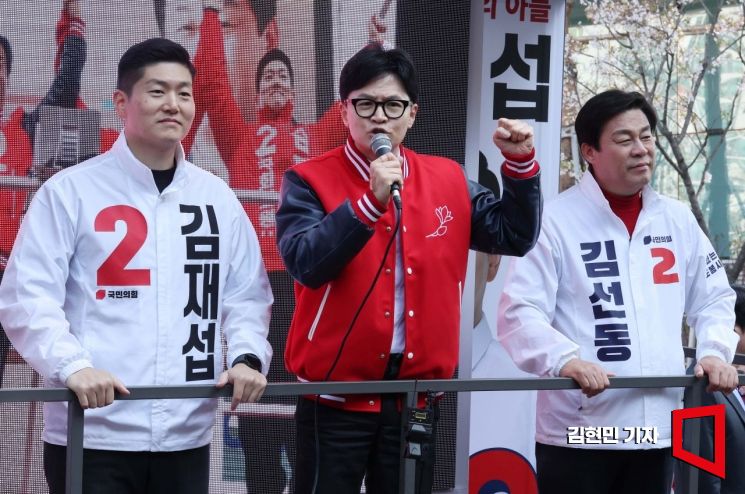 Handonghun, Emergency Response Committee Chairman and General Election Countermeasures Committee Chairman of the People Power Party, is appealing for support in front of Changdong Station, Dobong-gu, Seoul on the 9th. Photo by Hyunmin Kim kimhyun81@
In the 21st National Assembly, the ruling party was criticized for being passive in legislation, but the situation could change if a majority ruling party and minority opposition scenario unfolds. The ruling party could push for the abolition of the financial investment income tax, the introduction of fiscal rules in the National Finance Act, and retroactive exemption of the Serious Accident Punishment Act for workplaces with fewer than 50 employees, among others. They could also pursue deregulation reform legislation aimed at economic revitalization.
The opposition is likely to counter with confrontation using the National Assembly Advancement Act. However, if the opposition suffers defeat in both the presidential and general elections, the intensity of their offensive is expected to decrease significantly, making it easier for the government and ruling party to secure reform momentum.
Meanwhile, the budget review process is also expected to change. Budget reviews, which had been delayed until the end of the year, are likely to follow a completely different pattern, enabling compliance with legal deadlines. Despite the automatic referral clause of the National Assembly Advancement Act, budget bills were processed late due to the minority ruling party and majority opposition situation. The government and ruling party have held budget formulation and increase approval rights, while the opposition has held budget review rights, leading to confrontation. However, if the ruling party wins the election, it will be able to process budgets and tax laws without opposition cooperation.
© The Asia Business Daily(www.asiae.co.kr). All rights reserved.



















