If Ruling Party Secures Majority, 'Yoon's Three Major Reforms' Legislation Will Flood In
Policy Shift Inevitable If Minority Rule Continues
If Fierce Confrontation Between Ruling and Opposition, Remaining Term Also a 'Lame Duck Government'
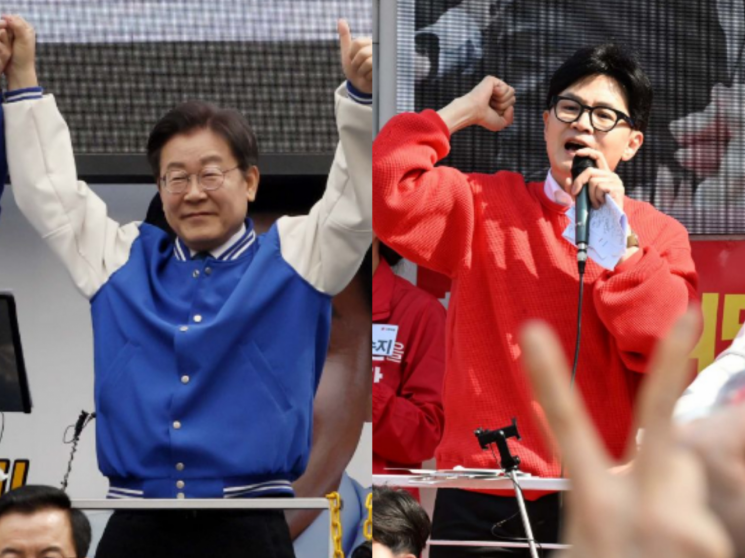 Lee Jae-myung, leader of the Democratic Party of Korea, and Han Dong-hoon, emergency response committee chairman of the People Power Party, campaigning during the election.
The general election that will determine the turning point of the economic reforms promoted by the Yoon Seok-yeol administration is just one day away. If the ruling party secures a majority of seats in the election, a flood of reform bills that the government has been urging the National Assembly to pass is expected. Conversely, if the opposition wins, it will be difficult to pass major legislative agendas, forcing a change in the policy direction that has been emphasized so far.
Among the three major reforms?labor, pension, and education?the labor reform is considered the most influenced by the general election. This is because the two parties have starkly different views on labor reform overall. A representative policy issue is 'working hours.' The government and the ruling party hold the position that working hours should be applied flexibly. Accordingly, they announced a plan to reform the working hours system in March last year, but it was scrapped amid controversy over the '69-hour workweek.' Currently, they are pursuing a plan to apply flexible working hours in certain industries while maintaining the framework of the '52-hour workweek' system.
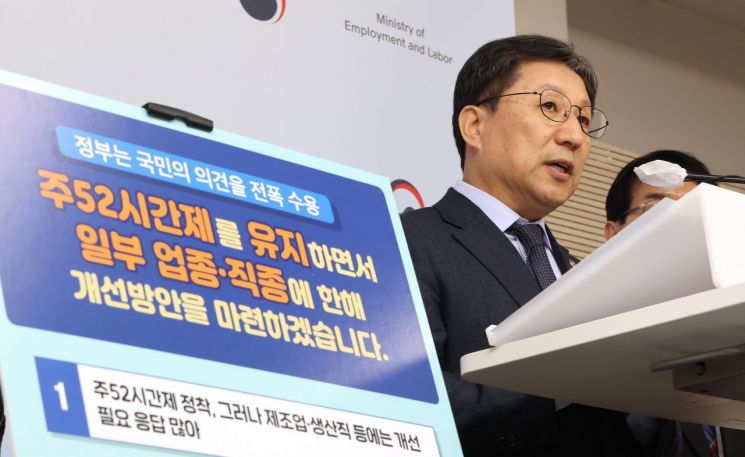 Lee Sung-hee, Vice Minister of Employment and Labor, is announcing the results of a public survey on working hours and future policy directions on the afternoon of November 13 last year at the Government Complex Sejong in Sejong City.
 [Photo by Yonhap News]
However, the opposition strongly criticizes the government and ruling party's working hours policy. Lee Jae-myung, leader of the Democratic Party of Korea, has consistently expressed opposition. In March last year, he said, "There is great public anger against policies that force overwork," and on the 13th of last month, he pointed out, "They are trying to roll back the barely established 52-hour workweek and regress to the 69-hour system." Since matters related to extended working hours involve amendments to the Labor Standards Act, if the opposition becomes the majority party, passing the original bill will be virtually impossible.
There are also differences in stance regarding the introduction of the 'four-day workweek.' Kwon Hyuk-tae, senior expert of the People Power Party, responded to a question about the four-day workweek at a forum held by the Korean Confederation of Trade Unions on the 12th of last month, stating, "Reducing working hours is desirable from the perspectives of protecting health rights and work-life balance," but argued, "Legislation to immediately reduce the statutory working hours (40 hours per week) is unrealistic for both labor and management." On the other hand, Jeong Gil-chae, senior expert of the Democratic Party of Korea, explained, "We have reflected the pledge to reduce working hours below the OECD average by 2030 through corporate support in our general election manifesto."
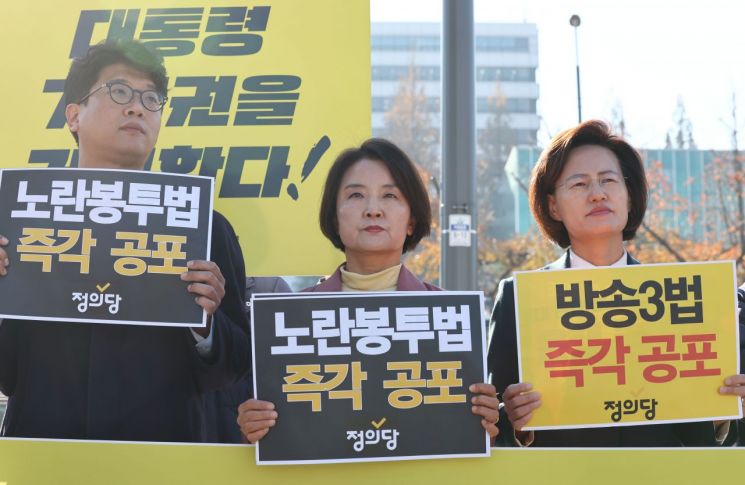 Emergency Response Committee Chair Kim Jun-woo (from left), Representative Lee Eun-joo, and Representative Kang Eun-mi of the Justice Party hold signs at the Justice Party's urgent action press conference urging the immediate promulgation of the Yellow Envelope Act by the president, held in front of the War Memorial in Yongsan-gu, Seoul, on November 21 last year.
 [Image source=Yonhap News]
Depending on the seat situation, labor policies opposed by the government may be passed under the leadership of the National Assembly. If the opposition holds more than two-thirds of the total seats, they could reintroduce the 'Yellow Envelope Act.' The Yellow Envelope Act expands the scope of collective bargaining to include primary contractors and prevents companies from indiscriminately claiming damages due to strikes. Although it passed the National Assembly last year, it failed after President Yoon Seok-yeol exercised his veto power. According to the constitution, if more than half of the total members and two-thirds of the attending members approve, the presidential veto is nullified.
The pension sector is also inevitably strongly influenced by the general election. Currently, pension reform discussions are led not by the government but by the 'National Assembly Special Committee on Pension Reform.' The committee is structured with an equal number of six members each from the Democratic Party and the People Power Party, but depending on the seat situation, the majority party's influence inevitably grows in electing the chairperson, operating the subordinate Pension Public Deliberation Committee, and setting discussion agendas. The Democratic Party has announced in its general election pledge that it will establish a 'National Assembly Public Pension Reform Special Committee' led by the Democratic Party.
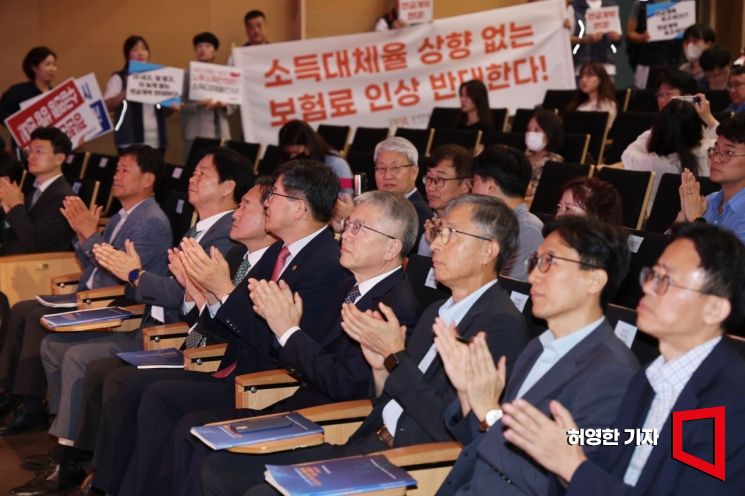 On September 1st last year, at the 5th National Pension Financial Calculation Public Hearing held at COEX, members of organizations such as the Korean Confederation of Trade Unions and People's Solidarity for Participatory Democracy were holding pickets opposing the deterioration of the National Pension, while attendees including the National Pension Financial Calculation Committee members were applauding. Photo by Younghan Heo younghan@
The government and ruling party and the opposition also have different views on pension reform. Since its inception, the government has emphasized 'fiscal stability' in pension reform issues. When the National Pension Fiscal Calculation Committee, a government advisory body, produced a report last year, it included extensive fiscal stabilization measures, leading some opposing scholars to resign from the committee. In contrast, the Democratic Party prioritizes 'income security.' Their election manifesto states pension reform goals such as 'adequate old-age income security' and 'resolving future pension anxiety.'
Each ministry is closely monitoring the election results. Lee Jeong-sik, Minister of Employment and Labor, described this year as the "second phase of labor reform," and Cho Kyu-hong, Minister of Health and Welfare, has also promised to "complete pension reform this year." If the ruling party secures a majority, legislative agendas that have been delayed must be passed swiftly; if the opposition controls the National Assembly, solutions must be found to pass bills during the remaining term. A senior government official said, "There is nothing the working-level ministries can do before the election," adding, "Depending on the legislative environment after the election, the policy direction of the ministries could change significantly."
© The Asia Business Daily(www.asiae.co.kr). All rights reserved.



















