Hanwha Aerospace's 'Arionsmet' Recognized in the US Mainland
Hyundai Rotem's 'HR-Sherpa' Builds Track Record in Rapid Acquisition Project
Domestic defense companies Hanwha Aerospace and Hyundai Rotem are set to compete. The military has decided to introduce multipurpose unmanned vehicles, presenting an opportunity not only for the first domestic contract but also for securing defense exports, leading to intense competition between defense companies.
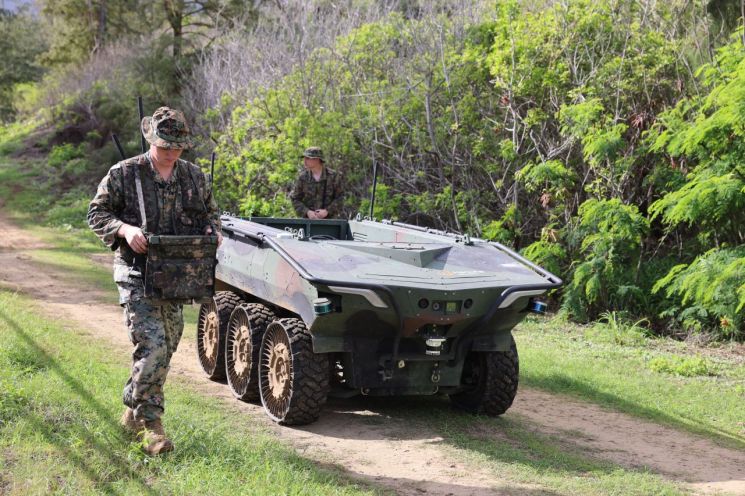
According to the Defense Electronic Procurement System on the 9th, the Defense Acquisition Program Administration (DAPA) will hold a business briefing on the 11th and close bidding by the 2nd of next month. The multipurpose unmanned vehicles will be supplied to the Army and Marine Corps, with a budget of 49.6 billion KRW.
The multipurpose unmanned vehicle is a remote-controlled vehicle weighing under 2 tons that can be equipped and operated with various equipment depending on the mission. It can conduct reconnaissance and surveillance in dangerous areas and provide fire support, enhancing soldier survivability. It is characterized by its versatile use, such as supplying ammunition and combat materials in close combat zones and evacuating casualties during combat.
For a military facing a shortage of manpower resources, additional procurement after deployment is possible. If demand increases, the impact on overseas defense exports will also grow.
This bidding differs from the rapid acquisition pilot project conducted in 2020. In the pilot project, companies submitted a delivery price of '0 KRW' to build delivery records. The evaluation resulted in a tie, and Hyundai Rotem was ultimately selected through a rock-paper-scissors draw, which caused controversy. DAPA plans to proceed with a 'comprehensive evaluation' method, conducting negotiations and test evaluations with participating companies and selecting the winning bidder based on the results.
Hanwha Aerospace's unmanned vehicle is called ‘Arionsmet’. It weighs about 1.8 tons and can carry up to 550 kg of cargo. It has six wheels and is electrically rechargeable, capable of traveling over 100 km on a single charge. Its top speed is 43 km/h on paved roads and 34 km/h on unpaved roads. It is equipped with a ‘smart autonomous return’ function that can recover itself or return to the initial departure point even if remote communication is lost in mountainous terrain. It can optionally be equipped with a Remote Controlled Weapon System (RCWS) that remotely operates 12.7 mm and 7.62 mm machine guns and 5.56 mm rifles as armament.
Hanwha Aerospace has undergone comparative performance testing in the US. In October 2022, it demonstrated the equipment to the US Forces Korea at Camp Humphreys in Pyeongtaek, receiving favorable reviews. Subsequently, in December last year, it conducted overseas comparative performance testing (FCT) at the US Marine Corps training ground in Hawaii, gaining recognition for its performance. The FCT is a test conducted by the US Department of Defense to evaluate excellent technologies from allied defense companies worldwide and link them to US military development and acquisition projects. Hanwha Aerospace’s US subsidiary plans to challenge the US Army’s unmanned vehicle (S-MET) project in the future.
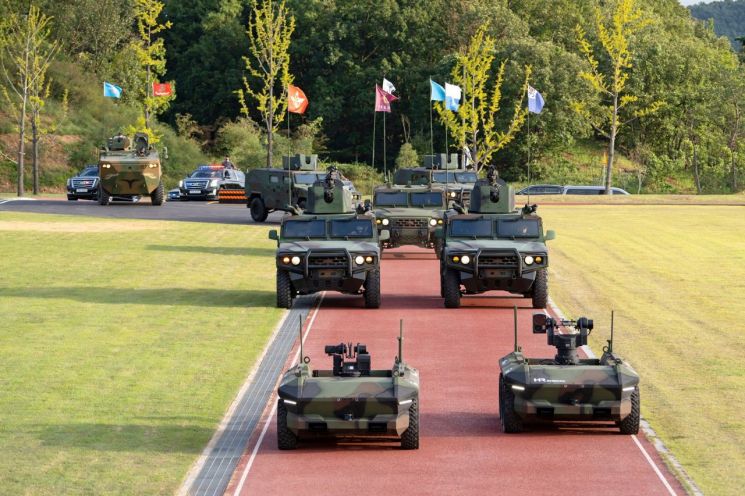 A rehearsal for the 72nd Armed Forces Day ceremony is underway at the Special Warfare Command in Icheon, Gyeonggi Province, using the HR-Sherpa, a multipurpose unmanned vehicle developed by Hyundai Rotem, and wheeled armored vehicles.
 [Image source=Yonhap News]
Hyundai Rotem’s unmanned vehicle is the HR-Sherpa. The HR-Sherpa is a 2-ton class multipurpose unmanned vehicle. It is about the size of a low-height compact car. It is powered by an electric battery and can travel at a maximum speed of 30 km/h on flat terrain and 10 km/h on rough terrain. Its maximum operating time is 12 hours.
It is also equipped with an RCWS. Its capabilities are enhanced to automatically track and fire at targets from a distance. The HR-Sherpa features airless tires, allowing continuous operation without punctures even under enemy attack, and can rotate 360 degrees in place. Notably, each of the six wheels is individually equipped with an in-wheel motor developed by Hyundai Mobis, enabling each wheel to exert independent driving force. This allows the vehicle to continue operating even if one or two wheels are damaged, powered by the remaining wheels. Additionally, it boasts excellent driving capabilities that maximize the advantages of unmanned vehicles, including remote driving, follower driving where the vehicle follows personnel in front, and autonomous route point driving where it explores and moves along a designated path on its own.
© The Asia Business Daily(www.asiae.co.kr). All rights reserved.


















