Seoul District's First Self-Training on Emerging, Reemerging, and Imported Infectious Diseases on the 5th
MERS Outbreak Scenario...Mastering the Sequence from Reporting to Confirmation and Measures
Establishing and Maintaining a Steady Response System in Infectious Disease Crisis
After the outbreak of SARS in 2003, it took 6 years for new influenza and MERS to become widespread, but the occurrence of COVID-19 came 4 years after MERS, shortening the cycle.
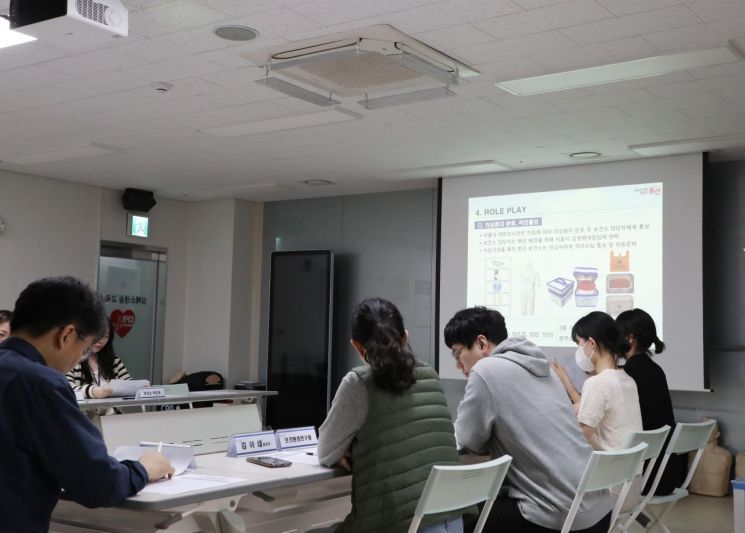
Yongsan-gu, Seoul (District Mayor Park Hee-young) conducted the first infectious disease crisis response simulation training among Seoul's autonomous districts on the 5th at the district health center's cardiopulmonary resuscitation training room (150 Noksapyeong-daero, Basement 1st floor).
This was an internal training to prepare for the increasingly shorter cycles of new, re-emerging, and imported infectious disease outbreaks.
The training was conducted as a discussion-based tabletop exercise based on a scenario involving a suspected case of Middle East Respiratory Syndrome (MERS).
The training scenario included actual roles such as ▲health center staff ▲health center epidemiologists ▲transport personnel ▲Seoul city ▲Korea Disease Control and Prevention Agency, allowing participants to understand the response flow when a suspected infectious disease patient occurs.
Health center employees responsible for infectious disease management and response learned the sequence of ▲recognition of occurrence and reporting ▲basic epidemiological investigation ▲reporting and patient classification ▲patient transport and specimen request ▲confirmation and follow-up measures.
During the training, the process of putting on and taking off personal protective equipment was demonstrated, and improvements and supplements to the overall response process were reviewed together. A district official stated, “We were able to clearly understand roles and responsibilities in actual situations and explore effective response system measures.”
The district also revised related forms to enable systematic response even in the event of new infectious disease outbreaks. Continuous communication and reporting without gaps are essential even during personnel transfers or when responsible staff are absent. The revised forms include ▲report forms ▲contact lists ▲guidelines for operating permanent screening clinics.
Situation-based simulation training will be conducted regularly. In addition to MERS-related scenarios, training will be planned assuming situations such as mass outbreaks of waterborne and foodborne diseases and the future domestic importation of new infectious diseases.
Park Hee-young, Mayor of Yongsan-gu, said, “We must always keep in mind the possibility of new infectious disease outbreaks and continuously strengthen preparedness and response capabilities,” adding, “Going forward, the district will strive to establish a stable, swift, and safe response system.”
© The Asia Business Daily(www.asiae.co.kr). All rights reserved.

















