Ruling and Opposition Parties Prioritize Housing Stability for Youth and Newlyweds
People Power Party Pledges to Repeal 'Lease 2 Laws'
Democratic Party Emphasizes Support for Jeonse Fraud Victims
With the 22nd general election just a day away, the focus of each party's real estate pledges to capture voter sentiment has been on stable housing supply and housing stability for youth and newlyweds. In particular, the ruling People Power Party pledged to supply public sale housing 'New:Home' through floor area ratio relaxation in station area development, while the opposition Democratic Party promised to create a residential complex platform on the scale of '1 million Basic Housing units.'
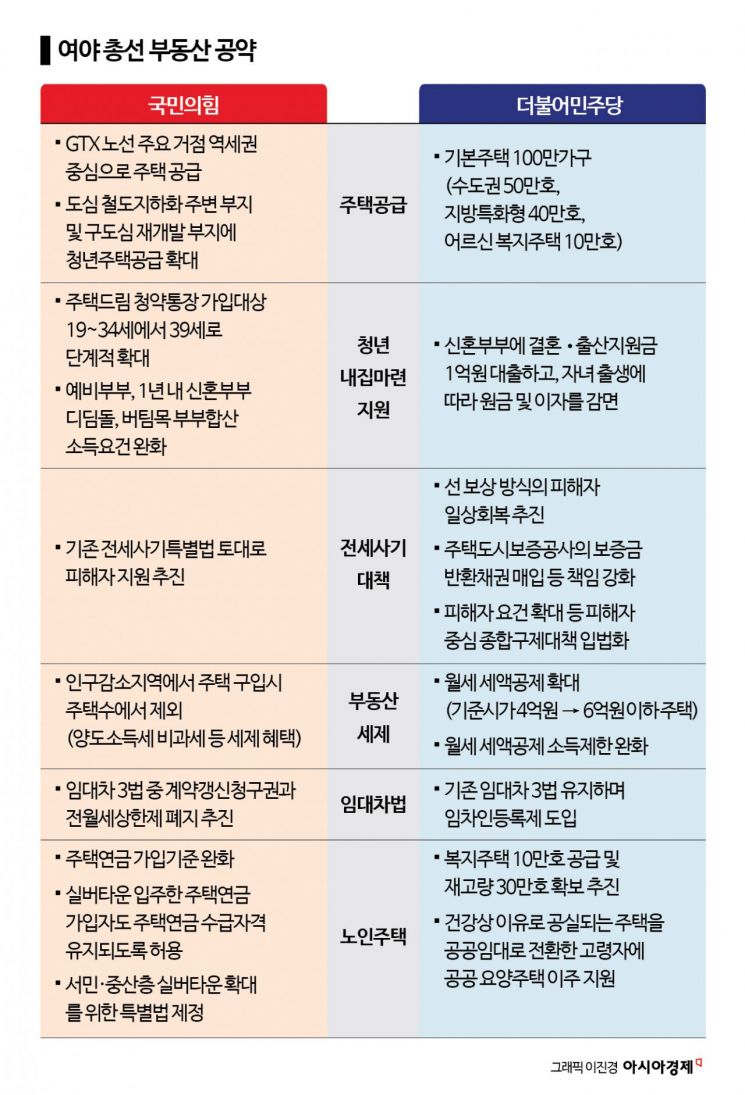
According to each party's general election pledge book on the 9th, the People Power Party pledged to supply New:Home, which the current government aims to supply 500,000 units during its term, around GTX station areas. Following the early opening of some GTX A lines at the end of last month, which stirred the local real estate market, the party plans to concentrate New:Home supply in GTX station areas. The People Power Party also plans to use part of the development profits generated from redevelopment and reconstruction projects for New:Home and priority supply to newborns.
The Democratic Party announced a pledge for 1 million Basic Housing units. Basic Housing, focused on the homeless, refers to public housing for sale or rent where residents can live long-term by paying reasonable rent. They plan to supply 500,000 units in the metropolitan area, 400,000 units of regional specialized housing, and 100,000 units of senior welfare housing. They also promised to supply 250,000 half-price apartments for youth and newlyweds and provide public rental housing with sale conversion to newlyweds with two or three children. This pledge was also part of Lee Jae-myung, the Democratic Party leader's 2022 presidential election platform.
In rental law pledges, the parties' positions showed clear differences. The People Power Party said it would abolish the right to request contract renewal and the rent ceiling system among the 'three rental laws.' These regulations were implemented under the Moon Jae-in administration to protect tenants. However, the People Power Party believes they rather fueled rent increases and increased rental fraud damage. The Yoon Suk-yeol administration has emphasized a full review of the three rental laws since the presidential election. On the other hand, the Democratic Party plans to maintain the existing rental laws while introducing a 'tenant registration system' to supplement shortcomings. They intend to enhance transparency in the rental market by providing incentives for registration.
The ruling and opposition parties also differed in their approaches to rental fraud measures. The People Power Party focused on preventing damage by abolishing two rental laws, while the Democratic Party emphasized 'relief' for rental fraud victims. The Democratic Party said it would amend the current special rental fraud law with a 'relief first, recourse later' approach. The Housing and Urban Guarantee Corporation (HUG) would purchase the deposit return claims of rental fraud victim houses to prioritize relief for affected tenants, then claim recourse from landlords to recover costs. They also proposed expanding the criteria for rental fraud victims and preventing financial transaction disadvantages in cases of bankruptcy or personal rehabilitation applications due to rental fraud.
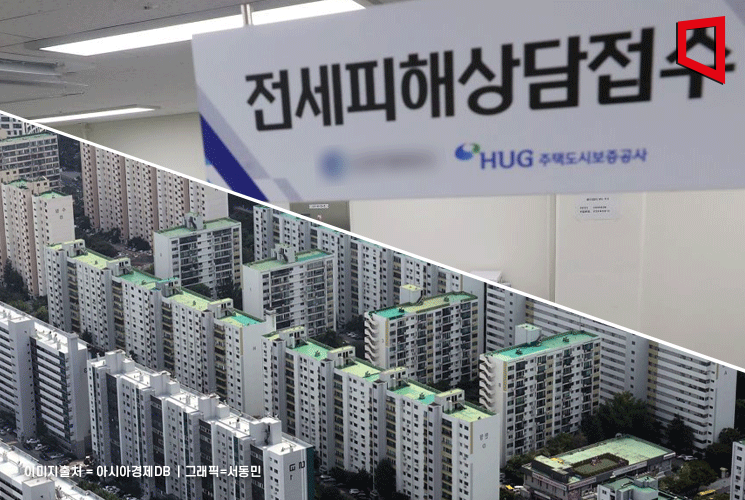
The Special Rental Fraud Act was enacted in June last year to support victims after rental fraud caused social problems, including victims taking extreme measures. The Democratic Party and the Justice Party had already proposed amendments to the special rental fraud law based on the relief first, recourse later principle at that time. However, the bill failed due to lack of bipartisan agreement. The People Power Party argued that the relief first, recourse later approach would cause taxpayers to pay off debts of malicious landlords and pledged to steadily implement the current special law enacted in May last year.
Additionally, regarding real estate taxation, the Democratic Party pledged to expand the monthly rent tax credit, which is also linked to rental fraud measures. The intent is to ease housing burdens as monthly rents have increased due to rising rental fraud. They plan to relax the criteria for monthly rent tax credit eligibility from houses with a standard market price of 400 million KRW or less to 600 million KRW or less and remove income limits to reduce monthly rent burdens for the middle class.
Meanwhile, experts predict that unless the ruling party achieves an overwhelming victory, the real estate market landscape will not change significantly.
Park Won-gap, Senior Real Estate Specialist at KB Kookmin Bank, said, "There are no real estate pledges worth noting as contentious issues between the ruling and opposition parties in this general election. The election is unlikely to have a major impact on the real estate market," adding, "Recent actual transaction prices have rebounded, so the market will not sharply decline depending on the election results." He viewed it as difficult to amend the three rental laws, citing that revisions would increase confusion.
Lee Eun-hyung, Research Fellow at the Korea Institute of Construction Policy, also said, "Even if the ruling party wins, it will be difficult to touch the two rental laws." He added, "The three rental laws were ruled constitutional by the Constitutional Court, and since this is not a period of rapid real estate price increases, they are not very significant."
© The Asia Business Daily(www.asiae.co.kr). All rights reserved.


















