"The world is currently at a historic turning point, and Japan's security policy will undergo fundamental changes in response."
Japanese Prime Minister Fumio Kishida stated this in an interview with CNN on the 7th (local time). Prime Minister Kishida said, "We are closely monitoring Russia's invasion of Ukraine, ongoing conflicts in the Middle East, and the tense situation in East Asia," adding, "In response, we have decided to fundamentally strengthen Japan's defense capabilities."
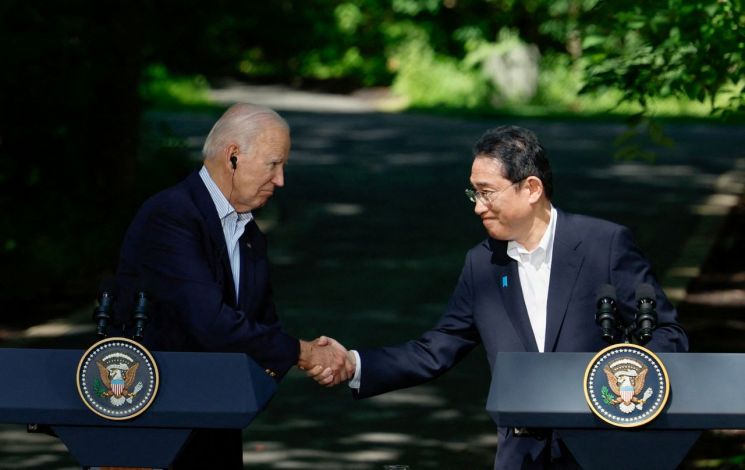
He continued, "In such a situation where security threats are intensifying, the U.S.-Japan alliance is becoming even more important," emphasizing, "I hope to gain bipartisan support in Washington." Prime Minister Kishida is scheduled to meet with U.S. President Joe Biden in Washington D.C. on the 10th. He also plans to deliver a speech at a joint session of the U.S. Congress and attend a trilateral summit with the U.S. and the Philippines.
CNN noted that these remarks and actions by Prime Minister Kishida suggest a departure from Japan's pacifist stance. Since taking office in 2021, Kishida has been leading a major shift in Japan's defense posture, including pushing to increase Japan's defense budget to 2% of its Gross Domestic Product (GDP) by 2027. When asked about the reasons for these changes, Kishida pointed to the "serious and complex" security environment surrounding East Asian countries.
He said, "Among our neighboring countries, some are secretly developing ballistic missiles and nuclear weapons, and there are attempts to forcibly change the status quo in the East China Sea and South China Sea," emphasizing, "I hope the United States understands that it is essential for Japan to have deterrence capabilities for the sake of our allies as well." Earlier, the U.S. government also described this U.S.-Japan summit as a historic opportunity to modernize the alliance in preparation for North Korea's weapons tests, a rapidly growing Russia, and China's aggression toward Taiwan.
The media assessed that this summit also puts the governance abilities and diplomatic skills of both leaders to the test. Prime Minister Kishida has recently seen his approval ratings plummet due to a scandal in the Liberal Democratic Party, and President Biden faces an unstable situation with the possibility of former President Donald Trump returning to the White House in the upcoming U.S. election in November. When asked about concerns over a change in the U.S. administration, Kishida explained, "The relationship between Japan and the United States has become stronger than ever," adding, "It is important that the American people recognize the significance of the U.S.-Japan relationship regardless of the election outcome."
Meanwhile, local media such as Taiwan's Liberty Times reported that former Taiwanese Premier Ma Ying-jeou, currently visiting China, is expected to meet with Chinese President Xi Jinping on the 10th. The meeting was initially expected to take place on the 8th, but the schedule appears to have been changed to the 10th to counterbalance the Biden-Kishida summit, where discussions on the Taiwan issue are anticipated, the media analyzed.
© The Asia Business Daily(www.asiae.co.kr). All rights reserved.

















