Expert "Responding to International Currency Uncertainty"
Reducing US Treasury Holdings to Defend Yuan
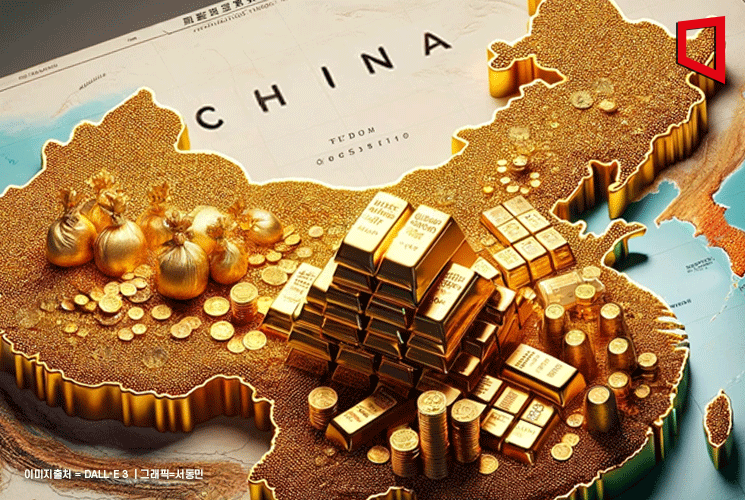
China has been increasing its gold reserves for 17 consecutive months. Local experts interpret this move as a focus on responding to uncertainties related to international currencies and strengthening national financial security.
On the 7th, the People's Bank of China, the country's central bank, announced that as of the end of March, China's gold reserves reached 72.74 million ounces, an increase of 160,000 ounces compared to the previous month. This marks the 17th consecutive month of growth in China's gold holdings. According to Investing.com, gold futures for the nearest delivery on the international futures market traded at a record high of $2,349.10 per troy ounce (approximately 3.17 million KRW) during the previous day’s session. Although prices fell slightly afterward, closing at $2,331.10 on the 7th, this still represents a sharp rise compared to the early-year trading price in the low $2,070s.
The Chinese state-run Global Times (GT), citing expert analysis, interpreted the increase in asset holdings as showing that "amid growing global market uncertainties, the central bank continues to emphasize traditional safe assets and national financial security." Professor Xi Junyang of Shanghai University of Finance and Economics told GT that "the main reason for expanding gold reserves is the uncertainty related to international currencies," adding, "especially because fluctuations in the US dollar exchange rate can impact the economy."
According to recent data released by the US Treasury, China's holdings of US Treasury bonds stood at $797.7 billion as of January, down $18.6 billion from the previous month. Since April 2022, China has maintained its US Treasury holdings below $1 trillion, and in October last year ($763.5 billion), it recorded the lowest amount in 14 years and 9 months since March 2009 ($776.4 billion). The market views this as the authorities selling US Treasuries to defend the value of the yuan.
On the same day, the State Administration of Foreign Exchange announced that as of the end of March, China's total foreign exchange reserves increased by $19.8 billion from the previous month to $3.246 trillion. The administration explained that the increase in foreign exchange reserves was influenced by "a combination of factors such as exchange rate and asset price changes," and that "macroeconomic indicators and expectations regarding major countries' monetary policies led to a rise in global financial asset prices, including the dollar index."
Hu Qimu, Deputy Director of the Digital Physical Payment Integration Forum 50, interpreted, "Maintaining foreign exchange reserves above $3 trillion is very important for China to prepare for international financial risks and stabilize the value of the yuan," adding, "It will also help the country focus on stabilizing economic growth." Hu further noted, "Global demand for affordable Chinese products remains strong despite economic uncertainties," and "trade is stable, making it highly likely that exports will increase further." He also added, "The recovery of the global raw materials market signifies a worldwide economic revival, which will support China's manufacturing and export sectors."
© The Asia Business Daily(www.asiae.co.kr). All rights reserved.