Kazuo Ueda, Governor of the Bank of Japan (BOJ), who implemented an interest rate hike for the first time in 17 years, marks his first anniversary in office on the 9th. Although he put an end to Japan's long-standing negative interest rates and began normalizing monetary policy in earnest, the "super yen depreciation" that has pushed the yen to its lowest level in 34 years remains a future challenge. Under Governor Ueda's administration, the yen's value has fallen by about 13% over the past year.
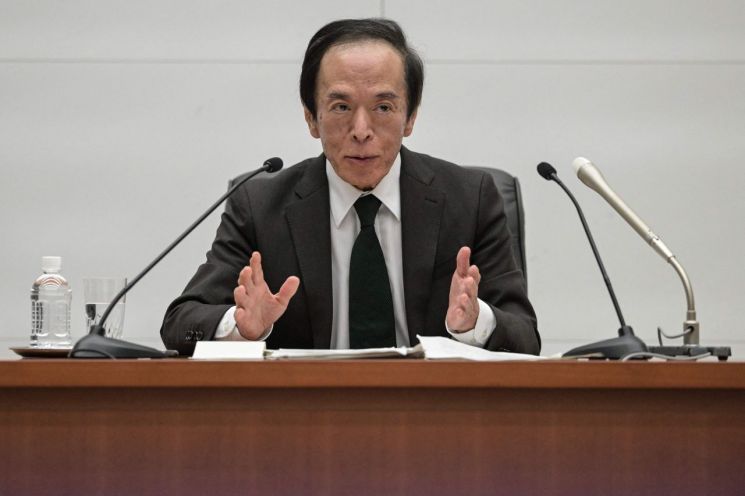
The Nihon Keizai Shimbun on the 8th cited the biggest achievement under Governor Ueda's administration as dismantling the "two-dimensional easing (simultaneous quantitative and qualitative easing)" that had continued for over 10 years during the tenure of his predecessor, Haruhiko Kuroda. It also pointed out that a byproduct of this was the acceleration of yen depreciation. As of the 5th, the yen's value had dropped by 13% over the past year. This is a remarkable level even among the 11 BOJ governors since the shift to a floating exchange rate system.
The newspaper diagnosed, "The history of yen appreciation that troubled Japan for a long time is now in the past," and added, "It is signaling a new battle with the yen (yen depreciation)." Under the floating exchange rate system, only three BOJ governors besides Governor Ueda have seen the yen's value fall during their first year in office. Notably, the yen's depreciation during Ueda's first year (-13%) is greater than that during former Governor Kuroda's tenure, who pursued ultra-loose monetary policy (-around 7%).
When Governor Ueda took office last year, voices calling for a review and improvement of the long-standing monetary easing policy emerged locally. Governor Ueda himself hinted that the side effects of the yield curve control (YCC) policy, which controls long-term interest rates, would be the first issue to be addressed. Ultimately, at the Monetary Policy Meeting in March, the BOJ raised interest rates for the first time in 17 years, escaping negative interest rates for the first time in 8 years. The BOJ also ended YCC, as well as purchases of exchange-traded funds (ETFs) and real estate investment trusts (REITs).
However, during this process, the bond market, yen exchange rate, and banking risks were identified as key concerns. The newspaper reported, "Governor Ueda prioritized the stability of the bond market over the exchange rate to avoid economic and market turmoil," and added, "In the early days of his tenure, he made several remarks that seemed to encourage yen depreciation, indicating difficulties in dealing with the yen depreciation issue."
Additionally, recent strong U.S. economic indicators have diminished expectations for Federal Reserve (Fed) rate cuts, supporting the dollar and further pushing down the yen's value. Wall Street predicts that if the Fed does not cut rates within this year, the USD/JPY exchange rate could rise to 160 yen per dollar (yen depreciation). The USD/JPY rate previously approached 152 yen per dollar, the highest level in 34 years, before slightly retreating.
The newspaper warned, "If high oil prices, worsening trade conditions, and accelerated yen depreciation coincide, the 'yen depreciation risk theory' could resurface," and pointed out, "The battle against yen depreciation will undoubtedly be a key issue in Governor Ueda's second year and beyond." The BOJ governor's term is five years. Earlier, in an interview with the Asahi Shimbun, when asked about the exchange rate, Governor Ueda responded with "No comment," adding, "If exchange rate trends are expected to have a significant impact on wage and price cycles, we can respond with monetary policy."
© The Asia Business Daily(www.asiae.co.kr). All rights reserved.

















