Geopolitical Concerns in Middle East and Russia + Mexico Export Cuts
Global Supply Shock Raises Inflation Fears
JPMorgan "Oil Prices to Exceed $100 per Barrel in Aug-Sept"
International oil prices have broken through the $90 per barrel mark, and forecasts are spreading that they will surpass $100. Global supply shock concerns have emerged as geopolitical tensions in the Middle East and Russia escalate, and Mexico has also reduced its crude oil exports. It is being observed that this could make the fight against inflation by central banks around the world, including the U.S. Federal Reserve (Fed), even more difficult.
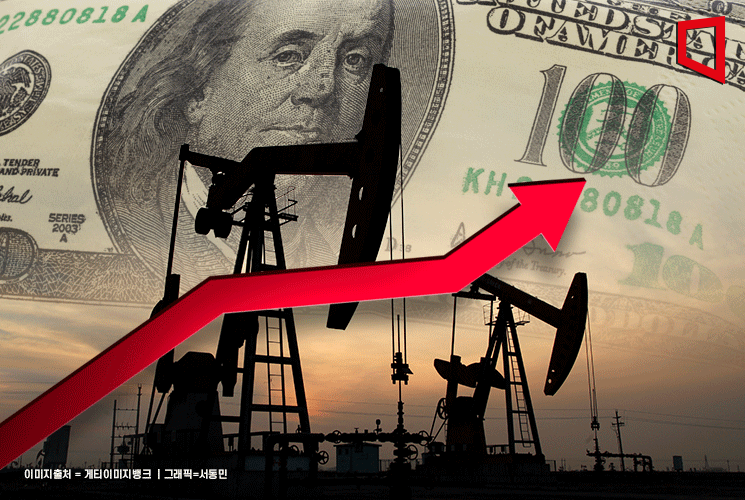
According to the global commodity market on the 7th (local time), the June contract for Brent crude oil, the global benchmark for crude oil prices, rose to $91.17 per barrel on the European ICE Futures Exchange on the 5th, marking the highest level since October last year. The increase this year alone has reached 18%. The May contract for West Texas Intermediate (WTI) crude oil also rose to $86.91 per barrel on the New York Mercantile Exchange on the same day, surging 21% since the beginning of the year.
The background to the roughly 20% surge in international oil prices this year is supply concerns. According to Bloomberg News, Mexico, a major crude oil supplier in the Americas, cut its crude oil exports by 35% last month, marking the lowest export volume since 2019. This is a result of the Mexican government deciding to stop importing expensive fuel and increasing domestic supply. Mexico’s export reduction, as the largest crude oil seller to the U.S., is expected to lead to increased domestic oil consumption and reduced exports in the U.S., the world's largest oil producer.
Geopolitical tensions in the Middle East and Russia are also factors pushing up oil prices. On the 1st, Israel bombed the Iranian embassy in Syria, and on the 2nd, Ukraine attacked Russian refining facilities with drones. Oil shipments have been delayed due to attacks on ships in the Red Sea by Yemen’s Iran-backed Houthi rebels, and ongoing U.S. and Western sanctions on Russian oil exports are also stimulating oil prices. Additionally, the Organization of the Petroleum Exporting Countries (OPEC) has extended production cuts, so concerns about supply shocks remain unresolved.
With economic recoveries in the U.S. and China increasing demand, oil inventories are also decreasing. The U.S. Energy Information Administration (EIA) expects global oil inventories to decrease by 200,000 barrels per day in the first quarter of this year and by 900,000 barrels per day in the second quarter. This is the first inventory decline in three years since 2021.
Market forecasts suggest that international oil prices will surpass $100 per barrel again for the first time in over two years.
Global investment bank JP Morgan Chase expects Brent crude oil to exceed $100 per barrel between August and September. International oil prices rose to $127 per barrel in March 2022, right after the Russia-Ukraine war began, before falling below $100 a few months later. Bank of America (BofA) projected average prices for Brent and WTI this year at $86 and $81 per barrel respectively, forecasting that oil prices could surpass $95 per barrel this summer.
Bob McNally, an analyst at energy consulting firm Rapidan Energy Group, said, "I think $100 per barrel for international oil prices is entirely realistic," adding, "You just need to price in a bit more risk for the real geopolitical risks."
Concerns are also growing that rising oil prices could reignite inflation in the U.S., which has recently been slowing down. Gasoline prices in the U.S. have already risen by 6% over the past month. Bloomberg’s major commodity index hit its highest level since November last year due to the rise in oil prices. If inflation rates rebound, the Fed’s pivot?its shift in policy direction, including interest rate cuts expected within the year?could be delayed further.
The New York Times (NYT) reported, "Oil prices are becoming a potential problem for President Joe Biden ahead of the elections," and "They are also raising new questions about the timing of the Fed’s interest rate cuts."
© The Asia Business Daily(www.asiae.co.kr). All rights reserved.
![Clutching a Stolen Dior Bag, Saying "I Hate Being Poor but Real"... The Grotesque Con of a "Human Knockoff" [Slate]](https://cwcontent.asiae.co.kr/asiaresize/183/2026021902243444107_1771435474.jpg)










