Gyeongbuk National University, Jeonbuk National University, Jeonnam National University Resume Classes This Month
Mid to Late April Deadline... "Avoid Mass Failing"
Medical schools that have been suspending classes since February due to students' refusal to attend in protest against the government's increase policy are gradually resuming classes starting this week. Attention is focused on whether the resumption of classes will become a turning point in the medical students' class boycott situation. Kyungpook National University announced to faculty and students that it will resume classes at the College of Medicine from the 8th.
Kyungpook National University held classes for first- to fourth-year medical students starting February 13 and conducted classes for one week. However, when 40 medical schools nationwide decided to engage in collective actions such as a strike starting February 19, the university extended the suspension of classes five times to persuade students to return. During this process, the class hours per subject, originally 20 weeks, were compressed to 15-16 weeks, the timetable was rearranged, and the end of the semester was adjusted to mid to late July.
However, judging that it would be difficult to properly complete the first semester academic schedule after mid-April and that a large number of students would fail, classes for first- and second-year medical students will resume on the 8th, and third- and fourth-year students will begin clinical practice at hospitals from the 15th. Further delaying the resumption of classes would disrupt the second semester academic schedule starting in August.
It is also known that there is a certain consensus among students that classes should be resumed. Lim Sung-kyu, Dean of Academic Affairs at Kyungpook National University, explained, "After announcing the resumption of classes, some students asked detailed questions, but there were no cases of expressing refusal," and added, "Based on students' opinions, classes for first- and second-year students will be conducted online for 2-3 weeks, and clinical practice for third- and fourth-year students will be conducted face-to-face."
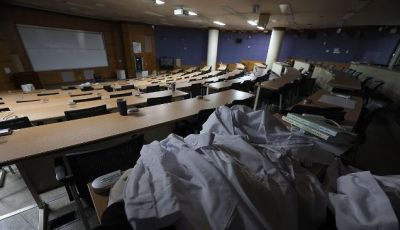 A medical school lecture hall at a university left empty due to a collective leave of absence by students [Image source=Yonhap News]
Jeonbuk National University College of Medicine also decided to resume classes on the 8th. Among 665 medical students at Jeonbuk National University, 641 submitted leave of absence forms, and classes had been postponed several times since February 26. However, like Kyungpook National University, it was judged difficult to delay the start of classes any further. Immediately after resuming classes, a combination of face-to-face and online lectures will be conducted to proceed with the academic schedule. Chonnam National University also plans to resume classes in mid-month, and Gachon University started online classes from the 1st of this month.
According to the Enforcement Decree of the Higher Education Act, the number of school days per academic year is set to be at least 30 weeks. Therefore, typically, more than 15 weeks of class hours per semester must be secured. However, if the start of classes is continuously delayed and classes and exams are conducted simultaneously, the burden on not only students but also medical school professors who juggle clinical duties and lectures will increase.
Universities regard mid to late this month as the 'deadline' for starting classes. Even after classes resume, if students do not attend, it is practically impossible to avoid failing. Most medical schools give an F grade if a student is absent for one-third or one-quarter of the class days according to school regulations, and if a student receives an F grade in even one subject, they will fail the year. A representative from a non-metropolitan university said, "Universities are now almost at a dead end, and students, especially medical students, have no time to spare," adding, "To prevent a large-scale failure situation, classes must be resumed by the end of this month."
Accordingly, each university is actively persuading students through individual interviews with faculty advisors and other professors. Also, considering the burden of returning, self-help measures such as online non-face-to-face classes have been prepared. Because of this, it is expected that a considerable number of students who had previously submitted leave of absence forms and refused classes and practical training will participate in classes from this month. A Ministry of Education official stated, "We plan to check this week whether each university has resumed classes and, if not, when they will start."
Meanwhile, unlike other four-year universities, medical schools consist of a total of six years: two years of pre-medical course and four years of medical course. Afterward, students obtain a general medical license through the national examination and complete one year as an intern (resident trainee) managing inpatients and surgical patients, followed by 3-4 years as a resident to obtain specialist qualifications. Residents refer to interns and residents who undergo training at university hospitals or other institutions with specialist training programs after obtaining a medical license. Interns graduate from medical school, acquire a medical license, and spend one year rotating through all clinical departments in a hospital to gain diverse clinical experience. They are also called resident trainees. They mainly handle sterilization, blood collection, surgical preparation, and patient list management.
After completing the intern course, residents apply to each department considering intern grades, resident selection exam scores, and medical licensing exam scores, and work as residents. Residents mainly manage inpatients, write charts, and assist in surgeries. As they gain experience, they also conduct outpatient care and perform minor surgeries independently. Residents account for about 40% of all doctors in major large hospitals in Seoul. The government activated an emergency medical system and took measures to fill the medical gap after many residents submitted resignation letters and left hospitals en masse.
© The Asia Business Daily(www.asiae.co.kr). All rights reserved.
![Clutching a Stolen Dior Bag, Saying "I Hate Being Poor but Real"... The Grotesque Con of a "Human Knockoff" [Slate]](https://cwcontent.asiae.co.kr/asiaresize/183/2026021902243444107_1771435474.jpg)










