Restaurants, Hotels, and Travel Industries 'Buzzing'
"Like the Super Bowl or Taylor Swift Concert"
An analysis has emerged suggesting that the total solar eclipse, observable in the United States for the first time in seven years, could generate an economic impact of $6 billion (approximately 8.118 trillion KRW). On the 6th (local time), CBS reported that the eclipse scheduled for noon on the 8th could create a boom in industries such as hotels, restaurants, and travel across several U.S. states, resulting in a financial stimulus effect worth $6 billion, according to the economic analysis firm Perryman Group.
Ray Perryman, CEO of Perryman Group and an economist, explained, "Although the impact will be concentrated over a short period, it will provide an opportunity for many cities, including small towns, to promote themselves." He added, "Especially since this eclipse occurs in spring, it is stimulating travel desires that had been dormant during the winter."
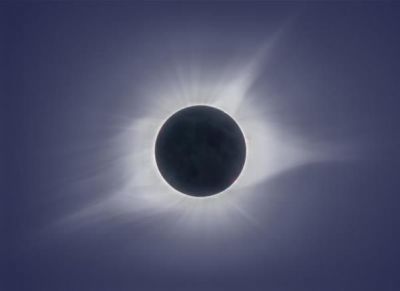 Total solar eclipse photographed in the United States by the Korea Astronomy and Space Science Institute's total solar eclipse observation team in August 2017 [Image source=Provided by Korea Astronomy and Space Science Institute]
In particular, the path of totality, stretching diagonally from southern Texas to northeastern Maine, is reported to be attracting millions of visitors from outside the region. Perryman estimated, "Texas, which includes major cities like Austin and Dallas, could enjoy the largest economic benefit of about $1.4 billion (1.8942 trillion KRW), and Vermont, the second smallest state in the U.S., could see an economic stimulus effect of $230 million (approximately 311.2 billion KRW)."
Jay Peak Ski Resort in Vermont, well known as one of the best places to view the total eclipse lasting over 3 minutes and 30 seconds, has had all 900 rooms booked for the night of the 7th at about $500 (approximately 680,000 KRW) per night over the past year and a half, with 800 rooms reserved for the night of the eclipse on the 8th. CBS reported, "A couple plans to hold their wedding at the summit of Jay Peak Resort, 4,000 meters above sea level, during the eclipse." Patrick Callier, CEO of the New York-based travel agency Visit Buffalo, said, "There are groups who booked trips right after the 2017 eclipse to see this one seven years later," adding, "It can be compared to the Super Bowl or a Taylor Swift concert."
Since viewing an eclipse with the naked eye without protective equipment can damage eyesight, Americans are reportedly spending significant amounts on eclipse glasses. Eclipse glasses approved by the American Astronomical Society and compliant with International Organization for Standardization (ISO) standards can be purchased in multi-packs on the e-commerce site Amazon for about $15 to $28 (approximately 20,000 to 38,000 KRW).
 Players Watching a Solar Eclipse at a Minor League Baseball Stadium in 2017
 [Image Source=Yonhap News]
A total solar eclipse occurs when the moon positions itself between the Earth and the sun, completely blocking the sun. The last total solar eclipse visible in the U.S. was on August 21, 2017, about seven years ago. This eclipse is predicted to be observable over a wider area and for a longer duration than in 2017. According to NASA, the width of the path where the total eclipse can be seen was 62 to 71 miles (approximately 100 to 114 km) in 2017, but this time it spans 108 to 122 miles (approximately 174 to 196 km).
The duration varies depending on the observation location, but compared to a maximum of 2 minutes and 42 seconds in 2017, this time it will last up to 4 minutes and 28 seconds in Mexico and about 4 minutes and 26 seconds in Texas. Furthermore, NASA has forecasted that the next opportunity to see a total solar eclipse in the U.S. will not come until 2045, about 20 years later, increasing its rarity and value.
© The Asia Business Daily(www.asiae.co.kr). All rights reserved.


















