"No Work-Family Balance, No Solution to Low Birthrate"
"Cash Pledge Criticism Is an Investment in the System"
"Regret Over Negative General Election... Focus Should Be on Livelihood"
"It is regrettable."
This was the sentiment expressed by Hong Seok-cheol, Chairman of the People Power Party's Special Committee on Gap Reduction, whom I met at the National Assembly on the 5th, less than a week before the 22nd general election. He joined the party's pledge development headquarters as the head in January to create election pledges for the People Power Party. This was because he was considered the right person to devise solutions to South Korea's most urgent low birthrate issue. Reflecting on the three months he spent developing the pledges, he said his feelings were mixed with pride and regret.
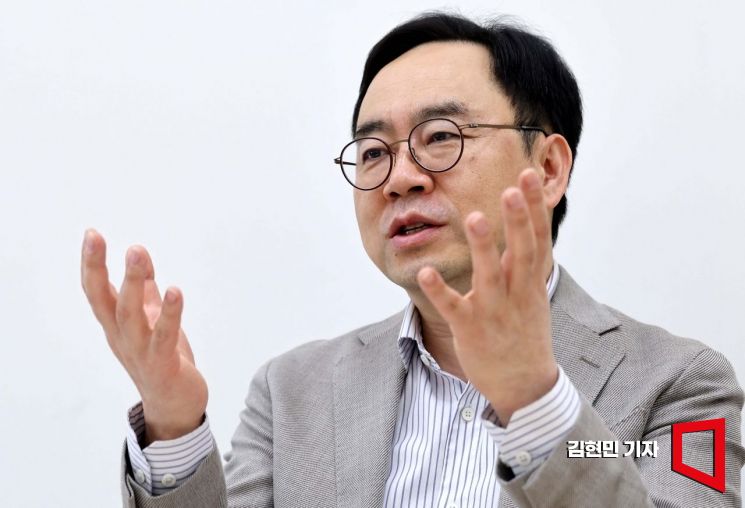 Hong Seok-cheol, Special Committee Chair for Gap Reduction of the People Power Party. Photo by Hyunmin Kim kimhyun81@
Chairman Hong explained that the People Power Party's election pledges were created under the value of 'community restoration.' Under this value, 'gap reduction' and 'sustainability' were also included. Hong said, "The most important value of conservatism is building a community," adding, "In today's Korean society, to build a community, I believe pledges to reduce gaps and support future generations are necessary."
The first pledge the People Power Party put forward to form the foundation of community?the family?is work-family balance. This is why the pledge book includes promises such as automatic initiation of maternity and parental leave, raising the upper limit of parental leave pay from 1.5 million won to 2.1 million won, and introducing paid child care leave for children up to 10 years old. Hong said, "Regardless of party lines, everyone knows we are facing a population crisis," and added, "The low birthrate crisis is a condensed phenomenon of various socio-economic problems. Especially as women's participation in society becomes prominent, if work-family balance is not achieved, solving the low birthrate problem is impossible."
People Power Party Proposes Tax Cut Pledges... On Concerns Over Revenue Shortfall: "Integrating Government Projects Takes Priority"
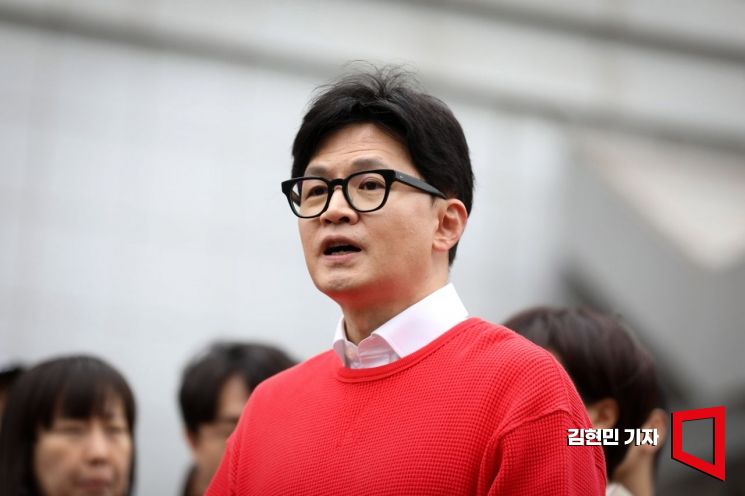 Handonghun, the General Election Committee Chairman of the People Power Party, is answering questions from reporters after casting his vote at the early voting station in Sinchon-dong, Seodaemun-gu, Seoul, on the first day of early voting for the 22nd National Assembly election on the 5th. Photo by Kim Hyunmin kimhyun81@
Ahead of this general election, the People Power Party proposed several tax cut pledges. Han Dong-hoon, the party's Emergency Response Committee Chairman, promised a temporary reduction of VAT on daily necessities and raising the simplified VAT taxpayer threshold for self-employed individuals to 200 million won. However, there were criticisms that these could undermine the tax structure. Hong countered, "Our country's tax policy is not perfect," and continued, "Lowering corporate tax and property tax is an international trend. While lowering corporate and property taxes, we need to adjust other taxes to maintain a reasonable balance. The temporary VAT reduction pledge can be understood in this context."
However, concerns have been raised that tax revenue could fall short if the People Power Party's pledges are implemented. Hong expressed the view that sufficient fiscal resources could be secured by reforming the inefficiently operated social security system. He said, "I don't think raising taxes unconditionally when more budget is needed is the answer. The government and local governments operate about 100,000 social security programs," adding, "There are many overlapping projects, and central ministries often don't know where the budget is spent. Integrating these programs should be the priority."
As measures against low birthrate, the People Power Party pledged full exemption of university tuition fees for families with three or more children, and significant increases in early childhood education and childcare fees to provide free childcare starting at age five. The estimated costs for these are 2 trillion won and 700 billion won, respectively. Hong argued that the party's pledges differ from the opposition's cash support pledges. He said, "If you give cash indiscriminately like the opposition, you don't know how it will be spent, reducing policy effectiveness. Tuition exemption and free childcare pledges are investments in systems, not cash transfers to parents' accounts." He added, "The Democratic Party leader Lee Jae-myung's livelihood recovery fund is estimated to cost 13 trillion won, which could sustain free childcare for five-year-olds for over ten years."
Limited Party-Government Dialogue... "Cautious Because of Election Season"
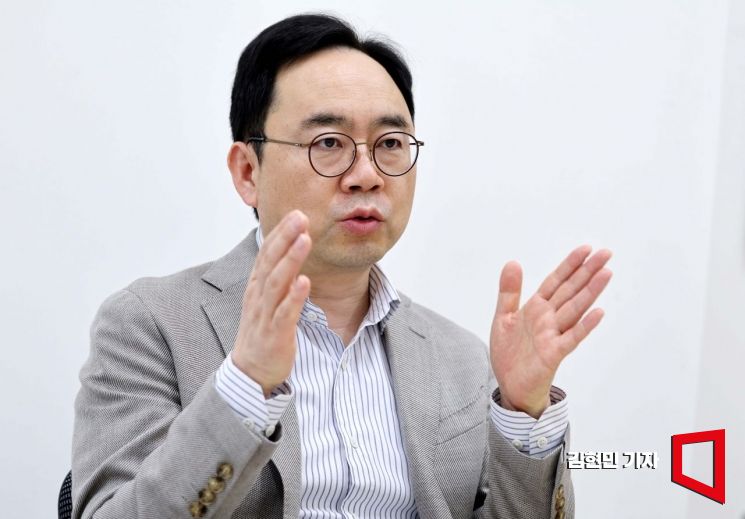 Hong Seok-cheol, Special Committee Chairman for Gap Reduction of the People Power Party. Photo by Hyunmin Kim kimhyun81@
For the People Power Party's pledges to be realized, cooperation with the government is essential. When asked whether there had been active dialogue between the party and government regarding the pledges ahead of this election, Hong replied, "It was not close." He explained, "Because it's election season, the conditions for close dialogue on all policies between the party and government are not present," adding, "The government is very cautious, and so is the party." However, he noted, "We have been following the livelihood discussion meetings held by the presidential office and inquired about their intentions," and explained, "The government accepted some of the party's pledges, such as easing the income criteria for newlyweds in the special newborn loan program."
The most regrettable aspect for Chairman Hong in this election was that the contest ultimately turned into a negative war rather than a policy battle. The People Power Party and the Democratic Party held a 'one-time' policy showdown on January 18 by releasing their low birthrate measures consecutively. Hong said, "There are actually too many pledges for a proper policy battle," adding, "Because they consider voters from various interest groups, a wide range of pledges are included in the pledge book." He continued, "I think parties should focus on livelihood pledges and compete on that basis in this general election."
In that regard, I asked a 'mischievous question' about whether there was any Democratic Party pledge they would like to steal. Hong praised the Democratic Party's 'Our Child Independence Fund' pledge, which provides a monthly 100,000 won deposit into a fund account from age 0 to 18 to help young generations build basic assets. He said, "Actually, the People Power Party had thought about this pledge as well. It's a very meaningful policy." He added, "Currently, the government operates a similar policy called the 'Didim Seed Account,' but it only targets children from vulnerable groups. It would be good to expand such policies to the middle class in the future."
© The Asia Business Daily(www.asiae.co.kr). All rights reserved.



















