Student slapped for submitting exam paper late
Claimed as 'disciplinary purpose' but not accepted
A 50-year-old elementary school teacher with 30 years of experience, accused of physically and emotionally abusing students by yelling at them for submitting test papers late, was found guilty again in the appellate court.
On the 6th, the Chuncheon District Court Criminal Division 1 (Presiding Judge Shim Hyun-geun) announced that A (54), who was indicted on charges of aggravated child abuse under the Child Abuse Punishment Act as a worker at a child welfare facility, was sentenced to a fine of 7 million won, the same as the original trial, and was ordered to complete 40 hours of a child abuse treatment program.
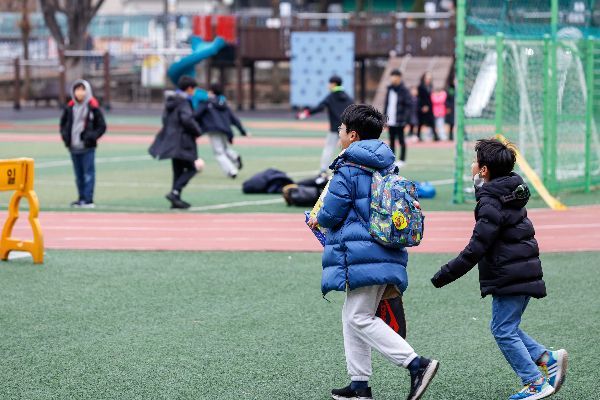 The photo is not related to the specific content of the article. It shows an elementary school in Seoul. Photo by Jinhyung Kang aymsdream@
A was charged with physically or emotionally abusing six students a total of 18 times in May 2021, including yelling "Why are you submitting this so late?" during math class and placing the back of his hand on a student's cheek. He also administered corporal punishment such as making students sit down and stand up or stand in the hallway even for relatively minor mistakes. A claimed these were legitimate acts for disciplinary purposes, but the first trial court judged the credibility of the victim children's testimonies to be reliable.
Previously, the first trial court based its guilty verdict on the fact that the victim children had sufficient communication skills and clearly described the situation at the time, that there was no motive or situation suggesting false testimony, and that no leading questions were asked during the investigation. Furthermore, the school regulations strictly prohibit any direct corporal punishment using body parts or tools under any circumstances, and there were no exceptional circumstances to justify A’s acts of making students sit down and stand up or stand in the hallway, which were deemed neither legitimate nor educationally effective. In particular, one of the victim children reported emotional anxiety and depression, and exhibited tic symptoms caused by stress, which the court considered to be due to experiencing a mentally traumatic event.
The appellate court, reviewing the case again, also stated, "It is difficult to see that the victim children's misbehavior at the time was so severe that correction was impossible through dialogue or non-physical disciplinary measures." It pointed out, "The defendant is an elementary school teacher with about 30 years of experience and should have easily recognized that using physical force on 7- to 8-year-old victim children regardless of the degree of wrongdoing, or excluding them from class, could harm their mental and physical health." The court dismissed both the prosecution’s and A’s appeals, citing no new circumstances warranting a change in sentencing after the original verdict.
Meanwhile, there was a recent case where an elementary school teacher who grabbed the collar of a 9-year-old student who talked back and threatened to hit him was sentenced to a suspended prison term in the first trial. On the 1st, the Ulsan District Court Criminal Division 3 (Presiding Judge Lee Jae-wook) sentenced B, a teacher in his 50s indicted for violating the Special Act on the Punishment of Child Abuse Crimes, to 8 months in prison with a 2-year suspension. B was also ordered to be banned from employment at child-related institutions for 2 years.
B, a physical education teacher at an elementary school in Ulsan, saw a student throwing a stone during a fight with another student on the school playground in the second semester of 2022. When B tried to stop the student, the student talked back and defied him, causing B to become angry, grab the student's collar, drag him to the classroom, and kick a chair. The court judged that although the student's attitude was problematic, B’s actions exceeded the scope of discipline.
© The Asia Business Daily(www.asiae.co.kr). All rights reserved.

















