Consolidation of Domestic Port Technology, Automation of Loading, Transport, and Stacking
Capable of Berthing 25,000 TEU-Class Container Ships
Busan Port New Port Pier 7, the first fully automated container port in Korea built with domestically developed port equipment technology, opened on the 5th.
About 500 people attended the opening ceremony of Busan Port New Port Pier 7, located in Jinhae-gu, Changwon City, including President Yoon Seok-yeol, Minister of Oceans and Fisheries Kang Do-hyung, Governor of Gyeongnam Province Park Wan-su, Mayor of Busan Park Hyung-joon, and officials and businesspeople related to shipping, ports, and logistics.
Governor Park said, "Busan Port New Port Pier 7, developed in Gyeongnam Province, is a Korean-style cutting-edge smart port based on domestically produced port equipment technology," adding, "It has provided an opportunity to enhance the global competitiveness of Busan Port New Port's logistics and to solidify its position as a truly global port."
He continued, "We expect significant ripple effects on local port equipment companies and parts manufacturers through the introduction of domestic port equipment," and added, "We will also strive to nurture port experts and young talents suitable for smart ports in line with changes in the port employment market that require specialized Fourth Industrial Revolution technologies."
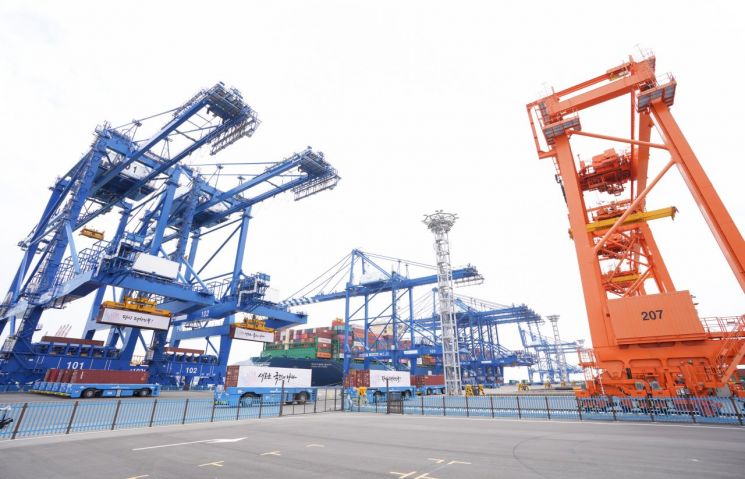 Busan Port New Port Pier 7, Jinhae-gu, Changwon-si, Gyeongnam. [Photo by Gyeongnam Provincial Government]
On the same day, Gyeongnam Province explained the progress of Pier 7's opening and showcased the 'Smart Port No. 1 Container Export Loading Performance' using automated port equipment technology remotely controlled based on the Internet of Things (IoT).
Additionally, as major provincial government agendas, they proposed six policies to the government, including ▲ reflecting the construction of transportation infrastructure for Jinhae New Port and Gadeok New Airport in the national plan ▲ building a New Port Business Center ▲ establishing a Jinhae New Port Smart Port Comprehensive Education Center ▲ creating a hinterland international logistics special zone for Busan Port New Port and Jinhae New Port ▲ changing the port construction name and equalizing local government recommendation rights for port committee members ▲ converting Geoje area local management trade port to national status, along with requesting national funding support estimated at 5.3922 trillion KRW.
Starting with Busan Port New Port Pier 7, the province plans to develop smart ports equipped with domestic port equipment for Busan Port New Port phases 2 to 6 (2 berths) scheduled to open in 2027 and Jinhae New Port (phase 1, 9 berths) targeted for opening in 2029.
According to the province, Busan Port New Port Pier 7 is a super container terminal capable of simultaneously berthing three 25,000 TEU-class vessels (1 TEU = one container measuring 6.096 meters) on an 827,000 square meter site, with a total project cost of 1.1315 trillion KRW.
It operates with Korea’s first domestically produced port equipment, including container cranes (quay cranes) manufactured by domestic port equipment companies Hyundai Samho Heavy Industries, HJ Heavy Industries, and Doosan Enerbility, and unmanned transport equipment (AGV - Automated Guided Vehicle) produced by Hyundai Rotem in technical cooperation with the Dutch company VDL.
With the introduction of unmanned remote container cranes and unmanned transport equipment, the entire cargo transport process within the port?from the quay to the yard?is fully automated.
No workers are deployed on-site, and all major port handling equipment operates electrically, which is expected to prevent safety accidents and create Korea’s first eco-friendly port with zero carbon emissions.
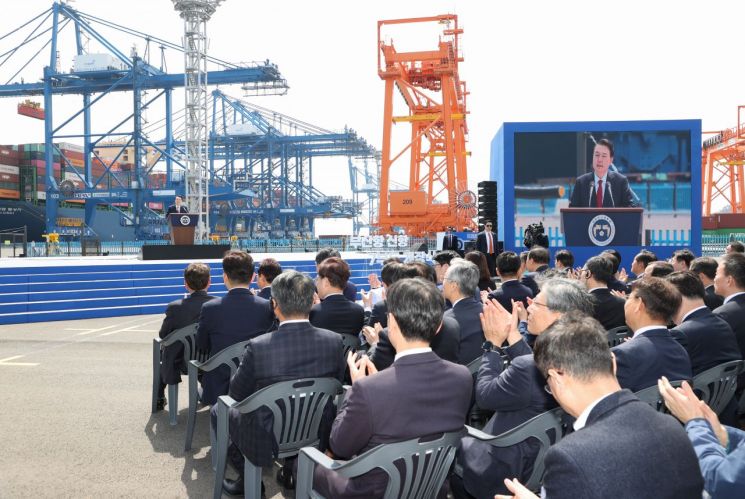 President Yoon Suk-yeol delivers a congratulatory speech at the opening ceremony of Pier 7 at Busan New Port.
 [Photo by Gyeongnam Provincial Government]
In his congratulatory speech, President Yoon stated, "I will greatly revitalize the shipping industry, a core economic security service that supports export economy’s lifelines and supply chains," expressing his intention to extend the ship tonnage tax system, which is set to expire this year.
"We will firmly advance port and shipping businesses to make Busan Port the world’s top smart port and build Jinhae New Port into a smart mega port by 2032," he said. "We will also steadily push forward the construction of Gadeokdo New Airport in Gyeongnam and develop Busan Port into a global logistics hub to firmly support advanced industries in Busan and Gyeongnam."
The tonnage tax system requires shipping companies to pay taxes based on the tonnage of their vessels and the number of operating days. Shipping companies can choose between the general corporate tax system and the tonnage tax system, whichever is more advantageous.
Korea has implemented this system since 2005 on a five-year sunset basis, and after three previous extensions, a review for extension is scheduled by the end of this year.
© The Asia Business Daily(www.asiae.co.kr). All rights reserved.
![Clutching a Stolen Dior Bag, Saying "I Hate Being Poor but Real"... The Grotesque Con of a "Human Knockoff" [Slate]](https://cwcontent.asiae.co.kr/asiaresize/183/2026021902243444107_1771435474.jpg)

















