Diagnosis of US-China Tech Dispute
China Concentrates National Power on Advanced Industries... Expect Intensified Confrontation
Need to Prepare for Semiconductor Supply Chain Changes
"Strategy from the Pursuer's Perspective Required"
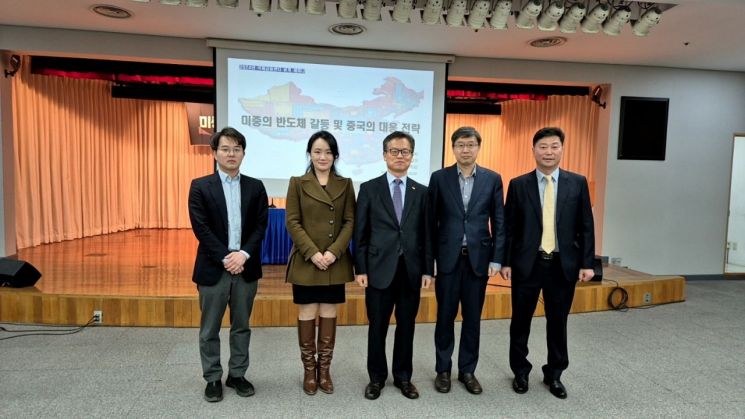 A seminar was held on the 4th at the 4th-floor auditorium of Seoul YWCA. From the left, Professor Baek Seo-in of Hanyang University, Professor Nam Eun-young of Dongguk University, Director Lee Yong-jae of the International Finance Center, and Manager Lee Chi-hoon of the International Finance Center. (Photo by International Finance Center)
Recently, concerns have arisen that the advanced industry rivalry between the U.S. and China will intensify as the Chinese government focuses its capabilities on semiconductors and other cutting-edge industries. With the expansion of technological competition in areas such as electric vehicles and artificial intelligence (AI), there are worries that the global economy will slow down and geopolitical conflicts will deepen. Voices are calling for preparedness against changes in the global supply chain structure stemming from technological disputes.
On the 4th, the International Financial Center held a seminar titled "The Future and Ripple Effects of the U.S.-China Advanced Technology Hegemony War" at the 4th-floor auditorium of the Seoul YWCA.
At the seminar, discussions were held on China's response strategy to the U.S.-China semiconductor conflict and the competitive situation between the U.S. and China in the AI and battery sectors.
Experts at the seminar evaluated that China is recently concentrating its national power by establishing semiconductor funds and promoting mass production of 3rd generation and AI semiconductors.
China accounts for more than 30% of global semiconductor demand. With the Chinese government focusing its policy capabilities on the semiconductor industry, which leads advanced industries, it is expected that complete isolation of China through regulations will be difficult.
Professor Nam Eun-young of Dongguk University, who gave a presentation that day, said, “At this point, China’s acceleration of independent semiconductor development represents China’s decoupling in the global semiconductor industry,” adding, “This means a significant change is approaching the current global semiconductor supply chain, which regards China as the largest export market for Korea’s semiconductors.”
Professor Nam emphasized the need for diplomatic efforts to ensure that China positively accepts the fact that Korea heavily depends on the U.S. and Japan for semiconductor production and must cooperate with the U.S. He also added that cooperation between local governments is necessary so that Korean small and medium-sized enterprises can enter China’s semiconductor clusters and grow together.
Professor Baek Seo-in of Hanyang University diagnosed that, when comparing technological competitiveness between the U.S. and China, the U.S. leads in AI, while China is far ahead in batteries.
The U.S. has established an ecosystem favorable to technology- and knowledge-intensive innovation capabilities centered around Silicon Valley and Boston. China has excellent labor-intensive innovation capabilities centered around Zhongguancun and Shenzhen. The U.S. has secured partner national companies such as SK, Samsung Electronics, and LG Energy Solution to complement its own insufficient capabilities. China is suffering from the U.S.’s various sanctions, which critically affect the sources of innovation. Depending on the success of technological innovations currently being pursued by the U.S., such as reusable rockets and small modular reactors (SMRs), there is a possibility of a paradigm shift.
Professor Baek said, “Korea needs to completely revise its global technology strategy from the perspective of a follower rather than a leader,” adding, “A strategy is needed to target the gaps left by the departure of Chinese companies and government.” He also added, “There is a need to consider a de-risking strategy that can safely utilize the global ecosystem and resources.”
© The Asia Business Daily(www.asiae.co.kr). All rights reserved.

















