On the first day of early voting for the April 10 general election, the nationwide average turnout rate at 10 a.m. on the 5th was recorded at 3.57%. This is more than 1 percentage point higher than the turnout at the same time during the general election four years ago, but slightly lower than the turnout during the last presidential election.
The National Election Commission announced that as of 10 a.m. (data compiled at 9:50 a.m.), out of a total of 44,280,011 eligible voters, 1,579,055 had cast their ballots.
This turnout rate is higher compared to previous elections. During the last general election, the turnout rate at 10 a.m. on the first day of early voting was 2.52%. However, it did not reach the 3.64% recorded during the presidential election. Considering that presidential election turnout rates are generally higher than those of other elections, this is an unusually high level.
The high early voting turnout in this general election appears to be significantly influenced by both ruling and opposition parties actively encouraging early voting.
Looking at the turnout by region, Jeollanam-do recorded the highest early voting rate among metropolitan units at 6.15% at this time. In contrast, Daegu Metropolitan City had the lowest turnout rate among the 17 metropolitan cities and provinces at 2.62%. Seoul recorded 3.53%, Gyeonggi-do 3.14%, and Incheon Metropolitan City 3.22%.
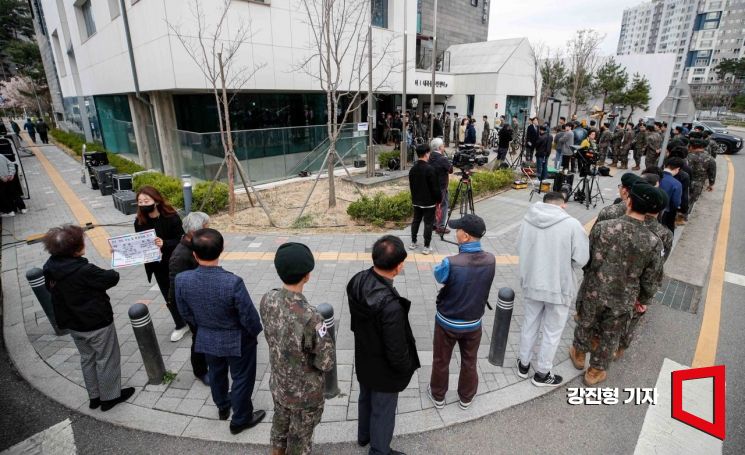 On the 5th, when early voting for the 22nd National Assembly election began, voters lined up to cast their votes at the Naegok-dong Early Voting Station set up at the Naegok-dong Open Culture Center in Seocho-gu, Seoul. Photo by Jinhyung Kang aymsdream@
Unlike in the past when the People Power Party was passive about early voting due to suspicions of election fraud, this time the party decided to actively encourage voting, with all its local constituency candidates and all People’s Future proportional candidates participating in early voting. This move came after Han Dong-hoon, the People Power Party’s Emergency Response Committee Chairman, urged active participation in early voting. After casting his vote in Sinchon, Seoul, Han said, "Whether early voting or the main voting day, the counting will be done manually," and urged people to "trust and participate in early voting."
Lee Jae-myung, leader of the Democratic Party, who voted early together with students from the Korea Advanced Institute of Science and Technology (KAIST), said after voting, "Since there may be circumstances that prevent voting on the main voting day, I ask everyone to actively participate in early voting today and tomorrow," adding, "If you give up your sovereignty and your vote, it only benefits the vested interests."
Early voting will continue on the 6th at 3,565 polling stations nationwide. Voters can cast their ballots at any early voting station regardless of their registered address, as long as they bring their ID. The locations of early voting stations can be checked on the National Election Commission’s website or through portal services. Voting hours are from 6 a.m. to 6 p.m. If a voter casts a ballot in their registered electoral district, they are considered an in-district voter; if they vote outside their district, they are classified as an out-of-district voter and their ballot will be transferred to the relevant district, city, or county election commission.
© The Asia Business Daily(www.asiae.co.kr). All rights reserved.
![Clutching a Stolen Dior Bag, Saying "I Hate Being Poor but Real"... The Grotesque Con of a "Human Knockoff" [Slate]](https://cwcontent.asiae.co.kr/asiaresize/183/2026021902243444107_1771435474.jpg)
















