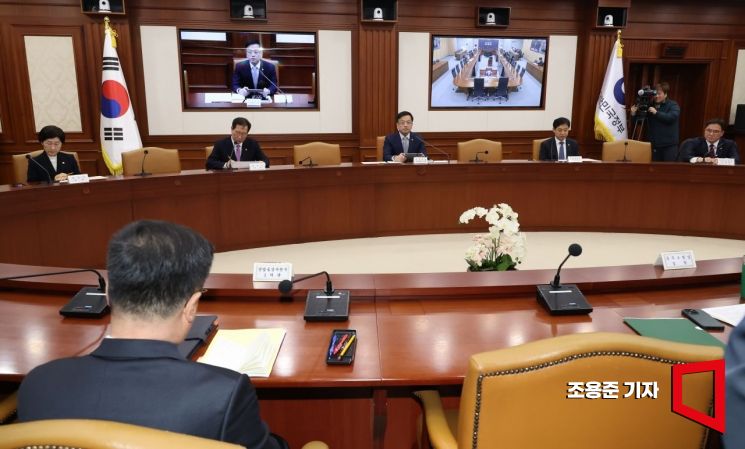
 Choi Sang-mok, Deputy Prime Minister for Economic Affairs and Minister of Economy and Finance, is speaking on recent economic issues at the Emergency Economic Ministers' Meeting held on the 26th at the Government Seoul Office in Jongno-gu, Seoul. Photo by Jo Yong-jun jun21@
Finance vice ministers and central bank deputy governors from major Asian countries Korea, China, and Japan assessed the current high inflation situation and geopolitical tensions as economic risk factors, emphasizing the need for continuous monitoring.
According to the Ministry of Economy and Finance on the 5th, Choi Ji-young, Director General of International Economic Affairs at the Ministry, attended the "ASEAN+3 (10 Southeast Asian countries plus Korea, China, and Japan) Finance Vice Ministers and Central Bank Deputy Governors Meeting" held in Luang Prabang, Laos, on the 3rd and 4th.
At the meeting, as joint chair countries, they coordinated member countries' opinions on key agendas, exchanged views on economic trend monitoring, and strengthening financial safety nets. Prior to this, the Korea-China-Japan vice ministers' meeting focused on regional financial cooperation agendas.
Regarding economic trends, regional macroeconomic research organizations such as AMRO projected stable growth based on member countries' solid domestic markets and recovery in investment and tourism, while still evaluating the persistently high inflation levels and ongoing geopolitical tensions as risk factors.
Additionally, the Asian Development Bank (ADB) mentioned the need for regional cooperation to activate sustainable finance in response to climate change and other challenges.
Our delegation emphasized that cooperation to respond to geopolitical risks, stabilize financial markets, and secure medium- to long-term growth engines is an important task, introducing the Korean government's efforts to enhance supply chain resilience through the Supply Chain Basic Act passed by the National Assembly last year and to stabilize financial markets.
Furthermore, they focused on discussing institutional improvements to enhance the effectiveness of the ASEAN+3 regional multilateral currency swap arrangement, the Chiang Mai Initiative Multilateralization (CMIM). Member countries agreed on the basic direction of introducing a Rapid Financing Facility (RFF) to provide quick funding support during crises and restructuring the CMIM resource framework, exchanging opinions on detailed issues.
Director General Choi stressed the importance of member countries' consensus for producing tangible outcomes before the ASEAN+3 Ministers' Meeting scheduled in May and decided to continue discussions on detailed issues based on the shared understanding among member countries.
The ASEAN+3 Finance Ministers and Central Bank Governors Meeting and the Korea-China-Japan Finance Ministers and Central Bank Governors Meeting will be held during the 57th Annual Meeting of the Asian Development Bank (ADB) in Tbilisi, Georgia, in May.
© The Asia Business Daily(www.asiae.co.kr). All rights reserved.
!["The Woman Who Threw Herself into the Water Clutching a Stolen Dior Bag"...A Grotesque Success Story That Shakes the Korean Psyche [Slate]](https://cwcontent.asiae.co.kr/asiaresize/183/2026021902243444107_1771435474.jpg)
















