"Inflation Concerns in January-February... Progress Needed"
Neel Kashkari, president of the Minneapolis Federal Reserve Bank (Fed), known for his hawkish (preference for monetary tightening) stance, mentioned that there might be no interest rate cuts this year.
On the 4th (local time), President Kashkari said at an online event hosted by the investment magazine "Pensions & Investments (P&I)," "At the March Federal Open Market Committee (FOMC) meeting, I said that if inflation continues to fall toward the 2% target, two rate cuts would be necessary this year, but if inflation remains sideways, I question whether rate cuts are needed."
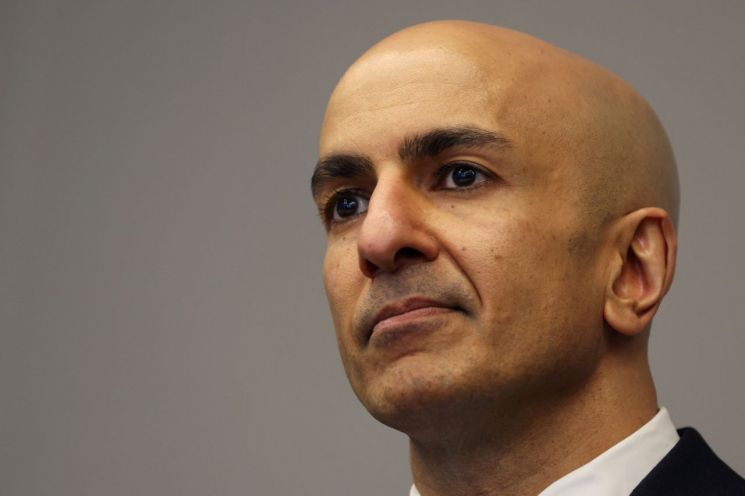
Regarding the inflation figures from January and February, he said, "They are somewhat concerning," adding, "More progress is needed to be confident that inflation is moving toward the Fed's 2% target."
Kashkari's remarks on the day were interpreted to mean that if the downward trend in inflation stalls, there is no need to cut rates within the year. Kashkari is a representative hawkish figure within the Fed. However, he does not have voting rights at this year's FOMC.
Another hawkish figure, Raphael Bostic, president of the Atlanta Federal Reserve Bank, said the day before that there would be only one rate cut in the fourth quarter of this year.
Recently, on Wall Street, there have been increasing forecasts that the Fed will slow the pace of rate cuts as inflation, which had rapidly slowed in the second half of last year, has stalled.
The day before, Fed Chair Jerome Powell said, "It is expected to be inappropriate to lower the benchmark interest rate until there is greater confidence that inflation will continue to fall toward 2%," and regarding the timing of the start of rate cuts, he said, "At some point this year."
On the same day, remarks from other Fed officials followed.
Patrick Harker, president of the Philadelphia Fed, pointed out in a discussion held at the Wharton School of the University of Pennsylvania, "Inflation is still too high," adding, "Especially those with limited assets and income are more severely affected."
Dovish (preference for monetary easing) Austan Goolsbee, president of the Chicago Fed, said that recent price indicators over the past two months should not obstruct the path toward the target, and that current economic activity is similar to traditional demand overheating.
Thomas Barkin, president of the Richmond Fed, said at a Richmond Home Builders Association event that it is wise for the Fed to take more time to clearly understand the inflation trajectory before lowering rates. He said, "Considering the strong labor market, there is time to wait for the clouds to clear before starting rate cuts," adding, "No one wants inflation to reappear."
Loretta Mester, president of the Cleveland Fed, said at an online discussion hosted by the Global Independent Center, "I expected inflation to decline, but more evidence needs to be confirmed," adding, "Once that (evidence) is seen, I think we will be in a position to lower rates."
© The Asia Business Daily(www.asiae.co.kr). All rights reserved.

















